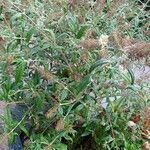
Buddleja asiatica
Dog tail · Asian Butterfly-bush · White Butterfly Bush · Asian Sagewood
Description
Source: leafsnapBuddleja asiatica, commonly known as the Asian butterfly bush, is a deciduous shrub belonging to the family Scrophulariaceae. Native to Asia, it can be found in countries such as China, Japan, Korea, and Taiwan. The plant can grow up to 3 meters tall and has a spreading habit with arching branches. The leaves of Buddleja asiatica are lance-shaped with serrated edges, measuring about 10-15 cm in length. The flowers, though small, are numerous and arranged in dense clusters at the ends of the branches. They have a tubular shape with four petals that range in color from white to pale pink or lavender. Buddleja asiatica is noted for its medicinal properties, as it contains compounds like flavonoids and iridoids which have anti-inflammatory effects on the body. Traditionally, it has been used to treat various ailments such as fever, coughs, and colds. The plant prefers well-drained soil in full sun or partial shade but can tolerate a wide range of soil types, including sandy or clay soils. While it is drought-tolerant once established, it benefits from regular watering during dry spells. Overall, Buddleja asiatica is an attractive shrub that offers both ornamental value with its beautiful flowers and medicinal properties, making it an interesting addition to any garden or landscape design project.
Care Guide
💧 Water Every 7 days
The dog tail plant, which comes from rocky terrains, is well-suited for dry conditions. It thrives in warmer climates and prefers to be watered every 1-2 weeks. During the growing season, it efficiently uses water while balancing moisture retention with drought tolerance.
How should I give water to my dog's tail?
Your Dog tail is not particular about how you water it. Any common watering tool like watering cans, hoses, or even cups will work fine. When watering, it's best to apply the water directly to the soil and make sure all areas are evenly moistened to provide sufficient water to the entire root system. Using filtered water is helpful as tap water may have harmful particles. It's also better to use water at or slightly above room temperature, as extremely hot or cold water can shock the Dog tail. However, the Dog tail usually responds well to any type of water.
What should I do if I give my dog too much or too little water for his tail?
Outdoor plants, especially newly planted ones or seedlings, are vulnerable to not being watered enough. Remember to water them consistently for the first few months while they are still small or have just been planted. Once the roots are established, outdoor plants can usually rely on rainwater. When it comes to potted plants, overwatering is a common issue. If you accidentally overwater your potted plant, take immediate action to fix the problem. First, stop watering the plant to minimize the impact of overwatering. Then, take the plant out of its pot and check the roots. If there is no sign of root rot, you can put the plant back in its pot. However, if there are signs of root rot, trim away the affected roots and consider applying a fungicide to prevent further damage. Finally, repot the plant using well-draining soil. On the other hand, if your potted plant is underwatered, simply water it more frequently. Underwatering is usually an easy problem to solve. The leaves of an underwatered plant will droop, dry out, and fall off. However, once the plant is sufficiently watered, the leaves will quickly recover and regain their fullness. Remember to adjust your watering frequency as soon as you notice signs of underwatering.
How often do I need to water my Dog tail?
Most outdoor plants can grow naturally with rainfall. However, if your area lacks rainfall, here's what you should do
How much water does my dog's tail require?
When watering your Dog tail plant, you may be surprised to learn that it doesn't always require a lot of water. If only a few inches of soil have dried since your last watering, you can maintain the plant's health by giving it about five to ten ounces of water each time you water. You can also base the amount of water on the moisture of the soil. Take note of how many inches of soil have dried between waterings. To ensure the Dog tail receives adequate moisture, water enough to moisten all the dry soil layers since the last watering. If over half of the soil has dried, it's best to give more water than usual. In such cases, keep adding water until you see excess water draining from the pot's drainage holes. If your Dog tail is planted in a location that receives ample rainfall, it may not need additional watering. For young or newly established Dog tail plants, make sure they receive 1-2 inches of rain per week. As the plant grows and becomes established, it can rely solely on rainwater, except during periods of hot weather without rainfall for 2-3 weeks. In those situations, providing a full watering will prevent the Dog tail from experiencing stress.
How do I know if I'm giving my dog enough water?
The Dog tail plant is often overwatered, which can be identified by its yellowing leaves and leaf dropping. Overwatering can also lead to shriveling and root rot. Conversely, an underwatered Dog tail will wilt and have brown or brittle leaves. If you notice signs of either overwatering or underwatering, it's important to intervene and restore the plant's health.
☀️ Light Full sun
Dog tail, originating in sun-loving environments, prefers abundant light. It grows best in full sun at all stages of development. Too little light can impede growth, while too much sunlight generally does not cause harm.
What are the sunlight requirements for growing Dog Tail?
Dog Tail (Buddleja asiatica) needs full sun, which means it requires more than 6 hours of sunlight daily, but it can also tolerate partial sun, approximately 3-6 hours of sunlight. It's essential to monitor the movement of sunlight through your garden to choose the best spots that offer a balance of light and shade, ensuring the plant's well-being.
How does insufficient or excessive sunlight affect Dog Tail?
Dog Tail thrives in environments with ample sunlight throughout all its growth stages. Insufficient sunlight can restrict its growth, whereas excessive sunlight doesn't typically cause harm. Indoor plants may need artificial lighting, especially in winter or less sunny spaces. LED lights, which can be customized to offer specific wavelengths, are recommended. For full sun plants, 30-50W/sq ft of artificial light is ideal, 20-30W/sq ft for partial sun plants, and 10-20W/sq ft for full shade plants.
What are the symptoms of light deficiency in Dog Tail?
When Dog Tail suffers from insufficient lighting, it may exhibit smaller new leaves, leggy or sparse growth, faster leaf drop, slower or halted new growth, lighter-colored new leaves, and symptoms of chlorosis. Additionally, excessive sunlight can lead to symptoms such as sunscald, leaf curling, wilting, and leaf scorching, indicating the plant's struggle with light management.
How can I solve lighting issues for my Dog Tail plants?
To address lighting issues for Dog Tail plants, gradually move them to sunnier locations, ensuring they get at least 6 hours of direct sunlight daily. Use south-facing windows for indoor plants, and keep curtains open for maximum light. Artificial lighting can supplement natural light, especially for large or immobile plants, by keeping lamps on for at least 8 hours daily. For outdoor plants, acclimate them gradually to sunnier spots to prevent sunburn. Minimize obstructions by pruning trees or relocating plants to sunnier areas, and consider transplanting smaller plants during their dormant period to locations with better sunlight and drainage.
🌡️ Temperature 20–37.8°C
Dog tail originates from warm regions and requires temperatures of 68 to 100 °F (20 to 38 ℃). The plant favors moderate warmth for optimal growth. In cooler conditions, consider using a greenhouse to maintain that temperature.
What are the optimal temperature requirements for Dog tail plants?
Dog tail plants thrive in warm climates and require temperatures between 68 to 100 °F (20 to 38 °C) for optimal growth. These plants love moderate heat and can be harmed by cold temperatures. During cooler weather, using a greenhouse can help maintain the necessary warmth. It's also advised to bring outdoor-grown Dog tail plants indoors during autumn and place them near a bright window, away from heaters, to ensure they remain above 20°C. Keeping the temperature above this threshold during winter is beneficial, while temperatures approaching 0°C can be detrimental to the plant.
How does low temperature affect Dog tail plants and what are the solutions?
Dog tail plants prefer warm temperatures and do not tolerate low temperatures well. They flourish when the temperature remains above 20°C and should be kept from dropping to 0°C during winter. Exposure to temperatures below -5°C can cause the leaves to lighten in color, leading to browning or blackening after frost damage, alongside wilting and drooping. To mitigate frost damage, trim off the damaged parts and move the plant to a warmer indoor setting promptly. Placing the plant near a south-facing window ensures ample sunlight, but it's crucial to avoid placement near heaters or air conditioning vents to prevent air dryness.
What should be done if a Dog tail plant experiences high temperature?
In the summer, it's important to keep Dog tail plants in conditions below 38°C to prevent heat stress. Temperatures exceeding 43°C can lighten the color of the leaves and increase the risk of sunburn. To address heat-related issues, remove the sunburned and dried parts of the plant. Relocate the plant to an area that offers shade during intense midday and afternoon sun to protect it. Watering the plant in the morning and evening helps keep the soil sufficiently moist, which is crucial during high temperatures.
💨 Humidity
🪴 Soil 6-7
🌱 Fertilizer
The best time to fertilize a Dog tail is in early spring, when it comes out of dormancy. This supports overall growth and encourages flower development. Fertilizing improves the foliage, stems, and branches and promotes flowers that are large, vibrant, and long-lasting. It also helps move nutrients from the roots to the flowers and strengthens the plant's health and resistance to disease.
Why do I need to put fertilizer on my dog's tail?
Ensuring proper fertilization for a Dog tail is crucial for overall health and well-being. By providing the right balance of energy and nutrients, your Dog tail will flourish with healthy foliage, sturdy stems, and branches. Additionally, gardeners greatly value the flowers of a Dog tail, which can be enhanced through fertilization. The right fertilizer aids in the production of larger, vibrant, and long-lasting flowers by facilitating the transfer of fuel from the roots to the stems and ultimately the flowers. Moreover, proper fertilization promotes the overall health of the plant, enabling it to effectively combat diseases.
When should I fertilize my Dogtail plant?
The best time to fertilize a Dog tail is in early spring, when the plant is coming out of dormancy and getting ready to bloom. By feeding it at this time, you provide the plant with the energy it needs to grow and develop flowers. However, it is not the only time you should fertilize this plant. Another feeding in the fall can also be beneficial, although it doesn't have to be as big as the spring feeding. Some gardeners also choose to fertilize when they plant the Dog tail, but this is not always necessary.
When is not a good time to fertilize my Dog tail?
During the winter, like many plants, you don't need to fertilize your Dog tail. This is because the plant is in a dormant phase and doesn't require much energy from the soil for new growth. Fertilizing in winter increases the risk of overfertilization, which can have negative outcomes. The best times to feed your Dog tail are early spring and fall. So, for most of the spring and summer, fertilizer is not necessary. It's also a good idea to hold off on feedings if the plant is experiencing extreme heat or dryness.
What kind of fertilizer does my Dog tail need?
When it comes to fertilizing Dog tail plants, using a general-purpose fertilizer with equal amounts of nitrogen, phosphorus, and potassium is usually fine. However, for optimal growth, it is often best to use a specific type of fertilizer. Nitrogen and phosphorus are the most important nutrients for Dog tail plants, so they should be present in higher concentrations compared to potassium in the fertilizer you choose. Aim for a fertilizer with an N-P-K ratio of 10-10-8 or something similar. Additionally, using organic materials like compost during at least one annual feeding can be beneficial. If you decide to use fertilizer, granular fertilizer is commonly used for Dog tail plants.
How can I make my dog's tail grow healthier?
Fertilizing your Dog tail plant is simple, even for beginner gardeners. To use granular fertilizer, just sprinkle it on the soil after you've moistened it with water. You can also improve the soil by adding organic material like compost or manure. To do this, put the material on top of the soil and gently work it into the first few inches using a hand rake without disturbing the roots.
🪴 Pot & Repot 2-3 years
Repot the Dog Tail plant every 2-3 years in the spring to prevent root crowding. When repotting, choose a slightly larger pot to allow for growth. After repotting, place the plant in a location with indirect sunlight and water it moderately. A well-chosen container will support the plant's bushy structure and distinctive tail-like flowers, ensuring optimal health.
✂️ Pruning
To ensure the health and appearance of dog tails, it is best to prune them in late spring. Focus on removing dead wood, thinning crowded areas to improve air circulation, and trimming back last season’s growth to encourage new shoots. By pruning at the right time, you can enhance blooms and manage the plant's size. Be careful to avoid cutting into old wood, as this helps preserve the plant's shape and vigor.
🌿 Propagating
🐛 Diseases & pets
☠️ Toxicity
Characteristics
- Plant Type
- Shrub
- Life Cycle
- Perennial
- Genus
- Buddleja
- Family
- Scrophulariaceae
- Hardiness Zone
- 9-12
- Mature Height
- 3.05 m
- Mature Spread
- 3.05 m
- Leaf Color
- Green, Silver, Gray
- Leaf Type
- Evergreen
- Flower Color
- White
- Flower Size
- 0.76 cm to 2.03 cm
- Bloom Time
- Late winter, Early spring, Mid spring
- Planting Time
- Spring, Summer, Autumn
- Harvest Time
- Late spring, Early summer, Mid summer
- Native Area
- Nepal, India, Malaysia, Indonesia, Cambodia, Vietnam, Myanmar, Papua New Guinea, Philippines, Bhutan, Bangladesh, Pakistan, Laos, Thailand, China