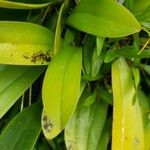
Bulbophyllum longiflorum
Pale umbrella orchid
Description
Source: leafsnapBulbophyllum longiflorum, commonly known as the pale umbrella orchid, is a species of epiphytic or lithophytic orchid. It has a creeping rhizome, widely spaced, dark green pseudobulbs with a single large, fleshy leaf, and flowers spreading in a semicircular umbel, resembling one-half of an umbrella. The flowers are canoe-shaped, greenish cream-coloured to yellowish with purple dots. It has a wide distribution and is found in parts of Africa, on islands in the Indian and Pacific Oceans, Southeast Asia, New Guinea and northern Australia.
Care Guide
💧 Water Every 7 days
The pale umbrella orchid thrives with adequate moisture but can tolerate some drought. Water the orchid weekly during the summer and every 10 days in the fall and winter. To maintain humidity in dry weather, mist the plant regularly. Use water that has a neutral pH. If using tap or rainwater, let it sit for a while before use to allow dissolved carbon dioxide to evaporate.
☀️ Light Partial sun
Pale umbrella orchid naturally occurs in habitats such as forest understories and rocky areas, where it experiences natural shade. It prefers partial sun but can adapt to full sun or full shade, illustrating its versatility and hardiness.
🌡️ Temperature 20–37.8°C
The pale umbrella orchid does best in warm conditions. It prefers moderately high temperatures and is not suited to extreme heat or very humid weather. Sunlight warms the plant and encourages flowering. However, long periods of direct sun in summer can cause sunburn, so its sunlight exposure should be controlled during that season. The plant typically tolerates cold poorly, so it needs adequate protection and warmer temperatures in winter to prevent freezing.
💨 Humidity high (>60%)
This plant needs special care because it loves high humidity levels of 60-80% or more. The best way to achieve this is by placing a humidifier near the plant. Daily misting is also essential! Make sure the room has good ventilation.
🪴 Soil 5-6
🌱 Fertilizer Every 30 days
Proper fertilization is essential for the Pale umbrella orchid's health and appearance. Fertilize the Pale umbrella orchid during summer, repeating the application monthly throughout the season. Nutrients supply the energy for growth and help maintain the plant's parts. Fertilization improves the Pale umbrella orchid's flower display, ensuring the best blooms.
🪴 Pot & Repot
When repotting Pale umbrella orchid, pick a slightly larger pot with good drainage—ideally a clear orchid pot. Use a well-draining, orchid-specific mix that includes bark or moss. Gently clean the roots and cut away any that are dead or rotting. Repot after flowering, usually in spring or fall, water thoroughly, and place in bright, indirect light. After repotting, avoid disturbing the roots.
✂️ Pruning
The pale umbrella orchid is characterized by its long, slender flowers, which are arranged like an umbrella. To encourage growth and blooming, prune any dead pseudobulbs and spent flower spikes between early and late spring. Regular pruning not only enhances air circulation but also helps reduce the risk of pests. Be sure to use sterilized tools for this task, and refer to specific horticultural guides for the best care practices.
🌿 Propagating
🐛 Diseases & pets
☠️ Toxicity
Characteristics
- Plant Type
- Herb
- Life Cycle
- Perennial
- Genus
- Bulbophyllum
- Family
- Orchidaceae
- Hardiness Zone
- 10-12
- Mature Height
- 15 cm to 30 cm
- Mature Spread
- 20 cm to 40 cm
- Leaf Color
- Green
- Leaf Type
- Evergreen
- Flower Color
- Yellow, Purple
- Flower Size
- 5.08 cm to 7.62 cm
- Bloom Time
- Summer, Early fall, Mid fall
- Planting Time
- Spring, Summer
- Harvest Time
- Late summer, Fall, Early winter
- Native Area
- Malawi, Vanuatu, South Africa, Philippines, Madagascar, Fiji, Brunei, Uganda, Tanzania, Zimbabwe, Indonesia, Vietnam, Mozambique, Congo (DRC), Thailand