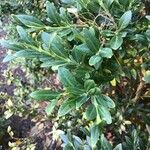
Buxus harlandii
Harland's boxwood · Harland boxwood · Japanese Boxwood
Description
Source: leafsnapBuxus harlandii, commonly known as Harland boxwood, is a slow-growing evergreen shrub in the Buxaceae family. Native to China and Vietnam, it is widely cultivated as an ornamental plant in gardens and landscapes. This plant has a compact growth habit with dense foliage, making it an excellent choice for hedges, topiaries, and borders. The leaves of Buxus harlandii are small, glossy green, and have a leathery texture. During the spring, the plant produces small, yellow-green flowers that aren't particularly showy but do attract pollinators like bees. The fruit of the Harland boxwood is a small capsule containing several seeds. Buxus harlandii prefers well-drained soil with moderate moisture levels but can tolerate drought once established. It thrives in partial shade to full sun exposure but can also endure full shade conditions. This shrub requires minimal maintenance once established and can be pruned into various shapes or left untrimmed for a natural form. However, it may be susceptible to pests like leaf miners or diseases such as root rot if grown under unfavorable conditions. Overall, Buxus harlandii is an attractive evergreen shrub that adds beauty and structure to any garden or landscape design, requiring minimal care from gardeners or landscapers alike.
Care Guide
💧 Water Every 7 days
Harland boxwood, originally from subtropical regions, thrives in environments with moderate humidity and can withstand brief periods of dryness. To keep it healthy, ensure the soil is consistently moist by watering it every one to two weeks. This evergreen plant is well-suited for indoor growth, even in low-light conditions, and its water requirements remain steady throughout the year.
☀️ Light Partial sun
Harland boxwood is native to places like forest understories or rocky sites, where it is naturally shaded. It prefers partial sun but can tolerate full sun or full shade, demonstrating its versatility and hardiness.
🌡️ Temperature 10–35°C
Harland boxwood has good tolerance for heat and can endure higher temperatures and wider temperature fluctuations. In hot weather, attention should be paid to watering and suitable shading should be provided to avoid sunburn. Conversely, Harland boxwood is relatively sensitive to cold; while it can tolerate some cold, very low temperatures can cause frost damage.
💨 Humidity
🪴 Soil 6-8
🌱 Fertilizer
Fertilize your Harland boxwood in early spring to encourage healthy growth. Regular feeding boosts overall health, leading to vigorous development, improved tolerance to adverse conditions, and increased resistance to pests and diseases. Follow a consistent fertilization schedule for your Harland boxwood to keep the foliage vibrant, deeply colored, and lush in appearance.
🪴 Pot & Repot
✂️ Pruning
Harland boxwood responds well to pruning and quickly grows new twigs. For best results, prune during the summer when the plant is lush or in the winter to maintain a tidy appearance. Be sure to remove any old or discolored leaves to enhance its overall look. Pruning in the summer has the added benefit of improving air circulation, which can help reduce the risk of pests.
🌿 Propagating
🐛 Diseases & pets
☠️ Toxicity
Characteristics
- Plant Type
- Shrub
- Life Cycle
- Perennial
- Genus
- Buxus
- Family
- Buxaceae
- Hardiness Zone
- 6-9
- Mature Height
- 1.22 m to 1.83 m
- Mature Spread
- 1.22 m to 1.83 m
- Leaf Color
- Dark Green
- Leaf Type
- Evergreen
- Flower Size
- 0.20 cm to 0.25 cm
- Bloom Time
- Mid spring, Late spring
- Planting Time
- Spring, Summer, Autumn
- Harvest Time
- Mid summer, Late summer
- Native Area
- China