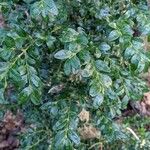
Buxus sempervirens
شمشاد جنگلی · Common boxwood · Box · Caucasian boxwood · European box
Description
Source: leafsnapBuxus sempervirens, commonly known as common boxwood, is a slow-growing evergreen shrub belonging to the Buxaceae family. Native to Europe, North Africa, and Western Asia, this plant has been cultivated for centuries for its ornamental value. It features dense growth with small, glossy green leaves that are oval-shaped and grow in opposite pairs along the stem. The leathery leaves emit a pleasant fragrance when crushed. Common boxwood is highly regarded for its versatility, making it suitable for various garden designs such as hedges, topiaries, or standalone specimens. It can grow up to 20 feet tall but can be easily pruned into any desired shape or size. The plant prefers well-drained soil with moderate moisture levels but can tolerate drought conditions once established. It thrives best in partial shade or full sun exposure, depending on the climate. Historically, Buxus sempervirens has been used extensively for medicinal purposes due to its anti-inflammatory properties, which help alleviate symptoms of arthritis and rheumatism when applied topically. Overall, Buxus sempervirens is an excellent choice if you’re looking for an easy-to-maintain evergreen shrub that adds aesthetic value to your garden design year-round.
💡 Common boxwood is a popular choice for hedges because it responds well to shearing and can be easily shaped into a variety of designs. Some enthusiasts even create living sculptures from Buxus sempervirens, cutting them into animal shapes or symbols. However, be cautious: to some people, the plant has an odor reminiscent of cat urine!
🌳 Common boxwood, besides being an ornamental staple, is valued for its dense, fine-grained wood. Historically, this compact timber has been used to make musical instruments—such as woodwind bodies—and chess pieces. The wood's durability also makes it suitable for precision craft items like engravings and detailed carvings, showing considerable potential across various artisan crafts.
🎭 Eternal life, long life
Care Guide
💧 Water Every 7 days
The common boxwood thrives in environments with moderate moisture and even demonstrates resistance to drought. It should be watered once every 1-2 weeks, allowing the soil to dry slightly between waterings. This evergreen ornamental shrub often benefits from mulching, which helps retain moisture and protects its roots in various climates.
When Should I Water My Common Boxwood?
Proper and timely watering is essential for the health and development of the common boxwood, contributing to its growth, vibrant foliage, and disease resistance. To determine the right time to water, check the soil moisture by inserting a finger up to 2 inches deep; if dry, it’s time to water. Wilting, limp, or dull leaves, and leaves that begin to fade or turn yellow are clear signs the common boxwood needs water. It is particularly crucial to ensure adequate watering during the pre-flowering stage and periods of warm temperatures or high sunlight exposure. Be mindful of the risks of watering either too early or too late, as both over-watering and under-watering can lead to significant health issues for the plant.
How Should I Water My Common Boxwood?
The common boxwood should be watered deeply but infrequently, ensuring the soil is thoroughly saturated and then allowed to dry out before the next watering. This method encourages healthy root growth and prevents overwatering. Use a watering can with a narrow spout for targeted watering at the plant base, and consider using a moisture meter to accurately gauge when the plant needs water. Focus on watering the base of the plant rather than the foliage to reduce fungal disease risks, and adjust your watering frequency based on various factors such as plant size, pot size, weather conditions, and soil type.
How Much Water Does Common Boxwood Really Need?
The amount of water a common boxwood needs depends on its size and the conditions it's grown in. A potted boxwood about 1 foot tall might need 1-2 liters of water, ensuring thorough distribution across the root system, while a 2-foot tall one may need around 3 liters. Water indicators include healthy, vibrant leaves for optimal watering and yellowing leaves, drooping, or brown leaf edges for over or under-watering. Always check the soil moisture 1-2 inches deep to see if it needs watering. Over-watering can cause root rot, indicated by brown leaves, whereas under-watering leads to dehydration, shown by wilting and dryness.
What Kind of Water is Best for Common Boxwood?
Common boxwood thrives best with rainwater or filtered tap water but can tolerate distilled and tap water if conditions are right. To use tap water, it’s advisable to let it sit overnight for chlorine to evaporate, as common boxwood can be sensitive to chlorine and fluoride build-up. Additionally, it's not overly sensitive to minerals but be cautious of extreme mineral levels such as high amounts of iron or calcium, which can harm the plant. Watering with room temperature water is recommended to avoid shocking the plant’s system.
How Do Common Boxwood's Watering Needs Change with the Seasons?
Common boxwood's watering needs vary across seasons. In spring, during its active growth, maintain consistent soil moisture. Summer calls for deep, less frequent watering to combat heat stress. As autumn approaches and the plant prepares for dormancy, decrease watering frequency, keeping the soil lightly moist. In winter, water sparingly, ensuring the topsoil doesn't become completely dry while the plant is dormant.
☀️ Light Full sun
Common boxwood prefers sites that get plenty of sunlight during the day. However, it is generally tolerant of places that only receive limited sunlight. Both excessive and insufficient sunlight can lead to stunted growth and harm the plant’s overall health. In its original natural habitat it experienced varying amounts of sunlight each day, which shaped its current sunlight habits.
What are the sunlight requirements for Common Boxwood?
Common Boxwood (Buxus sempervirens) requires full sun, meaning it needs above 6 hours of sunlight, while partial sun, about 3-6 hours of sunlight, is also suitable for its growth. It's crucial to watch how sunlight moves through your garden and choose spots that provide the perfect balance of light and shade for your plants, ensuring their happiness. The plant has a broad tolerance for varied levels of sunlight, stemming from its natural habitat, which exposed it to direct sunlight throughout the day. However, both too much and too little sunlight can lead to growth stagnation and impact the plant's overall health.
How do artificial lighting conditions affect the growth of indoor Common Boxwood plants?
For indoor Common Boxwood plants, when natural sunlight is insufficient, especially during winter or in less sunny spaces, artificial lighting can be an essential solution for promoting healthier growth. Effective artificial lighting involves choosing the correct type of light, such as LED lights, which can provide specific wavelengths necessary for plant health. The amount of artificial light recommended varies depending on plant type: full sun plants need 30-50W/sq ft, partial sun plants require 20-30W/sq ft, and full shade plants need 10-20W/sq ft of light. Additionally, the light source should be placed 12-36 inches above the plant to mimic natural sunlight, and plants generally need 8-12 hours of light per day.
What are the signs of insufficient or excessive sunlight in Common Boxwood?
Common Boxwood demonstrates several symptoms when exposed to suboptimal lighting. Insufficient sunlight can lead to smaller new leaves, leggy or sparse growth, faster leaf drop, slower or halted growth, and lighter-colored or pale new leaves. Excessive sunlight exposure can cause chlorosis (leaves turning yellow), sunscald (damage from intense sunlight), leaf curling (as a defense mechanism against water loss), wilting (due to loss of turgor pressure), and leaf scorching (brown, dry edges on leaves). These symptoms highlight the plant's need for the right balance of sunlight.
What solutions can be applied to address light-related issues in Common Boxwood?
To address light-related issues in Common Boxwood, consider gradually moving plants to sunnier locations to ensure they receive adequate sunlight, at least 6 hours daily. An outdoor plant can be adapted by weekly adjustments to sunlight exposure, avoiding sunburn. For indoor plants, keeping them near a south-facing window or using artificial light for at least 8 hours a day can supplement light. Additionally, reducing obstructions like pruning tree branches, or transplanting smaller plants to sunnier spots with good drainage, can improve sunlight access. Note that parts of the plant already affected by bad lighting may not recover, but new growth will be healthy with proper light adjustment.
🌡️ Temperature 10–35°C
Common boxwood thrives in temperatures from 50 to 95℉ (10 to 35℃), matching its native presence in temperate regions. In summer, it is best to keep temperatures between 65 and 75℉ (18 to 24℃) to prevent heat stress, and in winter temperatures should stay above 23℉ (-5℃) to prevent frost damage.
What temperature is best for Common boxwood?
Common boxwood thrives best at temperatures between 65~80℉(18~27℃). In the primary growing phase, it can tolerate a maximum temperature of 95℉(35℃) and a minimum temperature of 15℉(-10℃). This species is able to withstand freezing winters and is generally tolerant of low temperatures. Here is a breakdown of the perfect, highest, and lowest temperature ranges: - Perfect Temperature Range: 65~80℉(18~27℃) - Highest Temperature Range: 85~95℉(30~35℃) - Lowest Temperature Range: -5~15℉(-20~-10℃) or below
Do I need to change the temperature for Common boxwood at different stages of growth?
According to research, Common boxwood may show stunted growth when exposed to prolonged periods of higher temperatures. This is particularly true during the development of axillary buds and the growth of main shoots. To promote robust growth after germination or transplanting, it is recommended to maintain consistent and cooler temperatures, around 65℉(18℃).
How can I protect Common boxwood from the cold weather?
Common boxwood can survive in-ground planting in locations where winter temperatures do not drop below 15℉ (-10℃). However, if planted in pots or containers, the roots need to be shielded from the cold. This can be achieved by wrapping the container in a blanket or bringing it indoors to ensure complete protection from the harsh winter elements.
If the temperature is too high or too low, what harm will be done to the Common boxwood?
Consistently high temperatures pose a greater threat to Common boxwood compared to consistently low temperatures. Heat stress triggers hormone imbalances that decrease seed germination and photosynthesis efficiency, leading to visible signs of wilting, leaf browning, and potentially death. On the other hand, if Common boxwood experiences prolonged cold temperatures, vital plant functions like nutrient uptake and photosynthesis cease, potentially causing the plant to die. Additionally, a single freezing event during the growing season can result in a membrane phase transition, leading to a halt in plant functions and potential death.
What should I remember about temperature for Common boxwood?
To ensure the health of Common boxwood and promote successful budding, flowering, and new growth, it is crucial to maintain a consistent soil temperature. This can be achieved by practicing regular watering, adding mulch to exposed soil, and planting in shaded areas.
💨 Humidity normal (40-60%)
This plant will thrive in moderate humidity, which is probably the level in your home. However, misting it a few times a week can be very beneficial. Make sure the room has good ventilation.
🪴 Soil 6-7
🌱 Fertilizer
Fertilize your Common boxwood in early spring to encourage healthy growth. Regular feeding improves overall health, leading to vigorous growth, better tolerance of harsh conditions, and increased resistance to diseases and pests. Keep a particular fertilization schedule for your Common boxwood to maintain foliage that is bright, richly colored, and lush.
Why is it important to fertilize my Common boxwood?
To ensure the health and resilience of your Common boxwood, regardless of its type, regular fertilization is key. Providing proper nutrients will promote strong growth and enhance its ability to withstand challenging conditions, while also improving its resistance against diseases and pests. The foliage of your Common boxwood is particularly appealing, so it's important to maintain its intact state. This can be achieved by following a regular fertilization schedule tailored to your specific Common boxwood, resulting in vibrant leaves with a rich color and a lush appearance.
When should I fertilize my Common boxwood?
To keep your Common boxwood healthy and promote growth, it is recommended to fertilize it in the late winter or early spring. This provides the necessary nutrients to support healthy growth when the weather becomes warmer. Additionally, if you live in a warm climate region, it can be beneficial to give your Common boxwood another round of fertilizer in early fall. This helps to add extra nutrients to the soil for the following growing season and makes the plant more resilient to withstand the winter cold without foliage damage. Fertilizing earlier in the year ensures that the new branches have enough time to grow and withstand the cold winter temperatures.
When is it not a good idea to add fertilizer to my Common boxwood?
There are specific times during the year when you should avoid fertilizing your Common boxwood. Firstly, during the early and mid-winter months when the plant is dormant, there is no need for feeding. Secondly, it is not advisable to fertilize the plant in late spring and throughout the summer. During this period, the weather tends to be hotter and drier, which can have a detrimental effect on the plant if fertilized. To prevent any problems, it is best to stick to a fertilization schedule that only involves feeding in early spring and early fall.
What kind of fertilizer does my Common boxwood plant require?
For a Common boxwood, nitrogen is usually the most important nutrient. However, phosphorus and potassium should not be disregarded as they are still important. It is advisable to provide your Common boxwood with a balanced fertilizer that contains all three main nutrients, such as a 10-10-10 blend. Nevertheless, a more tailored nutrient ratio often yields optimal growth. Fertilizers with a slightly higher nitrogen content, such as a 10-6-4 ratio, tend to work better. You have the option of using either granular or liquid-based fertilizers for your boxwood.
How do I give my Common boxwood plant the nutrients it needs to grow well?
To fertilize your Common boxwood, you have two options: using a granular fertilizer or a liquid fertilizer. With the granular fertilizer, simply sprinkle it on the soil at the right time. This type of fertilizer releases nutrients slowly over time. It's recommended to lightly water your Common boxwood before applying the fertilizer. On the other hand, the liquid fertilizer method is less common. You'll need to mix the fertilizer with water and pour it around the base of your Common boxwood. It can be helpful to do a soil test beforehand to determine if any pH adjustments are needed.
🪴 Pot & Repot 2-3 years
When repotting Common boxwood, select a pot 1–2 inches (2.5–5.1 cm) larger with good drainage. Use a potting mix that drains well. Repot in spring or fall, making sure the root ball is slightly lower than the rim of the flower pot. Water thoroughly after repotting and set it in a warm spot with indirect sunlight.
✂️ Pruning
Regular pruning is crucial for maintaining healthy common boxwood. It's typically done from early to late winter to safeguard new growth. Thinning out dense areas helps improve air circulation, while removing dead branches boosts the plant's health and appearance. Always use sharp tools to prevent the spread of disease, and refer to horticultural guides for detailed care instructions.
🌿 Propagating
🐛 Diseases & pets
☠️ Toxicity
Characteristics
- Plant Type
- Shrub
- Life Cycle
- Perennial
- Genus
- Buxus
- Family
- Buxaceae
- Hardiness Zone
- 6-9
- Mature Height
- 0.91 m to 9.14 m
- Mature Spread
- 4.88 m
- Leaf Color
- Green, Yellow, Variegated
- Leaf Type
- Evergreen
- Flower Color
- Yellow, White, Green
- Flower Size
- 2.54 cm
- Bloom Time
- Mid spring, Late spring
- Planting Time
- Spring, Autumn
- Harvest Time
- Early summer, Mid summer
- Native Area
- Libya, Turkey, Austria, Slovakia, Greece, Croatia, Slovenia, Morocco, Russia, Germany, Italy, Spain, Switzerland, Iran, Albania, Azerbaijan, United Kingdom, Hungary, Algeria, Belgium, Turkmenistan, France