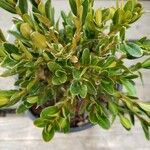
Buxus sinica
Chinese boxwood · Chinese box
Description
Source: leafsnapBuxus sinica, the Chinese box or small-leaved box, is a species of flowering plant in the family Buxaceae, native to central and southern China, Taiwan, South Korea, and Japan. A shrub or small tree, in the wild it is found in a variety of habitats, usually from 600 to 2,600 m (2,000 to 8,500 ft) above sea level. There are a number of cultivars, all derived from Buxus sinica var. insularis (syn. Buxus koreana), including 'Winter Gem', 'Green Gem', 'Justin Brouwers', 'Wintergreen', 'Chegu', 'Tall Boy', 'Tide Hill', 'Rococo', 'Winter Beauty', 'Green Mountain', 'Pincushion', 'Filigree', 'Green Velvet', and 'Sunny‑side'. In addition to its use in hedging, it is used in bonsai.
💡 According to legend, the Chinese box plant grows very slowly, at a rate of only one inch per year, and supposedly shrinks during leap years. However, it has been shown that in leap years, the Chinese box does not actually shrink. Instead, its growth simply stagnates.
🌳 The Chinese box is a versatile plant commonly used in gardens as a privacy screen or a border. It also thrives in containers, making it a flexible choice for various garden styles, including cottage, English, rock, and winter gardens. This plant is valued for its hardy green foliage, which is both drought-tolerant and resistant to animals. To enhance the garden's visual appeal, consider pairing the Chinese box with plants that offer a broader range of colors, such as Mediterranean spurge, English lavender, and Midwinter Fire dogwood.
🎭 Persistence
Care Guide
💧 Water
The Chinese box, originally from moderate climates, thrives with consistent moisture and can tolerate short dry periods. It is recommended to water it weekly. This evergreen plant prefers well-draining soil to maintain stable moisture levels without becoming waterlogged, which helps ensure year-round greenery.
☀️ Light Full sun
Chinese box performs best in locations that receive strong sunlight most of the day, but it can also tolerate sites with moderate light. Too much shade can impair its growth, making it weak or pale. Its native habitat indicates it is used to plentiful sunshine.
What amount of sunlight is necessary for a plant to be considered in full sun versus partial sun?
A plant is considered to be in 'Full sun' when it receives above 6 hours of sunlight per day, while 'Partial sun' refers to receiving about 3-6 hours of sunlight daily. It's important to observe how sunlight moves through your garden to ensure that you're placing your plants in areas that offer them the perfect balance of light and shade. This balance is crucial for their growth and happiness.
How does sunlight affect the growth of a Chinese box plant?
The Chinese box thrives in areas with predominant sunlight throughout the day, although it can also adapt to moderate sunlight exposure. Originating from habitats accustomed to abundant sunlight, excessive shade can hinder its growth, potentially causing weakness or paleness in the plant. To counter insufficient natural light, especially during winter or in less sunlit spaces, artificial lights such as LEDs can provide essential wavelengths, promoting healthier growth. The right amount of artificial light ranges from 10-50W/sq ft depending on the plant's sun requirements, with the light source placed 12-36 inches above the plant for 8-12 hours a day.
What are the symptoms of light deficiency in a Chinese box plant?
A Chinese box plant, thriving in full sunlight, can exhibit various symptoms when light conditions are too low. These symptoms include smaller new leaves, leggy or sparse growth, faster leaf drop, slower or ceased new growth, lighter-colored new leaves, chlorosis (leaf yellowing), sunscald, leaf curling, wilting, and leaf scorching. Each symptom signifies the plant's struggle to adapt to suboptimal lighting conditions, affecting its growth and health significantly.
How can optimal growth conditions be maintained for Chinese box plants?
To maintain optimal growth conditions for Chinese box plants, gradually increase their sunlight exposure to at least 6 hours daily by moving them to sunnier spots each week, ensuring maximum sunlight and nutrient accumulation. For indoor plants or those too large to move, consider artificial lighting such as desk or ceiling lamps for at least 8 hours a day, or invest in professional plant grow lights. Outdoor plants should also be moved gradually to avoid sunburn. For plants in the ground, reducing obstructions like pruning trees or transplanting to sunnier locations with good drainage can help improve growth. It's noted that while parts affected by insufficient sunlight may not recover, new growth will be healthy with proper light exposure.
🌡️ Temperature 5–32.2°C
Chinese box is native to temperate climates and prefers temperatures from 41 to 89.6 ℉ (5 to 32 ℃). In summer it may need extra watering and some shade to tolerate the heat. In winter, shielding it from severe cold is advised.
What is the native environment of the Chinese box?
Chinese box, botanically known as Buxus sinica, is native to temperate environments. It thrives in temperatures ranging from 41 to 89.6°F (5 to 32°C), demonstrating a preference for mild and moderate climates. This plant can handle both summer heat, with care such as additional watering and shading, and winter cold, where it shows strong cold resistance. However, extreme cold protection measures are advisable when temperatures are expected to drop below -25°C.
How should you care for Chinese box in winter?
During winter, Chinese box demonstrates strong cold resistance and usually does not require special frost protection measures. Yet, if temperatures are forecasted to fall below -25°C, it's important to provide extra protection by wrapping the trunk and branches with insulating materials like non-woven fabric or cloth. To help the plant withstand winter and early spring conditions, it's recommended to water it abundantly before the first freeze of autumn, ensuring that the soil remains moist and enters a frozen state. This practice aids in preventing drought and water scarcity for the plant during the colder months.
What are the symptoms of low temperature stress on Chinese box, and how can it be treated?
The Chinese box is notably cold-tolerant, optimally growing when temperatures are kept above 5°C and needing to remain above -20°C during winter. Exposure to temperatures below -25°C might not show immediate effects in winter, but by spring, the branches may turn brittle and dry, potentially leading to no new shoot development. The solution for this is to prune away any dead branches that have failed to produce new leaves in the spring, encouraging healthier growth.
How does high temperature affect Chinese box, and what are the remedies?
In the summer, it's crucial to keep the Chinese box's environment below 32°C to prevent heat stress. Exposure to temperatures over 35°C can cause the leaves to lighten in color, the tips to become dry and withered, and increase susceptibility to sunburn. To combat this, trim away sunburned and dried-up parts of the plant. Moving the plant to a shaded location or utilizing a shade cloth can protect it from harsh midday and afternoon sun. Adequate watering in the morning and evening is key to maintaining soil moisture and supporting the plant's health under high temperatures.
💨 Humidity
🪴 Soil 6-7
🌱 Fertilizer
Fertilize your Chinese box in early spring to encourage healthy growth. Regular feeding improves overall vigor, leading to strong growth, better tolerance of harsh conditions, and increased resistance to pests and diseases. Follow a consistent fertilization schedule for your Chinese box to keep the foliage vibrant, richly colored, and lush in appearance.
🪴 Pot & Repot
For optimal health and growth, potted Chinese boxwood, especially those planted in purple sand pots, should be repotted every 2 to 3 years.
✂️ Pruning
The Chinese box plant has dense foliage and thrives when properly pruned between early and late winter. Focus on removing dead branches, thinning out crowded areas, and shaping the plant to encourage fuller growth. It's important to clean your tools before pruning to prevent disease, thereby ensuring resilient, healthy growth and an improved appearance of the plant.
🌿 Propagating
🐛 Diseases & pets
☠️ Toxicity
Characteristics
- Plant Type
- Tree, Shrub
- Life Cycle
- Perennial
- Genus
- Buxus
- Family
- Buxaceae
- Hardiness Zone
- 5-8
- Mature Height
- 0.91 m to 6.1 m
- Mature Spread
- 1.22 m to 6.1 m
- Leaf Color
- Green
- Leaf Type
- Evergreen
- Flower Color
- Yellow, Green, Gold
- Flower Size
- 0.25 cm to 0.51 cm
- Bloom Time
- Mid spring, Late spring
- Planting Time
- Spring, Autumn
- Harvest Time
- Early summer, Mid summer
- Native Area
- China