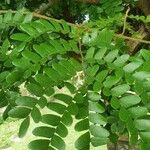
Caesalpinia echinata
Brazilwood · Pernambuco-wood · Peachwood · Indian savin tree · Pernambuco
Description
Source: leafsnapPaubrasilia echinata is a species of flowering plant in the legume family, Fabaceae, that is endemic to the Atlantic Forest. It is a Brazilian timber tree commonly known as Pernambuco wood or brazilwood (Portuguese: pau-de-pernambuco, pau-brasil; Tupi: Ibirapitanga) and is the national tree of Brazil. This plant has a dense, orange-red heartwood that takes a high shine, and it is the premier wood used for making bows for stringed instruments. The wood also yields a red dye called brazilin, which oxidizes to brazilein.The name pau-brasil was applied to certain species of the genus Caesalpinia in the medieval period, and was given its original scientific name Caesalpinia echinata in 1785 by Jean-Baptiste Lamarck. More recent taxonomic studies have suggested that it merits recognition as a separate genus, and it was thus renamed Paubrasilia echinata in 2016. The Latin specific epithet of echinata refers to hedgehog, from echinus.The name of Brazil is a shortened form of Terra do Brasil, 'land of brazilwood'.
Care Guide
💧 Water
☀️ Light Full sun
Brazilwood comes from open habitats, like sunlit meadows and forest margins, that offer plentiful light. It does best in Full Sun but can handle Partial Sun, adapting well to different light conditions.
🌡️ Temperature 20–37.8°C
Brazilwood comes from tropical areas where the climate is usually warm and humid. Consequently, it is suited to high temperatures and humidity. It does not like abrupt temperature changes and prefers a consistent temperature, so avoiding indoor temperature fluctuations is important. It generally cannot tolerate cold conditions and needs relatively high temperatures to grow. If the surrounding temperature becomes too low, the plant may stop growing or even die.
💨 Humidity
🪴 Soil 6-7
🌱 Fertilizer
The best time to fertilize a Brazilwood is in early spring as it breaks dormancy. This encourages overall growth and flower development. Fertilizing improves foliage, stems, and branches and encourages large, vivid, long-lasting flowers. It also helps transport nutrients from the roots to the blooms and enhances the plant's health and resistance to disease.
🪴 Pot & Repot
✂️ Pruning
🌿 Propagating
🐛 Diseases & pets
☠️ Toxicity
Characteristics
- Plant Type
- Tree
- Life Cycle
- Perennial
- Genus
- Caesalpinia
- Family
- Leguminosae
- Hardiness Zone
- 10-11
- Mature Height
- 12 m
- Mature Spread
- 6.1 m to 7.92 m
- Leaf Color
- Dark Green
- Leaf Type
- Evergreen
- Flower Color
- Red
- Flower Size
- 1.02 cm to 1.52 cm
- Bloom Time
- Late spring, Early summer, Mid summer
- Planting Time
- Spring, Summer, Autumn
- Harvest Time
- Mid summer, Late summer, Early fall