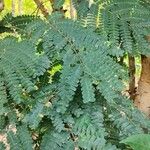
Caesalpinia sappan
Sappanwood · Indian redwood · Bakam · Pattangi · Gango
Description
Source: leafsnapBiancaea sappan is a species of flowering tree in the legume family, Fabaceae, that is native to tropical Asia. Common names in English include sappanwood and Indian redwood. Sappanwood is related to brazilwood (Paubrasilia echinata), and was originally called "brezel wood" in Europe.Biencaea sappan can be infected by twig dieback (Lasiodiplodia theobromae).This plant has many uses. It has antibacterial and anticoagulant properties. It also produces a valuable reddish dye called brazilin, used for dyeing fabric as well as making red paints and inks. Slivers of heartwood are used for making herbal drinking water in various regions, such as Kerala, Karnataka and Central Java, where it is usually mixed with ginger, cinnamon, and cloves. The heartwood also contains juglone (5-hydroxy-1,4-naphthoquinone), which has antimicrobial activity. Homoisoflavonoids (sappanol, episappanol, 3'-deoxysappanol, 3'-O-methylsappanol, 3'-O-methylepisappanol and sappanone A) can also be found in B. sappan. The wood is somewhat lighter in color than brazilwood and other related trees. Sappanwood was a major trade good during the 17th century, when it was exported from Southeast Asian nations (especially Thailand) aboard red seal ships to Japan.
Care Guide
💧 Water
Sappanwood flourishes in humid, tropical environments where consistent moisture is essential. It's best to water the plant twice a week, and using rainwater during the growing season can be especially beneficial. Although Sappanwood is moderately drought-tolerant, maintaining adequate humidity significantly boosts its growth and nutrient absorption. This makes it ideal for both decorative and medicinal purposes.
☀️ Light Full sun
Sappanwood comes from open habitats, like sunny meadows and forest edges, that offer abundant light. It thrives in Full Sun but can also tolerate Partial Sun, adapting readily to different sunlight conditions.
What are the sunlight requirements for Sappanwood?
Sappanwood, known botanically as Caesalpinia sappan, thrives under specific sunlight conditions to ensure its growth and health. Full sun exposure, defined as receiving above 6 hours of direct sunlight a day, is essential for the optimal growth of Sappanwood. However, it can also tolerate partial sun, which means it can grow adequately with about 3-6 hours of sunlight per day. It is important to observe the movement of sunlight through your garden carefully, to identify spots that offer the right balance of light and shade. This mindfulness will support the well-being and happiness of your Sappanwood plants.
🌡️ Temperature 20–37.8°C
Sappanwood is indigenous to regions with temperatures between 68 and 100.4 °F (20 to 38 ℃). It generally thrives within this warm temperature range. Adjustments for the plant's temperature requirements may be needed during colder seasons.
What is the native temperature range for Sappanwood?
Sappanwood thrives in native temperatures ranging from 68 to 100.4 °F (20 to 38 °C). This plant prefers a warm temperature spectrum and might require adjustments during colder seasons to meet its temperature needs.
What is the botanical name of Sappanwood?
The botanical name of Sappanwood is Caesalpinia sappan.
💨 Humidity
🪴 Soil 6-7
🌱 Fertilizer
The best time to fertilize a Sappanwood is in early spring, as it breaks dormancy. This encourages overall growth and flower development. Fertilizing improves the foliage, stems, and branches, and promotes flowers that are large, colorful, and long-lasting. It also helps transport nutrients from the roots to the flowers and enhances the plant’s health and resistance to disease.
🪴 Pot & Repot
✂️ Pruning
Sappanwood is known for its vibrant yellow flowers and dense foliage. To keep the plant healthy and looking its best, prune it in early spring. This will help maintain its shape and encourage growth by removing dead branches and thinning out crowded areas. These steps not only enhance its appearance and stimulate flowering but also reduce the risk of disease. Always use clean, sharp tools when pruning to ensure the best results.
🌿 Propagating
🐛 Diseases & pets
☠️ Toxicity
Characteristics
- Plant Type
- Tree
- Life Cycle
- Perennial
- Genus
- Caesalpinia
- Family
- Leguminosae
- Hardiness Zone
- 10-12
- Mature Height
- 6.1 m
- Mature Spread
- 7.01 m
- Leaf Color
- Green
- Leaf Type
- Semi-evergreen
- Flower Color
- Yellow
- Flower Size
- 2.03 cm to 3.05 cm
- Bloom Time
- Summer, Early fall, Mid fall
- Planting Time
- Spring, Autumn
- Harvest Time
- Fall, Early winter, Mid winter