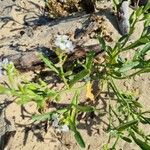
Cakile maritima
تربچه دریایی، کاکله · Sea Rocket · Two-head sea rocket · European searocket · Two-horned Sea-Rocket
Description
Source: leafsnapCakile maritima, commonly known as sea rocket, is a flowering plant species in the mustard family. It thrives in coastal regions and is typically found on sandy beaches and dunes along the Atlantic and Mediterranean coasts of Europe, North Africa, and Western Asia. This resilient plant features succulent leaves that are well-adapted to endure salt spray and drought conditions. Its small flowers, each with four petals, vary in color from white to pinkish-purple. The plant produces siliques as fruits, which contain seeds that can float on water over long distances. Traditionally, sea rocket has been used in herbal medicine for its diuretic properties and as an anti-inflammatory agent to treat skin conditions like eczema. Moreover, it plays a crucial role in coastal ecosystems by stabilizing sand dunes with its extensive root system and providing food sources for insects such as bees and butterflies. In summary, Cakile maritima is a fascinating coastal species with unique adaptations that allow it to survive in harsh environments while offering significant ecological benefits.
🌳 European searocket is not commonly noted for direct human uses but exhibits unexpected ecological connections. For example, it serves as an important food source for certain insects, such as bees and butterflies, which visit its flowers for nectar and pollen. This relationship is important because it helps sustain local biodiversity and supports the life cycles of these important pollinators, thereby playing a subtle yet meaningful role in ecosystems.
Care Guide
💧 Water Every 7 days
The European searocket flourishes in sandy coastal soils and can tolerate occasional exposure to water and saltwater spray. It thrives in well-drained conditions and benefits from weekly watering, which mimics its natural environment. This plant is also resilient to saline soils, making it less dependent on freshwater irrigation.
How should I water my European searocket plant?
European searocket is not particular about how it is watered and can thrive with rainwater, tap water, or filtered water. However, it is best to avoid watering this plant from overhead as it can harm the leaves and flowers and increase the risk of disease. Instead, a drip irrigation system is ideal for providing even and direct watering to the soil. For container-grown European searocket, simply use a cup, watering can, or tap water to apply water directly to the soil.
What should I do if I give my European searocket too much or too little water?
If you notice that your European searocket lacks moisture, the solution is simple: water it more regularly. Overwatering, on the other hand, can have more serious consequences. It can lead to disease and ultimately cause the plant to decline and die. To prevent this, choose a growing location with plenty of sunlight and good drainage, which will help dry the soil and prevent water from pooling. If you have overwatered your potted European searocket, consider changing it to a new pot. Make sure the new pot has good drainage and add loose soils when repotting.
How often should I water my European searocket plant?
European searocket requires regular watering during the growing season. In the spring, watering once a week is sufficient. As the season progresses and temperatures rise, you may need to increase watering to two or three times per week. It is important not to exceed this rate as it can harm the plant. Regardless of watering frequency, it is important to keep the soil moist but not wet. When it comes to potted European searocket, watering needs to be increased due to faster drying of the soil. In most cases, you should water container-grown European searocket a few times per week compared to once per week for plants in the ground.
How much water does my European searocket require?
Determining the appropriate amount of water for your European searocket can be approached in a few different ways. Some gardeners prefer to assess soil moisture by feeling the soil. This method suggests watering until the top six inches of soil feels moist. Another method is using a set measurement, such as providing about two gallons of water per week, adjusting based on temperature and soil dryness. However, strictly following such guidelines may result in overwatering if your plant requires less water. For container-grown European searocket, a different approach is needed. In this case, you'll want to moisten all dry soil layers, which can be determined by feeling the soil or observing slight excess water exiting the pot's drainage holes.
How do I know if I'm giving enough water to my European searocket?
Avoiding overwatering your European searocket can be somewhat challenging. While these plants have deep roots that require weekly watering, they are also highly susceptible to root rot. Overwatering can lead to browning and other issues. Underwatering is less of a concern as these plants can survive without supplemental watering for a while. However, if you wait too long to water, your searocket may wilt and develop dry leaves.
☀️ Light Full sun
European searocket performs best with abundant sunlight, a trait from its coastal origins where light is strong. It can cope with reduced light and survive, but not prosper. However, prolonged periods in poor light will weaken the plant's vigor and may impair its growth.
What are the sunlight requirements for European searocket?
European searocket requires full sun, meaning it thrives best with above 6 hours of sunlight daily. This need stems from its coastal origins, where it is accustomed to robust lighting conditions. While the plant can manage with limited exposure, flourishing is optimal under full sunlight. Continuous scanty light exposure may weaken the plant, potentially stunting its growth. It's important to watch how sunlight moves through your garden to find the perfect balance of light and shade, ensuring your plants' happiness.
How can artificial lighting be used for European searocket?
Artificial lighting is crucial for European searocket's growth, especially when natural sunlight is insufficient. Indoor plants benefit from adequate lighting, which promotes faster, healthier growth. LED lights are recommended due to their customization capabilities, providing specific wavelengths needed by the plants. Full sun plants require 30-50W/sq ft, partial sun plants need 20-30W/sq ft, and full shade plants need 10-20W/sq ft of artificial light. The artificial light source should be placed 12-36 inches above the plant to mimic natural sunlight, ensuring the plant receives 8-12 hours of light per day.
What are the symptoms of inadequate light for European searocket?
When European searocket is exposed to inadequate light, it may exhibit symptoms such as smaller new leaves, leggy or sparse growth, faster leaf drop, slower or no new growth, lighter-colored new leaves, chlorosis, sunscald, leaf curling, wilting, and leaf scorching. These symptoms highlight the plant's struggle in low light conditions, from stretching for more light to experiencing issues with chlorophyll production and water loss due to excessive sunlight exposure.
What solutions can help European searocket get adequate sunlight?
To ensure European searocket receives adequate sunlight, gradually introduce it to sunnier spots each week until it gets at least 6 hours of direct sunlight daily, especially for indoor plants. Utilize south-facing windows and consider artificial lighting, like grow lights, to supplement sunlight. For outdoor plants, avoid drastic changes to prevent sunburn. Minimize sunlight obstructions by pruning trees or relocating smaller plants to sunnier locations, ensuring they're moved during their dormant period for best results. While parts of the plant affected by insufficient sunlight might not recover, new growth should be healthy with improved light exposure.
🌡️ Temperature 5–35°C
European searocket originates from regions where average temperatures range from 68 to 95 °F (20 to 35 ℃). Because the plant prefers warmer conditions, it is recommended to keep it at temperatures above 50 °F (10 ℃) during winter.
What is the ideal climate for European searocket?
European searocket is native to climates averaging between 68 to 95 °F (20 to 35 ℃), showing a preference for warmer conditions. It thrives best when temperatures are maintained above 50 °F (10 ℃) during winter. Despite its strong cold resistance, where special frost protection measures are not generally required, it's important to provide protection if winter temperatures are expected to drop below -25°C by covering the plant with materials such as soil or straw. Additionally, abundant watering before the first freeze in autumn helps the soil remain moist and enters a frozen state, preventing drought and water scarcity for the plant during winter and early spring.
How does European searocket respond to low temperatures?
European searocket is notably cold-tolerant and fares best when the temperature remains above 20°C. During the winter months, it should be kept above 0°C to ensure its health. However, if temperatures fall below -25°C, there might not be any noticeable changes during the winter, but these conditions can lead to a decrease in sprouting or even no sprouting at all come springtime. It is recommended to remove any parts of the plant that have failed to sprout once spring arrives.
What should I do if European searocket experiences high temperatures?
In the summer, it is crucial to ensure that European searocket's environment does not exceed 35°C. When temperatures surpass 38°C, the plant may exhibit signs of stress such as lighter-colored leaves, curling, susceptibility to sunburn, and in extreme cases, wilting and drying out. To mitigate these issues, trim away any sunburned and dried-up parts of the plant. Moving the plant to a shaded location during the midday and afternoon sun or utilizing a shade cloth can provide necessary protection. Additionally, watering the plant in the morning and evening will help maintain soil moisture and support the plant's health through high temperatures.
💨 Humidity high (>60%)
This plant needs special care because it loves high humidity levels of 60-80% or more. The best way to achieve this is by placing a humidifier near the plant. Daily misting is also essential! Make sure the room has good ventilation.
🪴 Soil 6-7
🌱 Fertilizer
European searocket does well with regular, low-strength fertilizer applications to encourage healthy leaf development. You should apply fertilizer about once a month during the summer. Nitrogen is essential for foliage, and providing nitrogen-rich sources helps European searocket thrive.
🪴 Pot & Repot Every 3 years
✂️ Pruning
The European searocket flourishes in sandy coastal soils. To encourage bushier growth, you should prune it from early to late spring. This involves removing leggy stems and controlling its shape. Regular pruning not only prevents the plant from becoming invasive but also promotes vigor and enhances blooming, resulting in a more attractive garden.
🌿 Propagating
🐛 Diseases & pets
☠️ Toxicity
Cakile maritima has no toxic effects reported.
Characteristics
- Plant Type
- Herb
- Life Cycle
- Annual, Perennial
- Genus
- Cakile
- Family
- Brassicaceae
- Hardiness Zone
- 5-9
- Mature Height
- 15 cm to 46 cm
- Mature Spread
- 30 cm
- Leaf Color
- Green, Dark Green
- Leaf Type
- Semi-evergreen
- Flower Color
- Lavender
- Flower Size
- 2.54 cm
- Bloom Time
- Late spring, Early summer, Mid summer
- Planting Time
- Spring
- Harvest Time
- Summer