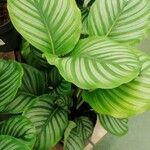
Calathea orbifolia
Prayer Plant · House plant · Calathea orbit peacock
Description
Source: leafsnapCalathea orbifolia is a breathtaking tropical plant native to South America. It belongs to the Marantaceae family and is celebrated for its large, round leaves adorned with intricate patterns of silver and green. The plant can grow to a height and width of 2 to 3 feet, making it an excellent choice for adding a dramatic flair to any indoor space. One of the most striking features of Calathea orbifolia is its foliage. The leaves are large, round, and have a velvety texture that sets them apart from other plants. They feature intricate patterns of silver-green stripes, giving them an almost metallic appearance. Calathea orbifolia thrives in bright but indirect light and prefers humid environments. It can be grown in pots or containers indoors, or outdoors in warm climates where temperatures do not drop below 60°F (15°C). The plant requires regular watering but should not be overwatered to avoid root rot. In summary, Calathea orbifolia is an excellent choice for anyone seeking a low-maintenance yet visually stunning tropical plant. It will add life and color to any indoor space or garden area.
🌳 The prayer plant might look like only an ornamental species, but it has a captivating trait: its leaves fold up at night, resembling hands in prayer, which is why it's called 'Prayer Plant'. This unique, rhythmic motion has not been harnessed by humans but could inspire inventions like a natural timekeeper, highlighting the potential of botanical biomimicry.
🎭 Contemplative act of a daily gratitude prayer
Care Guide
💧 Water Every 7 days
Water your prayer plant frequently throughout the growing season (when the top layer becomes dry) and never let the potting soil dry out completely. Drought-resistant, these plants will not thrive if left unwatered for long periods of time. However, do not let water sit directly on the leaves or allow the plant to become wet to avoid fungal problems. Water your prayer plant with water that is at least room temperature, if not slightly warmer.
☀️ Light Full shade
The prayer plant prefers locations with gentler light and tolerates spots where illumination is soft or partly shaded. Native to areas where sunlight is mostly filtered, it performs best in these conditions. However, if light is too weak the plant can experience growth problems, while too much light may cause the leaves to burn.
🌡️ Temperature 20–37.8°C
The prayer plant originates from areas where average temperatures range from 68 to 100 ℉ (20 to 38 ℃). In temperate regions, it is best kept indoors in a warm environment with consistent temperatures between 65 and 75 ℉ (18 to 24 ℃). In summer months it can tolerate higher temperatures up to 85 ℉ (29 ℃), while in winter it may benefit from occasional cooler temperatures as low as 60 ℉ (15 ℃).
💨 Humidity high (>60%)
This plant needs special care because it loves high humidity levels of 60-80% or more. The best way to achieve this is by placing a humidifier near the plant. Daily misting is also essential! Make sure the room has good ventilation.
🪴 Soil 6-7
🌱 Fertilizer Every 30 days
The prayer plant needs the most fertilizer during its active growth phase, which occurs mainly in spring, summer, and early fall. Fertilization supplies essential nutrients that the soil may lack, encouraging healthy root and stem development and supporting the attractive foliage that is a key feature of this plant.
🪴 Pot & Repot 3-4 years
When repotting a Prayer plant, pick a pot slightly larger than the current one that has good drainage. Repot during spring or fall, using a well-draining potting mix. Place the plant at the same depth as it was previously. Water thoroughly after repotting and put it in a warm spot with bright, indirect light. Avoid overwatering to prevent root rot.
✂️ Pruning
Using a pair of disinfected garden scissors, prune your prayer plant slightly above the leaf nodes. Pruning twice or three times a year (the optimal times are in the fall and spring) promotes bushy growth. Pruning a prayer plant also helps to get rid of any dead leaves or lanky stalks.
🌿 Propagating
🐛 Diseases & pets
☠️ Toxicity
Prayer plants are not dangerous or have no known toxic traits to people or pets.
Characteristics
- Plant Type
- Herb
- Life Cycle
- Perennial
- Genus
- Calathea
- Family
- Marantaceae
- Hardiness Zone
- 10-12
- Mature Height
- 61 cm to 91 cm
- Mature Spread
- 61 cm to 91 cm
- Leaf Color
- Green, Silver, Gray
- Leaf Type
- Evergreen
- Flower Color
- White
- Flower Size
- 2.03 cm to 3.05 cm
- Bloom Time
- Mid spring, Late spring, Early summer, Mid summer
- Planting Time
- Spring
- Harvest Time
- Late spring, Summer
- Native Area
- Brazil