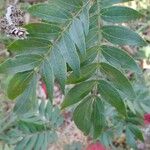
Calliandra haematocephala
Powderpuff-tree · Red powder-puff · Blood red tassel flower · Stickpea · Lehua-haole
Description
Source: leafsnapCalliandra haematocephala, commonly known as Powderpuff or Red Powderpuff, is a flowering shrub native to South America. It belongs to the Fabaceae family and can reach heights of up to 10 feet. This plant has a dense, bushy growth habit with dark green, pinnately compound leaves. The primary attraction of this plant is its flowers, which bloom in bright red or pink, powder puff-like clusters throughout the year. The flowers of Calliandra haematocephala are rich in nectar, attracting hummingbirds and butterflies. This makes it an excellent addition to any garden or landscape design. While it prefers full sun exposure, the plant can also tolerate partial shade in hotter climates. Calliandra haematocephala is relatively easy to grow, requiring minimal maintenance once established. It prefers well-draining, slightly acidic soil but can tolerate a wide range of soil types as long as they are not waterlogged. In traditional medicine, Calliandra haematocephala has been utilized for its anti-inflammatory properties and for treating skin conditions such as eczema and psoriasis. Overall, Calliandra haematocephala is an attractive flowering shrub that adds color and beauty to any garden while also supporting wildlife biodiversity.
💡 If you live in the Americas and want to attract native wildlife, this plant is an excellent choice. Hummingbirds are particularly drawn to the red powderpuff, as are many butterfly species. These butterflies not only feed on the plant but may also lay eggs on it, as it serves as a host plant for many caterpillar species. An additional benefit of the red powderpuff is that it blooms throughout the entire year.
🌳 The bright red flowers of the red powderpuff act as a magnet for pollinators such as bees and butterflies. It is an excellent plant for gardeners aiming to promote biodiversity. Its nectar-rich blooms also support honey production, allowing bees to produce high-quality honey from the nectar. This offers an eco-friendly way to enhance the quality of local honey.
🎭 Mountain of pure affection: you are aspiring,
Care Guide
💧 Water Every 7 days
The Red Powderpuff plant thrives in warm, humid environments and is moderately drought-tolerant. It needs watering every 1-2 weeks to prevent the soil from becoming too dry. Although it is usually grown outdoors, it requires plenty of water to ensure vibrant flowering, in line with its tropical origins for optimal growth.
How should I water my Red powderpuff plant in the most effective way?
Your Red powderpuff plant is not very particular about how it is watered. You can use various watering tools, such as watering cans, hoses, or even cups. It is important to make sure the water is applied directly to the soil and that all areas receive equal moisture. Using filtered water is recommended, as tap water may have harmful particles. It is also best to use water at or slightly above room temperature to avoid shocking the plant. However, the Red powderpuff typically responds well to any type of water.
What should I do if I give my Red powderpuff plant too much or too little water?
When it comes to outdoor plants, especially newly planted ones or seedlings, they may suffer from lack of water. It's important to remember to keep watering them consistently for a few months while they are small or recently planted. This is because once their roots are established, they can rely on rain for hydration most of the time. If you have a Red powderpuff plant in a pot, overwatering is a common issue. In case you accidentally overwater your Red powderpuff, you need to take immediate action to fix the situation. First, stop watering the plant right away to minimize the impact of overwatering. Then, remove the plant from its pot to check its roots. If you find that none of the roots have developed root rot, you can place the plant back in the pot. However, if there are signs of root rot, trim away the affected roots and consider applying a fungicide to prevent further damage. Finally, repot the Red powderpuff in well-draining soil. On the other hand, if your Red powderpuff is underwatered, the remedy is simpler. Water the plant more frequently to solve the issue. Underwatering can be easily fixed, as the leaves will droop, dry out, and fall off when the plant lacks water. Once you water it sufficiently, the leaves will quickly regain their fullness. Make sure to adjust your watering schedule as soon as you notice underwatering occurring.
How many times should I water my Red powderpuff plant?
If your area lacks rainfall, you should water your outdoor plants every 2 weeks during the spring and fall. In the summer, you need to water them more frequently. In the winter, you can water them less often or not at all because they require less water during that time. However, if your Red powderpuff is young or newly planted, it needs more frequent watering to help it establish and grow. For potted plants, there are two main approaches to determine watering frequency for your Red powderpuff. The first is to have a set watering schedule of once a week or once every other week. However, this may not take into account the specific conditions of your plant's environment. The other approach is to base watering frequency on the moisture level of the soil. It's best to wait until the top two to four inches of soil, or about ⅓ to ½ depth of the pots, have completely dried out before watering again. It's important to adjust the watering frequency according to the season, as the plant's water needs are highest during the summer.
How much water does my Red powderpuff plant require?
To water your Red powderpuff, you don't always need a lot of water. If only a few inches of soil have dried since your last watering, give it about five to ten ounces of water each time. You can also gauge how much water to give based on the soil moisture. If more than half of the soil has dried out, give more water until you see excess water coming out of the pot's drainage holes. If your Red powderpuff gets plenty of rain outdoors, it may not need extra watering. When it's young or getting established, make sure it gets 1-2 inches of rain per week. As it grows, it can rely on rainwater, but in hot weather without rain for 2-3 weeks, give it a full watering to prevent stress.
How can I know if I am watering my Red powderpuff plant enough?
The Red powderpuff is more commonly affected by overwatering, and there are a few signs to watch for. If the plant is overwatered, its leaves will turn yellow and it might lose some leaves. Overwatering can also cause the plant to shrivel and lead to root rot. On the other hand, an underwatered Red powderpuff will begin to wilt and its leaves may turn brown or become brittle. If you notice signs of overwatering or underwatering, it's important to take action and restore the plant's health.
☀️ Light Full sun
Red powderpuff prospers when given abundant sunlight, so it does best in places where the sun's rays are strongest. It can tolerate light shade, although that will reduce its vigor. It comes from habitats with plentiful sunlight. Both too much or too little sun may cause stunted growth or, respectively, paler foliage.
What are the sunlight requirements for Red Powderpuff?
Red Powderpuff plants thrive best in full sun, requiring more than 6 hours of sunlight daily. They can also tolerate partial sun conditions, about 3 to 6 hours of sunlight. It's essential to observe the movement of sunlight through your garden to find a spot that offers a perfect balance of light and shade, ensuring the plant's well-being.
How should Red Powderpuff be cared for in terms of sunlight exposure?
Red Powderpuff requires generous sunlight exposure for optimal growth, faring best in areas where the sun's rays are most potent. Although it can survive in slightly shaded conditions, its vigor may be affected. Originating from environments abundant in sunlight, it displays signs of stress when exposed to too much or too little sun, such as stunted growth or paler foliage. To compensate for insufficient natural light, especially in winter or darker spaces, artificial lighting such as LED lights, tailored to provide specific light wavelengths, can promote healthier growth. Indoor plants generally benefit from 8-12 hours of artificial light per day, placed 12-36 inches above the plant.
What are common symptoms of improper light conditions in Red Powderpuff?
Improper light conditions can lead to several symptoms in Red Powderpuff plants, including smaller new leaves, leggy or sparse growth, faster leaf drop, slower or halted growth, and paler or irregularly colored new leaves. Too much light can cause chlorosis, sunscald, leaf curling, wilting, and leaf scorching, damaging the plant's health and appearance.
What are some solutions for Red Powderpuff experiencing light-related issues?
For indoor Red Powderpuff plants struggling with insufficient light, gradually moving them to a sunnier location or using artificial lighting can help. Placing the plant near a south-facing window or using a desk or ceiling lamp for at least 8 hours daily are good practices. Outdoor plants should be moved gradually to avoid shock. Pruning surrounding foliage and possibly relocating the plant can ensure it receives adequate sunlight. Remember, parts of the plant damaged by poor lighting may not recover, but new growth should be healthy with proper care.
🌡️ Temperature 20–37.8°C
The natural growing conditions for red powderpuff favor temperatures of about 20 to 38 ℃ (68 to 100.4 ℉). It is a temperate woody plant that can tolerate a range of temperatures. In hotter conditions, it is recommended to water more to keep the soil moist. In cooler conditions, it is best to water less and keep the plant in a sheltered spot.
What is the ideal growth temperature for Red powderpuff?
The ideal growth environment for Red powderpuff falls within temperatures of 20 to 38°C (68 to 100.4°F). This temperate woody plant is extremely heat-loving and can adapt to a range of temperature conditions. However, it's crucial to adjust watering based on the temperatures; in hotter climates, increase watering to maintain soil moisture, and in cooler temperatures, reduce watering and protect the plant, particularly by bringing it indoors during autumn to a location near a bright window but away from direct heat sources.
How does low temperature affect Red powderpuff and what are the solutions?
Red powderpuff thrives in warmth and is not tolerant of low temperatures, showing preference for environments above a certain temperature threshold. During winter, keeping the plant above the minimum tolerable temperature is key. Exposure to temperatures below the growth limit may lead to symptoms like leaf discoloration to lighter shades, which can progress to brown or black following frost damage, along with wilting and drooping. To mitigate these effects, trim off frost-damaged parts and move the plant indoors to a warm, bright environment away from direct heat sources like heaters or air conditioning vents.
How should Red powderpuff be cared for in high temperatures?
In high temperatures, particularly during summer, it's important to ensure that Red powderpuff is not exposed to conditions exceeding its maximum tolerable temperature. Signs of distress include leaf discoloration and increased susceptibility to sunburn. The care regimen includes trimming away sun-damaged leaves, relocating the plant to partly shaded areas during peak sun hours, and maintaining soil moisture with watering routines scheduled for cooler times of the day like mornings and evenings.
💨 Humidity normal (40-60%)
This plant will thrive in moderate humidity, which is probably the level in your home. However, misting it a few times a week can be very beneficial. Make sure the room has good ventilation.
🪴 Soil 5-7
🌱 Fertilizer
The best time to fertilize a Red powderpuff is in early spring, when it emerges from dormancy. Fertilizing then stimulates overall growth and flower development. It enhances the foliage, stems, and branches, and encourages large, vibrant, long-lasting flowers. It also helps move nutrients from the roots to the flowers and improves the plant’s health and resistance to disease.
Why is it important to fertilize my Red powderpuff?
Proper fertilization is crucial for the overall health and well-being of a Red powderpuff plant. It provides the necessary energy and nutrients for the development of healthy foliage, sturdy stems, and branches. Gardeners particularly value the flowers of this plant, and fertilization boosts their size, vibrancy, and longevity. The right fertilizer facilitates the transfer of fuel from the roots to the flowers through the stems, while also maintaining the plant's general health, making it more resistant to diseases.
When should I fertilize my Red powderpuff plant?
To ensure optimal growth and flower development for your Red powderpuff, the best time to fertilize is in early spring as it emerges from its dormant phase and prepares to bloom. This initial feeding provides ample energy for overall plant growth. However, remember that feeding in spring is not the only beneficial time. Another feeding in the fall months can also be advantageous, although it does not need to be as substantial as the first. Additionally, although some gardeners choose to fertilize their Red powderpuff during planting, it is not always necessary.
When is it not a good idea to fertilize my Red powderpuff?
During the winter, Red powderpuff plants, like many others, do not require fertilization. This is because they are in a dormant phase, where they do not need much energy from the soil to grow. Fertilizing them during this time can lead to negative outcomes, such as overfertilization. The best times to feed a Red powderpuff are in early spring and fall. Therefore, during most of spring and summer, fertilization is not necessary. It's also a good idea to skip feedings when the plant is experiencing hot or dry conditions.
What kind of fertilizer does my Red powderpuff plant require?
When fertilizing Red powderpuff plants, using a specific type of fertilizer is usually better than a general-purpose one. Nitrogen and phosphorus are the most important nutrients for Red powderpuff, so the fertilizer should have higher amounts of these compared to potassium. Aim for a fertilizer with an N-P-K ratio of 10-10-8 or similar. It's also helpful to use organic materials like compost for one of the annual feedings. If using fertilizer, granular fertilizer is the most common choice for Red powderpuff plants.
How can I make my Red powderpuff plant grow better?
Fertilizing your Red powderpuff plant is easy for any gardener, even those without much experience. To use granular fertilizer, simply sprinkle it on the soil after wetting it with water. Alternatively, you can improve the soil by adding compost or manure. Just place the material on top of the soil and gently work it in using a hand rake, being careful not to disturb the roots.
🪴 Pot & Repot 2-3 years
When you repot Red powderpuff, select a container 1-2 inches (2.5–5.1 cm) larger that has ample drainage. Use a well-draining potting mix. Repot in spring or fall, making sure the root ball sits slightly below the rim of the flower pot. Water thoroughly after repotting and place it in a warm spot with indirect sunlight.
✂️ Pruning
The Red Powderpuff, known for its vibrant red blooms, should be pruned in late spring to maintain its shape and encourage healthy growth. To improve air circulation and reduce the risk of disease, trim any dead branches and remove faded flowers. Be sure to use clean, sharp tools to ensure optimal healing and vitality.
🌿 Propagating
🐛 Diseases & pets
☠️ Toxicity
Characteristics
- Plant Type
- Shrub, Tree
- Life Cycle
- Perennial
- Genus
- Calliandra
- Family
- Fabaceae
- Hardiness Zone
- 10-12
- Mature Height
- 4.88 m
- Mature Spread
- 3.05 m to 4.57 m
- Leaf Color
- Green
- Leaf Type
- Evergreen
- Flower Color
- Red
- Flower Size
- 3.05 cm
- Bloom Time
- Spring, Late summer, Fall, Winter
- Planting Time
- Spring, Autumn
- Harvest Time
- Spring, Early summer, Fall, Winter
- Native Area
- Colombia, Bolivia, Venezuela