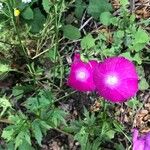
Callirhoe bushii
Bush's poppymallow
Description
Source: leafsnapCallirhoe bushii is a species of flowering plant in the mallow family known by the common name Bush's poppy-mallow. It is native to the United States, where it can be found in Arkansas, Kansas, Missouri, and Oklahoma. There are also some introduced populations in Iowa.This plant was first described in 1909 and named for the botanist Benjamin Franklin Bush. It produces poppy-like magenta flowers. It is commonly grown as an ornamental plant. In the wild it grows in woodlands and on prairies, often on calcareous soils. It is associated with Verbesina helianthoides, Campanula americana, Ampelopsis cordata, Campsis radicans, Cassia sp., Melilotus alba, Rudbeckia triloba, Polymnia canadensis, Smilax sp., and Clematis virginianaThere are 49 known occurrences, the largest containing hundreds of individuals. Most populations, however, have fewer than 50 plants. The species is threatened by habitat loss during development and urbanization. Habitat is also being consumed for grazing and cropland. The plant can tolerate some disturbance, but not the destruction of habitat.
Care Guide
💧 Water
Bush's Poppymallow flourishes in well-drained soils with moderate moisture levels and requires weekly watering to ensure optimal growth. As an herbaceous perennial, it benefits from consistent moisture during its growing season, which boosts both its flowering and overall health. Its success is also influenced by seasonal rainfall patterns.
☀️ Light Full sun
Bush's Poppymallow grows best with plenty of light. It comes from habitats that get a lot of sunlight throughout the day, and that light is important for its growth and overall health. Too much light is not a problem, but too little can slow its development and reduce its vigor.
What are the sunlight requirements for Bush's Poppymallow?
Bush's Poppymallow requires more than 6 hours of sunlight daily to thrive, ensuring a perfect balance of light and shade in your garden for the plant's happiness. It is crucial to observe how sunlight moves through your garden to select the best spot. This plant, originating from environments with substantial sunlight, relies heavily on light for its growth and wellbeing, although overexposure is not a concern. Inadequate sunlight, however, can significantly hinder its development and vitality.
How can artificial lighting benefit indoor plants like Bush's Poppymallow?
Artificial lighting is essential for indoor plants, especially when natural sunlight is insufficient, like in winter or in less sunny spaces. It promotes faster, healthier growth by providing adequate lighting. LED lights, popular for indoor gardening, can be customized to meet specific plant needs by offering the required wavelengths of light. For optimal growth, full sun plants need 30-50W/sq ft, partial sun plants require 20-30W/sq ft, and full shade plants need 10-20W/sq ft of artificial light. The artificial light source should be placed 12-36 inches above the plant to mimic natural sunlight, ensuring the plant receives 8-12 hours of light daily.
What symptoms indicate light deficiency in Bush's Poppymallow?
Symptoms of light deficiency in Bush's Poppymallow include smaller new leaves, leggy or sparse growth, accelerated leaf drop, halted new growth, lighter-colored new leaves, conditions like chlorosis, sunscald, leaf curling, wilting, and leaf scorching. These symptoms arise when the plant doesn't receive sufficient sunlight, leading to reduced growth, chlorophyll breakdown, and diminished plant health.
What solutions are available for managing light deficiency in Bush's Poppymallow?
To manage light deficiency in Bush's Poppymallow, gradually move the plant to a sunnier location to achieve at least 6 hours of direct sunlight daily, especially for indoor plants. Use south-facing windows and keep curtains open during the day for maximum exposure. Artificial light, like desk or ceiling lamps or professional grow lights, can provide additional light. For outdoor plants, ensure a gradual transition to avoid sunburn. If sunlight is obstructed by elements like trees, consider pruning to improve exposure. For smaller plants, transplanting them during their dormant period to a location with ample sunlight and good drainage can address the issue. Note, parts of the plant damaged by insufficient sunlight may not recover, but new growth should be healthy with improved light exposure.
🌡️ Temperature 0–35°C
Bush's Poppymallow is native to regions where temperatures range from 32 to 95 °F (0 to 35 ℃). It does best within that range. During colder months, provide extra warmth to encourage growth.
What is Bush's Poppymallow and where is it native to?
Bush's Poppymallow, botanically known as Callirhoe bushii, is a plant native to regions where temperatures range from 32 to 95 °F (0 to 35 °C). It thrives best within this temperature range. Native to environments that experience such temperatures, this plant possesses strong cold resistance, making it adaptable to a wide range of weather conditions.
How should Bush's Poppymallow be cared for in the colder months?
During the colder months, it's crucial to provide Bush's Poppymallow with additional warmth to encourage growth, despite its strong cold resistance. If winter temperatures are expected to drop below -35°C, cold protection becomes important. This can involve covering the plant with insulating materials like soil or straw. Additionally, watering the plant abundantly before the first freeze in autumn is recommended, ensuring the soil is moist as it enters a frozen state helps to prevent drought and water scarcity for the plant during winter and early spring.
What are the signs of temperature stress in Bush's Poppymallow and how can they be mitigated?
Bush's Poppymallow shows different symptoms based on temperature stresses. When temperatures drop below -35°C, there may not be immediate visible changes, but a notable decrease in sprouting, or even a lack thereof, can occur in spring. In such cases, removing parts that have failed to sprout in spring is advisable. On the other hand, when temperatures exceed 38°C, the leaves may become lighter, curl, be prone to sunburn, and the plant can wilt and dry up in severe cases. Solutions include trimming sunburned and dried parts, relocating the plant to a shaded area or using a shade cloth, and watering in the morning or evening to keep the soil moist.
💨 Humidity
🪴 Soil 6-7
🌱 Fertilizer
The primary time to fertilize Bush's Poppymallow is in early spring while the flowers are forming. The appropriate fertilizer promotes better blooms and helps Bush's Poppymallow produce attractive flowers. Fertilizing in early spring ensures strong flowers during the season and supplies energy for dormant growth phases.
🪴 Pot & Repot
✂️ Pruning
To ensure the optimal health of your Poppymallow bush, prune it from early to late spring. Begin by removing any dead stems and then thin out crowded areas to improve air circulation. Trim overgrown stems carefully, avoiding excessive cutting, to encourage denser growth and more abundant blooms. This will help reduce the risk of disease while keeping your garden looking attractive.
🌿 Propagating
🐛 Diseases & pets
☠️ Toxicity
Characteristics
- Plant Type
- Herb
- Life Cycle
- Perennial
- Genus
- Callirhoe
- Family
- Malvaceae
- Hardiness Zone
- 3-9
- Mature Height
- 30 cm to 61 cm
- Mature Spread
- 30 cm to 61 cm
- Leaf Color
- Green
- Leaf Type
- Semi-evergreen
- Flower Color
- Purple, Pink, Red, Lavender
- Flower Size
- 2.54 cm to 7.62 cm
- Bloom Time
- Late spring, Early summer, Mid summer
- Planting Time
- Spring, Summer
- Harvest Time
- Mid summer, Late summer, Early fall