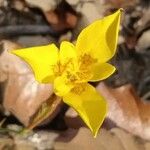
Calochortus monophyllus
Yellow star-tulip
Description
Source: leafsnapCalochortus Monophyllus, commonly known as the Yellow Star Tulip, is a perennial plant species belonging to the family Liliaceae. Native to California, it thrives in various habitats such as grasslands, chaparral, and oak woodlands. Typically reaching up to 30 cm in height, the plant features a single, long, and narrow basal leaf. The striking flowers of Calochortus Monophyllus are characterized by three bright yellow petals, each adorned with brown or purple spots at the base. Additionally, the flower has three green sepals. Blooming from April to June, Calochortus Monophyllus attracts pollinators, including bees, butterflies, and hummingbirds, with its vibrant colors. The plant favors well-drained soils and can thrive in both full sun and partial shade conditions. Propagation is possible through seeds or bulbs, with minimal care required once the plant is established. In traditional Native American cultures of California, where the plant grows natively, it was used medicinally, such as for treating headaches by making tea from its roots. Overall, Calochortus Monophyllus not only enhances natural landscapes with its beauty but also provides ecological benefits by attracting pollinators, thereby helping to maintain biodiversity within the ecosystems where it naturally grows.
Care Guide
💧 Water Every 7 days
☀️ Light Partial sun
The yellow star-tulip thrives in its natural habitats like forest understories and rocky terrains, where it is naturally shaded. While it favors partially sunny conditions, it can also adjust to completely sunny or fully shaded environments, reflecting its adaptable and resilient characteristics.
🌡️ Temperature 15–35°C
The Yellow star-tulip can acclimate to a diversity of temperature circumstances, yet its dispersion might still be hindered by various combinations of aquatic and thermal conditions. It prospers optimally in temperate climates during summer, provided there is sufficient rain or watering. Extended intervals of overcast and rainy weather or sustained high temperatures can raise the chances of Yellow star-tulip perishing. During the winter months, suitable safeguarding against the cold can enhance the plant's chances of survival.
💨 Humidity
🪴 Soil 6-7
🌱 Fertilizer
The optimal period to apply fertilizer for Yellow star-tulip is during the early part of the spring when the flowers are developing. Using the correct fertilizer promotes superior blossoms and aids in the generation of exquisite flowers by the Yellow star-tulip. Providing fertilizer in the initial phase of spring guarantees impressive blossoms throughout that period and supplies energy for the periods of inactive growth.
🪴 Pot & Repot
✂️ Pruning
The yellow star-tulip showcases vibrant yellow flowers and benefits from pruning in early spring. Focus on removing spent blooms and damaged foliage to maintain the plant's health and improve bloom quality. Although minimal pruning is required, it's important to ensure good airflow and sufficient light for robust growth and an enhanced floral display.
🌿 Propagating
🐛 Diseases & pets
☠️ Toxicity
Characteristics
- Plant Type
- Herb
- Life Cycle
- Perennial
- Genus
- Calochortus
- Family
- Liliaceae
- Hardiness Zone
- 7-9
- Mature Height
- 0 cm to 30 cm
- Mature Spread
- 10 cm to 20 cm
- Leaf Color
- Green
- Leaf Type
- Deciduous
- Flower Color
- Yellow
- Flower Size
- 2.03 cm to 3.05 cm
- Bloom Time
- Early spring, Mid spring
- Planting Time
- Spring, Summer
- Harvest Time
- Late spring, Early summer