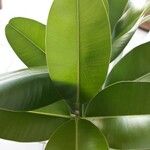
Calophyllum calaba
Marí · A · Santa-Marí · Brazil beauty leaf · Calaba oil plant
Description
Source: leafsnapCalophyllum calaba, commonly known as the Alexandrian laurel or the Santa Maria tree, is a tropical evergreen species belonging to the Clusiaceae family. This tree is indigenous to the Caribbean as well as Central and South America. It can reach impressive heights of up to 30 meters and has a trunk that can measure up to 1 meter in diameter. The leaves of Calophyllum calaba are dark green, glossy, and arranged in opposite pairs along the branches. Its small flowers, which are white or yellowish-green and have five petals, bloom from May through August. The tree produces a large, green drupe that contains one or two seeds with notable medicinal properties. These seeds yield tamanu oil, a substance that Polynesians have used for centuries for its ability to heal wounds and treat skin conditions like eczema. Beyond its medicinal applications, the wood of Calophyllum calaba is valued in construction due to its durability and resistance to termites. The tree also produces high-quality charcoal that serves as an excellent fuel source. In summary, Calophyllum calaba is a significant species due to its medicinal benefits and its economic value in construction and fuel production.
Care Guide
💧 Water Every 7 days
☀️ Light Full sun
Antilles calophyllum is found in open habitats, such as sunlit meadows and forest edges, which provide abundant light. It flourishes in Full Sun but can also tolerate Partial Sun, adapting well to a range of sunlight conditions.
🌡️ Temperature 20–37.8°C
Antilles calophyllum comes from tropical areas, where the climate is generally warm and humid. Therefore, it is suited to high temperatures and humidity. It does not tolerate abrupt temperature changes and prefers a consistent temperature, so avoiding indoor temperature fluctuations is important. It usually cannot withstand cold and needs higher temperatures to grow. If the surrounding temperature falls too low, the plant may stop growing or even die.
💨 Humidity
🪴 Soil 6-7
🌱 Fertilizer
The best time to fertilize an Antilles calophyllum is in early spring, as it comes out of dormancy. This stimulates overall growth and flower development. Fertilization improves the foliage, stems, and branches, while encouraging large, vibrant, long-lasting flowers. It helps transfer nutrients from the roots to the flowers and enhances the plant's health and resistance to disease.
🪴 Pot & Repot
✂️ Pruning
🌿 Propagating
🐛 Diseases & pets
☠️ Toxicity
Characteristics
- Plant Type
- Tree
- Life Cycle
- Perennial
- Genus
- Calophyllum
- Family
- Calophyllaceae
- Hardiness Zone
- 10-12
- Mature Height
- 14.94 m to 20.12 m
- Mature Spread
- 7.92 m to 11.89 m
- Leaf Color
- Dark Green, Forest Green
- Leaf Type
- Evergreen
- Flower Color
- White
- Flower Size
- 1.02 cm to 2.03 cm
- Bloom Time
- Summer
- Planting Time
- Spring, Summer, Autumn
- Harvest Time
- Late summer, Fall
- Native Area
- Sri Lanka, Malaysia, Indonesia, Cambodia, Vietnam, Singapore, Laos, Australia, Thailand