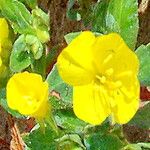
Camissoniopsis cheiranthifolia
Beach suncup
Description
Source: leafsnapCamissoniopsis cheiranthifolia, the beach suncup or beach evening primrose, is a species of the evening primrose family and is native to open dunes and sandy soils of coastal California and Oregon. The beach suncup grows prostrate along the beach surface, forming mats more than 1 m across. It forms long stems growing from a central crown, lined with silvery grey-green leaves. The prostrate form and swinging stems allow the plant to survive well on the windy, shifting sands of the coast. The four-petalled flowers open in the morning (typical among suncups) and are bright yellow, fading to reddish. The two subspecies are: Camissoniopsis cheiranthifolia subsp. cheiranthifolia Camissoniopsis cheiranthifolia subsp. suffruticosa (S.Watson) W.L.Wagner & Hoch
Care Guide
💧 Water
☀️ Light Full sun
Beach evening primrose grows best in abundant sunlight and has little tolerance for shade. Originating in open coastal habitats, it is adapted to capture maximum sunlight for growth. Both excessive and insufficient light stress the plant, harming its health and development.
🌡️ Temperature 15–35°C
Beach evening primrose can adapt to a wide range of temperature conditions, but its distribution may still be restricted by different combinations of water and heat. It performs best in warm summers with adequate rainfall or watering. Extended periods of cloudy, rainy weather or prolonged high temperatures increase the likelihood of Beach evening primrose dying. In winter, proper protection from cold can enhance the plant's survival rate.
💨 Humidity
🪴 Soil 6-7
🌱 Fertilizer
The best time to fertilize a Beach evening primrose is in early spring, when it is coming out of dormancy and beginning active growth. Fertilizing supplies essential nutrients for healthy development. Although Beach evening primrose has fairly low fertilizer requirements, applying fertilizer once a year can improve its survival and encourage better, longer-lasting flowers.
🪴 Pot & Repot
✂️ Pruning
🌿 Propagating
🐛 Diseases & pets
☠️ Toxicity
Characteristics
- Plant Type
- Herb
- Life Cycle
- Perennial
- Genus
- Camissoniopsis
- Family
- Onagraceae
- Hardiness Zone
- 8-10
- Mature Height
- 0.61 m to 1.22 m
- Mature Spread
- 91 cm
- Leaf Color
- Light Green, Gray
- Leaf Type
- Evergreen
- Flower Color
- Yellow
- Flower Size
- 0.51 cm to 2.03 cm
- Bloom Time
- Spring, Summer, Fall, Early winter
- Planting Time
- Spring, Summer
- Harvest Time
- Late spring, Summer, Fall, Early winter, Mid winter