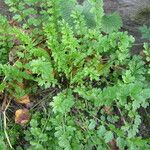
Cardamine impatiens
Narrow-leaf bittercress · Narrow-leaved Bitter-cress · Narrowleaf Bittercress · Narrow-leaved Bittercress · Touch-me-not Bittercress
Description
Source: leafsnapCardamine impatiens, the narrowleaf bittercress or narrow-leaved bitter-cress, is a plant species in the genus Cardamine of the family Brassicaceae. It is a slender, biennial herb, that produces sterile leaves in the first year, one to several flowering stems during the next. Its leaves are pinnate with several pairs of lanceolate, dentate leaflets and a terminal, slightly longer leaflet. The short petals surpass the calyx by half of its length. The seeds are arranged in one row on each side of the central membrane of the narrow pod and are ejected out in a shower due to the tension formed as the seed pod (silique) dries. It grows on walls, open ground in shady places in forests usually disturbed by man.
🌳 Interestingly, narrowleaf Bittercress uses a distinctive seed-dispersal mechanism called ballistic dispersal, or "explosive dehiscence." In this process the plant forcefully ejects its seeds by rapidly expelling them from its fruit pods in an explosive fashion, thereby promoting wide distribution. While many species depend on the environment or animals to disperse their seeds, narrowleaf Bittercress takes a more active approach, flinging its seeds into new areas. This counterintuitive tactic reveals an unexpected aspect of plant behavior that parallels certain animal strategies for dispersing offspring.
Care Guide
💧 Water
Narrowleaf Bittercress thrives in moist, temperate regions and prefers evenly moist soil. To prevent dryness, it benefits from weekly watering. This plant is best suited for outdoor cultivation, where it can flourish with consistent hydration. Regular watering is particularly important during its growth cycle, as it helps meet the plant's water needs.
How should I water my Narrowleaf Bittercress?
To water Narrowleaf Bittercress, you have a few options. You can use a garden hose with a spray nozzle, a watering can, or any other common watering tool. This plant isn't too particular about how it's watered, so rainwater, tap water, or filtered water will all work just fine. However, it's best to avoid watering from above as this can harm the leaves and flowers and potentially cause disease. A drip irrigation system is often recommended for watering, as it evenly and directly applies water to the soil. If you have Narrowleaf Bittercress in a container, you can use a cup, watering can, or tap to water it directly into the soil.
What do I do if I give my Narrowleaf Bittercress too much water or too little water?
To remedy underwatering of Narrowleaf Bittercress, simply start watering it more regularly when you notice it lacks moisture. Overwatering is a more serious issue, which can lead to disease and death if not caught early. To prevent this, choose a sunny spot with good drainage to allow excess water to drain. If you overwater Narrowleaf Bittercress in a pot, consider transferring it to a new pot with better drainage and loose soil during repotting.
How often do I need to water my Narrowleaf Bittercress?
To keep your Narrowleaf Bittercress healthy, water it regularly throughout the growing season. In spring, water once a week, but as the weather gets warmer, increase watering to two to three times per week. Be careful not to overwater, as this can harm your plant. Make sure the soil is consistently moist but not wet. When watering Narrowleaf Bittercress in a pot, you'll need to water more frequently because the soil can dry out faster. In most cases, water container-grown Narrowleaf Bittercress a few times per week compared to just once per week for plants in the ground.
How much water does my Narrowleaf Bittercress plant need?
When it comes to watering your Narrowleaf Bittercress, there are a few different approaches you can take. Some gardeners prefer to gauge the soil's moisture level by touching it. According to this method, you should water until the top six inches of soil feels moist. Another option is to use a specific measurement as a guideline for watering your plant. Typically, you would give your Narrowleaf Bittercress around two gallons of water per week, taking into account factors like heat and the speed at which the soil dries. However, it's important to be cautious with such set guidelines, as overwatering can occur if your plant doesn't actually require two gallons per week. When growing Narrowleaf Bittercress in a container, you'll need to follow a different approach to determine how much water to provide. The general rule is to water enough to moisten all layers of dry soil. To check if the soil is sufficiently moist, simply stick your finger in it to feel for moisture. Additionally, you can water until you observe a slight trickle of excess water coming out of the pot's drainage holes.
How do I know if I'm giving enough water to my Narrowleaf Bittercress?
Avoiding overwatering your Narrowleaf Bittercress can be challenging due to its specific needs. These plants have deep roots that need to be moistened weekly, but they are also highly prone to root rot and browning from excess water. Underwatering is less of a concern for these plants as they can survive without additional watering for some time, but if they go too long without water, they may wilt and develop dry leaves.
☀️ Light Full sun
For the best development, narrowleaf Bittercress requires a substantial amount of sunlight, although it can also happily survive in areas that gain a moderate amount of sun. In its natural habitat, it flourishes under an uncovered environment, but it can also cope under intermittent shade. Either too little or too much sun exposure can have a negative effect on its health.
What are the sun requirements for Narrowleaf Bittercress?
Narrowleaf Bittercress requires a robust amount of sunlight for optimal growth and its well-being. It thrives in full sun conditions, which means it prefers locations that receive more than 6 hours of direct sunlight per day. However, it can also tolerate partial sun environments, receiving about 3-6 hours of sunlight. The plant's natural habitat allows it to grow under open skies or with minimal shade, such as under scattered canopies. It's important to watch how sunlight moves through your garden to select the best spots that offer the right balance of light and shade, ensuring your Narrowleaf Bittercress plants stay happy and healthy.
How do artificial lights help in growing Narrowleaf Bittercress indoors and what are the recommendations?
Artificial lighting plays a crucial role in the growth of Narrowleaf Bittercress when natural sunlight is insufficient, especially during winter or in spaces that don't receive enough sun. Indoor plants benefit significantly from the correct type of artificial lighting, which includes LED lights known for their customizability to provide specific wavelengths necessary for plant growth. For full sun plants like Narrowleaf Bittercress, 30-50W per square foot is recommended, with the light source placed 12-36 inches above the plant to mimic the sun. Ensuring the plant receives 8-12 hours of artificial light per day mimics natural daylight hours, promoting healthier and faster growth.
What are the symptoms of light deficiency in Narrowleaf Bittercress?
When Narrowleaf Bittercress does not receive enough light, it may show several symptoms indicating light deficiency. These include the development of smaller leaves than usual, leggy or sparse growth with long spaces between leaves or stems, leading to a stretched-out appearance, faster leaf drop as a result of the plant trying to conserve resources, slower or halted new growth putting the plant in survival mode, and the appearance of lighter-colored or irregularly colored new leaves due to insufficient sunlight. These symptoms suggest the need for better lighting conditions to prevent the adverse effects on the plant's health.
What are some solutions to light deficiency problems in Narrowleaf Bittercress?
To combat light deficiency in Narrowleaf Bittercress, consider gradually relocating your plants to areas with more sunlight, ensuring they receive at least 6 hours of direct sun daily. For indoor plants, move them closer to a south-facing window or use artificial lights such as a desk or ceiling lamp for a minimum of 8 hours daily or invest in professional plant grow lights. For outdoor plants, avoid sudden changes in light intensity to prevent sunburn. Prune nearby branches and leaves that may be creating shade and transplant smaller plants during their dormant period to sunnier locations with good drainage. Although parts of the plant that have already been affected may not recover, new growth should be healthy with adequate light exposure.
🌡️ Temperature 5–32.2°C
The Narrowleaf Bittercress is indigenous to regions where temperatures consistently fall between 68 and 95°F (20 to 35℃). It flourishes optimally in this temperate environment, necessitating regulation of these seasonal temperatures to promote the best growth.
What is Narrowleaf Bittercress and where is it native to?
Narrowleaf Bittercress, scientifically known as Cardamine impatiens, is native to climates with temperatures ranging between 68 to 95 °F (20 to 35 °C). It thrives in these temperate conditions and has strong cold resistance, making it adaptable to various environments without needing special frost protection measures in most cases.
What are the ideal temperature conditions for the growth of Narrowleaf Bittercress?
Narrowleaf Bittercress grows best in temperatures that are between 68 to 95 °F (20 to 35 °C). It requires care to maintain these temperature levels seasonally for optimal growth. The plant is cold-tolerant, so it typically does not need special frost protection measures during winter. However, if temperatures are expected to drop below -30°C, it is important to provide cold protection by covering the plant with materials such as soil or straw.
How should Narrowleaf Bittercress be cared for during winter?
Before the first freeze in autumn, Narrowleaf Bittercress should be watered abundantly to ensure the soil remains moist and enters a frozen state. This helps prevent drought and water scarcity for the plant during winter and early spring. If winter temperatures are expected to drop below -30°C, the plant should be covered with materials like soil or straw to provide extra protection against the cold.
What are the symptoms of Narrowleaf Bittercress when exposed to low temperatures?
When exposed to low temperatures, specifically below -30°C, Narrowleaf Bittercress may not show any noticeable changes during winter. However, there may be a decrease in sprouting or even no sprouting during springtime. To address this, any parts of the plant that have failed to sprout in spring should be removed.
What happens to Narrowleaf Bittercress when temperatures exceed its optimal range?
When temperatures exceed the optimal range of 68 to 95 °F (20 to 35 °C), particularly above 38°C, the leaves of Narrowleaf Bittercress may become lighter in color, prone to curling, susceptible to sunburn, and in severe cases, the entire plant may wilt and become dry. To mitigate these effects, trim away the sunburned and dried-up parts, move the plant to a location with shade from the midday and afternoon sun, or use a shade cloth. Additionally, watering the plant in the morning and evening can help keep the soil moist and protect it from extreme heat.
💨 Humidity
🪴 Soil 6-7
🌱 Fertilizer
Regular, low-strength applications of fertilizer can aid in the healthy development of leaves in Narrowleaf Bittercress. During the summer months, it's advisable to fertilize Narrowleaf Bittercress once a month. Nitrogen is essential for leaf growth, and using sources rich in nitrogen assists Narrowleaf Bittercress to flourish.
🪴 Pot & Repot
✂️ Pruning
🌿 Propagating
🐛 Diseases & pets
☠️ Toxicity
Characteristics
- Plant Type
- Herb
- Life Cycle
- Annual, Biennial
- Genus
- Cardamine
- Family
- Brassicaceae
- Hardiness Zone
- 4-8
- Mature Height
- 20 cm to 61 cm
- Mature Spread
- 20 cm to 30 cm
- Leaf Color
- Green, Blue
- Leaf Type
- Deciduous
- Flower Color
- White
- Flower Size
- 0.20 cm
- Bloom Time
- Mid spring, Late spring, Early summer
- Planting Time
- Spring, Summer, Autumn
- Harvest Time
- Late spring, Early summer, Mid summer
- Native Area
- India, Austria, Turkey, Sweden, Slovakia, Montenegro, Pakistan, Thailand, Croatia, Slovenia, Belarus, Uzbekistan, Russia, Germany, Estonia, Koppen, South Korea, Latvia, Romania, Belgium, Netherlands, Nepal, France, Tajikistan, Czech Republic, Bulgaria, Armenia, Poland, Ukraine, Serbia, China, Lithuania, Norway, Afghanistan, Kyrgyzstan, Kazakhstan, Italy, Spain, Switzerland, Denmark, Japan, Mongolia, Finland, Bhutan, Iran, Albania, Azerbaijan, United Kingdom, Hungary, Turkmenistan