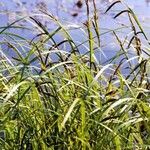
Carex acuta
Slender Tufted-sedge · Acute Sedge · Graceful sedge · Slender Tussock-sedge · గుత్తి తుంగ
Description
Source: leafsnapCarex acuta, the acute sedge, slender tufted-sedge, or slim sedge, can be found growing on the margins of rivers and lakes in the Palaearctic terrestrial ecoregions in beds of wet, alkaline or slightly acid depressions with mineral soil. Carex acuta does not tolerate prolonged desiccation. The community is distributed, in particular, in northern France, the Low Countries, Central Europe south to the Sava and Drava valleys of Croatia, the northern Morava valley of Serbia and Romania, north to Poland, the Kaliningrad District, Lithuania and Latvia, in southern Scandinavia, in the Dnieper basin of northern Ukraine and southern Belarus, in the lower Volga Valley.
💡 In 1754, Lin Nai established the genus known as "true sedge." This plant is a significant component of China's flora and is the dominant grass species in the lowest layer of many forests. In some areas, true sedge makes up most of the lower vegetation.
Care Guide
💧 Water
Acute sedge is a plant that thrives in wetland habitats, where it requires consistent moisture. While it can tolerate brief periods of flooding, it benefits from weekly watering. As an herbaceous perennial, acute sedge grows well outdoors, but it needs adequate drainage to prevent root rot during the growing season.
What do I do if I give my Acute sedge plant too much or too little water?
Proper watering is essential for the health and performance of this beautiful ornamental grass. In the ground, watering issues can be resolved, however, in a container, excessive or insufficient water will quickly kill Acute sedge. When the grass doesn't receive the correct amount of water, its growth may be stunted. Overwatering will cause yellow leaves with brown tips, while underwatering will result in drooping leaves, weak seed head production, and browned leaves. If you suspect your Acute sedge has been watered improperly, first determine if it is receiving too much or too little water. If it's getting too much, immediately stop watering it. Heavy soils may take weeks to dry out, so be patient. Once you see new growth, test the soil for moisture and decide if it needs more water. If the grass is not getting enough water, simply give it a deep drink and observe if it perks up. Remember, it is better to provide a long, deep watering rather than frequent shallow waterings. This encourages the grass to develop deep roots, making it more resistant to drought and watering-related problems.
How often should I give my Acute sedge water?
The watering requirements for Acute sedge depend on its planting location. In general, it should be watered every week. However, in hot climates, it may need to be watered once or twice a week during the summer. In moderate climates, watering once every seven days or even less may be sufficient. Grass in containers generally needs more frequent watering than those planted in the ground. The amount of shade also affects watering frequency, with shaded grass requiring less water than in-ground grass. Acute sedge should only be watered when the soil is dry, which can be determined by feeling the soil or using signs like folded and thin blades. Despite its ability to withstand drought, regular deep waterings will enhance its color. While Acute sedge is naturally found in open scrubland and can tolerate harsh conditions, it still requires care and attention, including consistent watering. Newly planted Acute sedge needs more frequent watering until it establishes deep roots. For potted sedge, the soil dries out quickly, especially in direct sun, so it should be checked every few days and watered when dry. In-ground sedge requires less watering, but this depends on the type of soil. Clay soil may feel dry at the surface but retain moisture below, while sandy soil that drains quickly will need more frequent watering.
What do I need to consider when watering my Acute sedge during different seasons, climates, or when it's in different stages of growth?
To determine if you are watering enough, observe the rate of growth of your grasses. Acute sedge tends to double in size during the hottest months of the year. If the weather is hot and the grass is not growing vigorously, you may need to adjust your watering schedule. In winter, watering once a month may be sufficient, but check the soil for moisture. During the warmest months, the grass requires more water than usual. However, in winter and cooler months, the need for water significantly reduces. Remember that the soil should be allowed to dry out completely before adding water to Acute sedge.
☀️ Light Full sun
Acute sedge does best with plentiful sunlight. Sufficient light is important for its growth and vigor. It can also tolerate areas with moderate sun. Too little light may inhibit its development, while too much sun can burn the plant. In its native environments, it grows well with abundant sun exposure.
What are the sunlight requirements for Acute Sedge?
Acute Sedge requires a generous amount of sunlight for optimal growth and health. It thrives best in full sun, defined as receiving more than 6 hours of sunlight daily, but can also manage well in areas with partial sun, about 3-6 hours of sunlight. The plant's development may be stunted under low light conditions, whereas excessive sunlight can cause scorching. Observing the movement of sunlight through your garden and choosing locations that offer a balance of light and shade is crucial for the plant's well-being.
How can artificial lighting be used for indoor Acute Sedge plants?
For indoor Acute Sedge plants, artificial lighting can be a vital solution when natural sunlight is insufficient, especially during winter or in less sunny spaces. LED lights are recommended because they can provide specific wavelengths needed by the plants. Full sun plants require 30-50W/sq ft, partial sun plants need 20-30W/sq ft, and full shade plants require 10-20W/sq ft of artificial light. The light source should be placed 12-36 inches above the plant to mimic natural sunlight, and most plants need 8-12 hours of light per day.
What are the symptoms of improper lighting on Acute Sedge?
Inadequate lighting may not immediately show symptoms in Acute Sedge, but over time, it could lead to several issues: smaller new leaves, leggy or sparse growth, faster leaf drop, slower or halted growth, lighter-colored new leaves, chlorosis (yellowing of leaves due to excessive sunlight), sunscald (damage from intense sunlight), leaf curling, wilting, and leaf scorching. These symptoms reflect either too little or too much light exposure.
What are the solutions to light-related problems in Acute Sedge?
To address light-related problems in Acute Sedge, gradually moving the plants to sunnier locations can be beneficial. For indoor plants, progressively adjust their position each week toward a south-facing window or make use of artificial lighting for at least 8 hours daily if relocation isn't feasible. Outdoors, ensure plants are moved gradually to avoid shock from sudden light intensity changes. Pruning nearby trees and relocating smaller plants to sunnier spots can help reduce sunlight obstructions. Note, while parts of the plant affected by insufficient light may not recover, new growth should appear healthy with improved light conditions.
🌡️ Temperature 5–35°C
Acute sedge is native to habitats where temperatures range from 41 to 95 °F (5 to 35 °C). It does best in these conditions, so major deviations may impact its growth. In colder seasons, it is advisable to keep acute sedge indoors or in a greenhouse to preserve its preferred temperature.
What temperature conditions are best for Acute Sedge?
Acute Sedge, scientifically known as Carex acuta, is native to environments where the temperature range is between 41 to 95 °F (5 to 35 °C). It performs well within this temperature spectrum, indicating that significant deviations from these conditions could impact its growth negatively. During colder seasons, it's advised to move Acute Sedge indoors or to a greenhouse to ensure it remains within its optimal temperature range. Although Acute Sedge possesses strong cold resistance and typically doesn't require special frost protection during winter, precautions may be necessary if temperatures are expected to plummet below -30°C, involving the use of insulating materials like soil or straw over the plant. Additionally, plentiful watering before the first freeze of autumn is recommended to keep the soil moist, aiding in the prevention of drought and water scarcity for the plant during the colder months.
How does Acute Sedge react to low temperatures and how can it be managed?
Acute Sedge is quite tolerant of cold conditions and generally thrives when temperatures remain above 5°C. During the winter season, it's crucial to ensure that the temperature does not fall below -25°C. In cases where the temperature drops below -30°C, though the plant may not exhibit noticeable changes immediately, a significant decrease in sprouting or complete lack of sprouting can occur by spring. To manage this, removing any parts of the plant that have failed to sprout in spring is advised.
What should be done if Acute Sedge experiences high temperatures?
During the summer months, it's important to make sure that Acute Sedge's environment doesn't exceed 35°C. Exposure to temperatures above 38°C might result in the leaves lighter in color and becoming prone to curling, sunburn, and in worse cases, the plant might wilt and dry out completely. To mitigate these effects, one should trim away the sunburned and dried-up portions of the plant. Relocating the plant to a shaded area during midday and afternoon hours or using a shade cloth can protect it from direct sunlight. Ensuring the soil remains moist by watering in the morning and evening also helps in reducing the stress on the plant caused by high temperatures.
💨 Humidity
🪴 Soil 5-7
🌱 Fertilizer
Acute sedge needs extra nutrients to encourage healthy new growth. In spring, spreading compost around the plant's base can effectively supply the nutrition it requires. Fertilizing supports vigorous growth and helps the plant fend off diseases and pests.
Why do I have to put fertilizer on my Acute sedge?
Fertilizing Acute sedge is essential for multiple reasons. Firstly, your plant requires the added nutrients to promote healthy new growth. Moreover, these additional nutrients play a vital role in supporting the overall health of older growth and enhancing your plant's defenses against diseases and pests.
When should I fertilize my Acute sedge?
For the survival of Acute sedge in the garden, it is important to know when to fertilize it. Acute sedge is not a heavy feeder and does not need extra nutrients when it is dying back. Rather than using diluted fertilizer at the beginning of the growing season, it is suggested to instead use mulch or compost around the base of the plant.
When is the best time to not fertilize my Acute sedge?
If you're not using packaged fertilizers, there's no need to be concerned about when to stop feeding Acute sedge. Simply adding compost or mulch in the spring will be sufficient to keep Acute sedge happy all year long. However, it is not necessary to mulch or compost during the winter when the plant is dormant.
What kind of fertilizer does my Acute sedge need?
There's no need to go to the garden center and buy fertilizer for acute sedge. Instead, in the spring, you can just lay down a layer of compost which will provide the necessary nutrients. Additionally, if you mulch your garden annually, the bark will also help keep your plant well-fed and content.
How can I add fertilizer to my Acute sedge plant?
When dealing with Acute sedge, whether you're using mulch or compost, the steps are the same. Start by placing a layer of the chosen material, ensuring it covers the base of the plant. If you decide to use both mediums, remember to decrease the amount of compost. Applying a layer of mulch can serve two functions: retaining moisture in the soil and providing nourishment for your plant.
🪴 Pot & Repot
✂️ Pruning
Acute sedge is a hardy perennial plant that resembles grass and has a tufted appearance. To encourage new growth and remove any dead stems, prune it in early spring. Be careful to avoid heavy pruning, as this helps preserve its natural shape. Use clean, sharp tools when pruning to improve its appearance and support vigorous health.
🌿 Propagating
🐛 Diseases & pets
☠️ Toxicity
Characteristics
- Plant Type
- Grass
- Life Cycle
- Perennial
- Genus
- Carex
- Family
- Cyperaceae
- Hardiness Zone
- 4-9
- Mature Height
- 30 cm to 91 cm
- Mature Spread
- 91 cm
- Leaf Color
- Green
- Leaf Type
- Deciduous
- Flower Color
- Yellow, Green, Brown
- Flower Size
- 2.54 cm
- Bloom Time
- Mid spring, Late spring
- Planting Time
- Spring, Summer, Autumn
- Harvest Time
- Early summer, Mid summer
- Native Area
- Turkey, Sweden, Austria, Slovakia, Montenegro, Slovenia, Morocco, Croatia, Belarus, Russia, Germany, Estonia, Romania, Latvia, Belgium, Portugal, Netherlands, France, Tunisia, Czech Republic, Bulgaria, Armenia, Poland, Greece, Ukraine, Serbia, Lebanon, Lithuania, Norway, Syria, Kyrgyzstan, Kazakhstan, Italy, Spain, Switzerland, Denmark, Mongolia, Finland, Albania, Ireland, United Kingdom, Hungary, Algeria, Azerbaijan