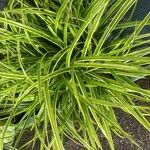
Carex morrowii
Japanese sedge · Morrow sedge · Morrow's sedge
Description
Source: leafsnapCarex morrowii, commonly known as Morrow's sedge, is a perennial, grass-like plant belonging to the Cyperaceae family. Native to Japan, it is widely cultivated as an ornamental plant in gardens and landscapes worldwide. The plant has a clumping growth habit with narrow, arching, glossy green leaves that can grow up to 30 cm long and 1 cm wide. During late spring or early summer, Carex morrowii produces small flowers arranged in spikes on stems that rise above the foliage. While the flowers are not particularly showy, they add an interesting texture to the plant's overall appearance. This sedge prefers moist soil conditions but can tolerate some drought once established. It thrives best in partial shade or full sun with well-draining soil. Several cultivars of Carex morrowii are available, featuring leaf colors such as variegated green-and-white or yellow-and-green stripes. These variations make it a popular choice for adding color contrast to garden beds or borders. Overall, Carex morrowii is an attractive, ornamental, grass-like perennial that adds texture and interest to any garden setting. It is relatively low maintenance once established.
💡 In 1754, Lin Nai established the genus known as "true sedge." This plant is a significant component of China's flora and is the dominant grass species in the lowest layer of many forests. In some areas, true sedge makes up most of the lower vegetation.
Care Guide
💧 Water Every 7 days
Originating from the forests of East Asia, Morrow's sedge thrives in environments with consistent moisture and partial shade. It does best in evenly moist soil, needing to be watered weekly. As an evergreen plant, Morrow's sedge requires regular watering throughout the year. This is particularly important during the colder months when indoor heating reduces humidity levels.
How should I water my Morrow's sedge plant?
Morrow's sedge is commonly grown as a lawn, and watering it properly is important. One option is to use a hose with a spray nozzle, but the best approach is to set up a sprinkler system. For even better results, a sprinkler system with a timer ensures the right amount of water at the right time. It is recommended to use cool or room temperature water and water in the morning. This allows the water to soak into the soil and allows excess moisture to evaporate with the help of sunlight.
What should I do if I give too much or too little water to my Morrow's sedge?
If you accidentally overwater your Morrow's sedge, there are a couple of steps you can take to restore your lawn's health. The first step is to aerate your lawn, which will fix any compacted soils that might be causing water to not drain properly. Additionally, you should consider dethatching your Morrow's sedge in this situation. On the other hand, if you underwater your Morrow's sedge, the solution is different. In these cases, you should allow your lawn to grow a bit longer before mowing it. It's also important to give your Morrow's sedge a bit more water than before.
How often should I water my Morrow's sedge plant?
The frequency of watering your Morrow's sedge depends on where you live, the climate, and the season. In cooler northern regions, water once every 1-2 weeks compared to more frequent watering in southern latitudes, usually once a week. However, if it regularly rains in your area, adjust your watering schedule accordingly. It's important to note that relying on rainfall alone may not be enough to sustain the lawn. In the summer, when Morrow's sedge goes into dormancy, it may still need water to prevent drying out but doesn't require watering for new growth.
How much water does my Morrow's sedge plant need?
Understanding how much to water your Morrow's sedge is fairly simple. Whether you live in a cooler northern region or a warmer southern area, the general rule is to give your Morrow's sedge about one inch of water during each watering session. However, during the peak of summer when the grass goes into a short dormancy period, it's best to provide light but appropriate waterings to protect it from the scorching sun. The amount of water needed will also depend on the size of your Morrow's sedge area. For instance, watering a large area will require more water compared to a small lawn of Morrow's sedge.
How do I know if I'm giving enough water to my Morrow's sedge?
There are clear signs to help you determine if your Morrow's sedge is receiving too much or too little water. Overwatering can be identified by softer blades and the presence of thatch buildup. On the other hand, underwatering can be recognized by brown patches, heat stress resulting in fungus growth and yellowing of blades, and longer preservation of footprints.
☀️ Light Partial sun
Morrow's sedge does best in moderate sunlight, though it can tolerate both reduced light and full sun. In its native range it occurs more beneath tree canopies than in open, sun-drenched areas. Excessive or insufficient sunlight can result in stunted growth or dull coloration.
What are the sunlight requirements for Morrow's sedge?
Morrow's sedge thrives in environments that offer moderate sunlight exposure but can also adapt to both lower light conditions and complete sun exposure. It generally prefers the dappled sunlight found under tree canopies rather than being in open, fully sun-drenched areas. Overexposure to sunlight as well as underexposure might hinder the plant's growth or cause its foliage to have a dull appearance. However, specific sunlight requirements include needing partial sun, which amounts to about 3-6 hours of sunlight daily, and either full shade or full sun situations, which involve less than 3 hours of sunlight. It's beneficial to observe the movement of sunlight in your garden carefully to select the best spots that provide an optimal balance of light and shade for your plants.
What are some common symptoms of inappropriate light exposure in Morrow's sedge, and how can they be addressed?
Morrow's sedge can show various symptoms when grown under inappropriate light conditions. These include smaller new leaves, leggy or sparse growth, faster leaf drop, slower or no new growth, lighter-colored new leaves, chlorosis, sunscald, leaf curling, wilting, and leaf scorching. Addressing these symptoms involves optimizing light conditions. Indoors, you might need to move plants to sunnier spots progressively or use artificial lighting to ensure they receive 3-6 hours of direct sunlight daily. For outdoor plants, it's key to gradually adjust them to sunlight exposure to avoid sunburn. Obstructions blocking sunlight should be minimized, and for small or easily movable plants, consider transplanting them during their dormant period to a better-lit location. If parts of a plant have suffered from light deficiency, those parts may not recover, but new growth should be healthy once lighting conditions improve.
How should artificial lighting be used for indoor Morrow's sedge plants?
When natural sunlight is insufficient, especially during winter or in less sunny spaces, artificial lighting becomes essential for indoor Morrow's sedge plants. To optimally use artificial lighting, select the right type such as LED lights that can be customized to provide specific wavelengths needed by the plants. Full sun plants require 30-50W/sq ft, partial sun plants need 20-30W/sq ft, and full shade plants require 10-20W/sq ft of artificial light. The light source should be positioned about 12-36 inches above the plant to mimic natural sunlight conditions. Also, mimic the natural daylight duration, ensuring most plants receive 8-12 hours of light per day. Adjusting these parameters helps promote healthier and faster growth.
🌡️ Temperature 5–35°C
Morrow's sedge can adjust to a wide range of temperatures, but its distribution may still be restricted by certain combinations of moisture and heat. It grows best in warm summer conditions with sufficient rainfall or watering. Long stretches of cloudy, rainy weather or extended high temperatures can raise the chances of Morrow's sedge dying. In winter, adequate protection from cold can enhance the plant's survival.
💨 Humidity
🪴 Soil 5-6
🌱 Fertilizer
Morrow's sedge is a cool-season grass that grows primarily in spring and fall. It becomes dormant in winter and its growth slows during summer. Applying appropriate fertilizers in spring can add nutrients and encourage vigorous, dense growth. Lawns that are well-fed are greener, more resilient, and better able to resist pests and weeds.
Why should I put fertilizer on my Morrow's sedge?
To ensure Morrow's sedge thrives and becomes thick, it is important to fertilize it. A lawn that is well-nourished and healthy maintains density, stays vibrant and green, recovers from insect or mechanical damage, and can handle seasonal stressors such as heat, drought, and cold temperatures much better. On the other hand, lawns that are under-fertilized and unhealthy gradually lose density, become thin over time, and allow unwanted grasses and weeds to take over. Additionally, malnourished lawns are more susceptible to insect and disease issues.
When should I fertilize my Morrow's sedge for the best results?
Morrow's sedge is a cool-season grass that primarily grows in the spring and fall, when temperatures are moderate. In the cooler winter season, it becomes dormant, and growth may slow down during the hottest part of summer. To provide proper nourishment, it is recommended to fertilize Morrow's sedge considering its growth pattern. This means replenishing nutrients towards the end of each significant growth period, ensuring reserves are filled to support it during summer and winter dormancy.
When is the best time to not add fertilizer to my Morrow's sedge?
Fertilizer can sometimes harm Morrow's sedge instead of helping it, especially when the plant is already stressed. To prevent further weakening of the plant's defenses and vulnerability to pests and diseases, avoid fertilizing if Morrow's sedge is dealing with issues like leaf spot, pythium, large patch, brown patch, fairy rings, grubs, chinch bugs, or armyworms. Additionally, refrain from fertilizing during the winter dormancy or slow growth in summer, and instead wait for active growth. During hot weather, fertilize in the morning or evening to reduce the risk of fertilizer burn. After a rainstorm, allow the soil to dry out for a day or two before applying fertilizer to minimize runoff and the contamination of ground and surface waters.
What kind of fertilizer does my Morrow's sedge plant need?
It's best to use lawn or turf fertilizers specifically made for Morrow's sedge instead of general garden fertilizers with a 12-12-12 blend. Turf blends have more nitrogen, less phosphorus and potassium, which give the lawn the needed nutrients without causing harm. Lawn fertilizers also have nutrients that are slowly released, providing consistent feeding over time. Nitrogen is the most important nutrient for established lawns as it promotes growth and color. Phosphorus and potassium are needed by Morrow's sedge for strong stems and roots, resistance to drought and extreme temperatures, and protection against pests and diseases.
How can I fertilize my Morrow's sedge plant?
To ensure healthy growth of Morrow's sedge, it is important to apply fertilizer at two key times during the year when the grass is actively growing. Spring and fall are the main growth periods for this cool-season grass, with slower growth during hot summer months. To support its growth, it is recommended to fertilize in late spring and fall before winter dormancy. Spring fertilization helps replenish nutrients the grass has utilized during spring growth, and also provides sufficient food to sustain it in case growth is slowed by heat. Fall fertilization, on the other hand, helps the grass recover from summer stress and prepares it for winter by storing reserves in the roots. For the fall application, it is advisable to do it approximately six weeks before the expected first frost. When applying fertilizer, always adhere to the recommended rates mentioned on the label or based on soil test recommendations. Additionally, make sure to water the product into the soil well after fertilizing.
🪴 Pot & Repot 2-3 years
When repotting Morrow's sedge, select a pot 1-2 inches (2.5–5.1 cm) larger with good drainage. Use a well-draining potting mix. Repot in spring or fall, making sure the root ball is slightly lower than the rim of the flower pot. Water thoroughly after repotting and place it in a warm spot with indirect sunlight.
✂️ Pruning
Morrow's sedge boasts beautiful variegated foliage, making it an excellent choice for landscaping. To encourage growth and maintain its appearance, prune the plant in early spring. Trim away old foliage to enhance its density and overall health. Always use clean tools when pruning to reduce stress on the plant, improve air circulation, and minimize the risk of fungal infections.
🌿 Propagating
🐛 Diseases & pets
☠️ Toxicity
Characteristics
- Plant Type
- Grass
- Life Cycle
- Perennial, Annual
- Genus
- Carex
- Family
- Cyperaceae
- Hardiness Zone
- 5-9
- Mature Height
- 30 cm to 46 cm
- Mature Spread
- 30 cm to 46 cm
- Leaf Color
- Green, White
- Leaf Type
- Evergreen
- Flower Color
- Yellow, Green, Brown, Cream
- Bloom Time
- Early spring, Mid spring
- Planting Time
- Spring, Autumn
- Harvest Time
- Late spring, Early summer
- Native Area
- Japan