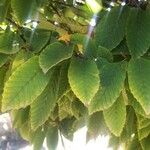
Carpinus japonica
Japanese hornbeam
Description
Source: leafsnapCarpinus japonica, the Japanese hornbeam, is a hornbeam endemic to Japan but cultivated elsewhere as an ornamental.It is a deciduous tree growing to 12–15 metres (39–49 ft) tall with leaves that are longer and darker than the European hornbeam (Carpinus betulus). The leaves are dark, glossy and slender, with 20-24 pairs of parallel sunken veins; every third tooth is whisker-tipped. The prominent catkins are green turning to brown.This tree has gained the Royal Horticultural Society's Award of Garden Merit.
Care Guide
💧 Water
The Japanese hornbeam thrives in balanced water conditions and prefers consistent moisture, needing to be watered every one to two weeks. Being a deciduous tree, it enters a dormant period in the winter, during which its water needs decrease significantly.
☀️ Light Partial sun
Japanese hornbeam naturally occurs in places like forest understories or rocky sites, where it grows in natural shade. It favors partial sun but can adapt to both full sun and full shade, demonstrating its versatility and hardiness.
🌡️ Temperature 5–32.2°C
Japanese hornbeam shows strong adaptability to a range of climate conditions, from hot summers to cold winters. However, it still has an ideal temperature range for growth. If temperatures become too high, the plant can suffer heat and humidity stress, which may kill it. In areas where temperatures approach the lower end of its cold tolerance, insulating the plant is important to protect it.
💨 Humidity
🪴 Soil 6-7
🌱 Fertilizer
Fertilize your Japanese hornbeam in early spring to encourage healthy growth. Regular fertilization boosts overall health, producing vigorous growth, greater tolerance of difficult conditions, and improved resistance to pests and diseases. Keep a consistent fertilization schedule for your Japanese hornbeam to maintain vibrant foliage with deep color and a lush appearance.
🪴 Pot & Repot
✂️ Pruning
The Japanese hornbeam is a deciduous tree known for its delicate foliage and graceful shape. To maintain its health and appearance, it is best to prune the tree in early spring. During pruning, remove any dead or crossing branches and thin out dense areas to enhance air circulation. Light, regular trimming helps develop a strong structure and enhances its ornamental appeal.
🌿 Propagating
🐛 Diseases & pets
☠️ Toxicity
Characteristics
- Plant Type
- Tree
- Life Cycle
- Perennial
- Genus
- Carpinus
- Family
- Betulaceae
- Hardiness Zone
- 5-8
- Mature Height
- 6.1 m to 9.14 m
- Mature Spread
- 3.66 m to 4.57 m
- Leaf Color
- Yellow, Green
- Leaf Type
- Deciduous
- Flower Color
- Tan
- Flower Size
- 2.03 cm to 3.05 cm
- Bloom Time
- Mid spring, Late spring
- Planting Time
- Spring, Summer
- Harvest Time
- Late summer, Early fall, Mid fall
- Native Area
- Japan