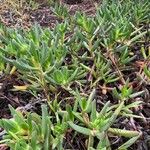
Carpobrotus glaucescens
Pigface · Angular Sea-fig · Angular Pigface · Coastal Pigface
Description
Source: leafsnapCarpobrotus glaucescens, commonly known as the sea fig or pigface, is a succulent plant native to the coastal regions of Australia. This low-growing plant forms dense mats and features fleshy, triangular leaves that are bluish-green. Its large and showy flowers, appearing in shades of pink or purple, bloom during the summer months. The plant's fruit is edible and resembles a fig, giving rise to its common name "sea fig." Carpobrotus glaucescens is often used for erosion control due to its extensive root system, which helps stabilize soil. Additionally, it has medicinal properties; compounds within the plant have been shown to have anti-inflammatory effects on the skin. However, the plant can be invasive in some areas outside of Australia, where it has been introduced either as an ornamental plant or for erosion control purposes.
Care Guide
💧 Water Every 7 days
The angular sea-fig, native to coastal areas, thrives in saline environments with minimal water, demonstrating a high tolerance for drought. To maintain leaf moisture, it needs watering every 2-3 weeks. Its ability to store water makes it an ideal choice for xeriscaping in seaside gardens.
☀️ Light Full sun
Originating in arid areas, the Angular sea-fig performs best in full sun, as its native habitat has strong sunlight and very little shade. It can also tolerate partial sun, giving it some flexibility in growth.
🌡️ Temperature 20–37.8°C
Angular sea-fig prefers warm conditions and requires relatively high temperatures during the growing season to support growth and metabolism. It likes abundant sunlight, suitable moisture levels, and good air circulation. It can be harmed by excessively low temperatures and by overwatering. Maintaining balance is important; excessively high temperatures and overly dry conditions should also be avoided.
What are the essentials for growing Angular sea-fig?
The Angular sea-fig, or Carpobrotus glaucescens, thrives best in warm environments, requiring higher temperatures during its growing season to promote growth and metabolism. It enjoys ample sunlight, appropriate moisture levels, and good ventilation. Special attention should be given to avoid excessively low temperatures, as it is susceptible to damage under such conditions. Equally, overwatering and excessively high temperatures should be avoided to prevent issues such as root rot and inhibited growth. During the winter, when the outdoor temperature drops below -5°C, it is advisable to move the plant indoors, ideally near a south-facing window, to ensure it receives as much sunlight as possible. In cases of insufficient natural light, supplementary lighting can be considered. Also, when temperatures fall below 15°C, the plant's growth slows, and watering should be reduced or stopped to prevent root damage. For those grown outdoors, watering should cease altogether in low temperatures, and measures like temporary greenhouses or wrapping the plant in protective materials can be taken.
What are the symptoms and solutions of low temperature effects on Angular sea-fig?
Angular sea-fig shows preference for high temperatures, thriving when the temperature is above 15°C, and needs to be kept above -5°C during winter. Exposure to temperatures below -10°C could result in the plant becoming weak, wilting, and prone to root rot. Mild frost damage may not show immediate symptoms, but within a week, the plant may gradually wither. The recommended solution in such cases includes trimming off the frostbitten areas and examining the roots for rot. If root rot is detected, the affected parts should be cut off, and the plant can be propagated through cuttings. To recover, the plant should be moved indoors to a warm environment near a south-facing window to maximize sunlight exposure. If sunlight is insufficient, supplemental lighting can be used to aid recovery.
How should high temperature effects on Angular sea-fig be handled?
In the summer, when temperatures rise, it’s important to ensure that Angular sea-fig is kept below 38°C to prevent stress on the plant. Should temperatures exceed 43°C, the plant will stop growing, lose water, wilt, and become more susceptible to sunburn. To manage sun damage, remove any sunburned or rotten parts of the plant. Protect the plant from the harsh afternoon sun until it shows signs of recovery and resumes growth. If root rot is present, watering should be ceased until new roots develop, marking the beginning of the recovery process.
💨 Humidity
🪴 Soil 0-0
🌱 Fertilizer
For Angular sea-fig, light applications of fertilizer once or twice a year during the growing season are enough. Do not fertilize in winter and summer when it is dormant. Use less fertilizer for plants that have been repotted and wait a couple of months after repotting before feeding. Fertilizing promotes healthy growth and encourages flowering.
🪴 Pot & Repot Every 2 years
Repot the angular sea-fig every two years to support its growth as a resilient ground cover. The best time for repotting is in the spring. Use larger containers to provide ample space for the roots, and make sure they have good drainage. Choose well-draining soil and provide moderate water to aid in recovery. The angular sea-fig is a low-maintenance plant that is also visually appealing.
✂️ Pruning
To maintain the shape of an angular sea-fig, it's recommended to prune during the spring and autumn by removing any redundant or dense branches. For propagation, cut leaves or stems that have 5-6 leaves, treat the cut wounds with sulfur powder, and allow them to heal before planting. Make sure the soil is slightly moist when inserting the cuttings.
🌿 Propagating
🐛 Diseases & pets
☠️ Toxicity
Characteristics
- Plant Type
- Succulent
- Life Cycle
- Perennial
- Genus
- Carpobrotus
- Family
- Aizoaceae
- Hardiness Zone
- 9-11
- Mature Height
- 20 cm
- Mature Spread
- 6.1 m
- Leaf Color
- Light Green, Medium Sea Green
- Leaf Type
- Evergreen
- Flower Size
- 6.35 cm to 7.62 cm
- Bloom Time
- Mid spring, Late spring, Early summer, Mid summer
- Planting Time
- Spring, Summer, Autumn
- Harvest Time
- Summer, Early fall
- Native Area
- New Zealand