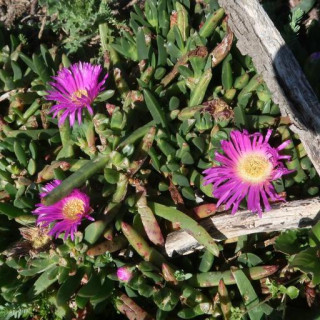
Carpobrotus rossii
Beach bananas · Karkalla · Pig face
Description
Source: leafsnapCarpobrotus rossii is a succulent coastal groundcover plant native to southern Australia. It is known by various common names, including karkalla, pig face, sea fig and beach bananas.C.rossii can be confused with rounded noon-flower Disphyma crassifolium subsp. clavellatum, which has also been erroneously called "karkalla" and "beach bananas" in the Australian native food trade.
Care Guide
💧 Water
☀️ Light Full sun
Native to arid areas, the Australian pig face flourishes in full sun, its native habitat marked by intense sunlight and very little shade. It can also tolerate partial sun, giving it some flexibility in how it grows.
🌡️ Temperature 15–37.8°C
Australian pig face does well in warm conditions and requires higher temperatures during the growing season to support its growth and metabolism. It prefers abundant sunlight, proper moisture levels, and good airflow. However, it can be damaged by temperatures that are too low and by overwatering. It is also important to maintain balance and avoid excessively high heat and overly dry conditions.
💨 Humidity
🪴 Soil 0-0
🌱 Fertilizer
Australian pig face only needs light fertilizer applications once or twice a year during the growing season. Do not fertilize in winter or summer when it is dormant. Cut back on fertilizer for repotted plants and wait a couple of months after repotting before you feed them. Fertilizing helps maintain healthy growth and promotes flowering.
🪴 Pot & Repot
✂️ Pruning
🌿 Propagating
🐛 Diseases & pets
☠️ Toxicity
Characteristics
- Plant Type
- Succulent
- Life Cycle
- Perennial
- Genus
- Carpobrotus
- Family
- Aizoaceae
- Hardiness Zone
- 8-11
- Mature Height
- 40 cm
- Mature Spread
- 3.05 m
- Leaf Color
- Green
- Leaf Type
- Evergreen
- Flower Color
- Pink, Purple
- Flower Size
- 6.35 cm to 7.62 cm
- Bloom Time
- Mid spring, Late spring, Early summer
- Planting Time
- Spring, Summer, Autumn
- Harvest Time
- Summer