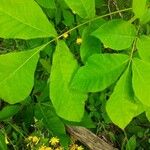
Carya laciniosa
Kingnut · Shellbark hickory · Big shagbark hickory · Big shellbark hickory
Description
Source: leafsnapCarya laciniosa, the shellbark hickory, in the Juglandaceae or walnut family is also called kingnut, big, bottom, thick, or western shellbark, attesting to some of its characteristics. It is a slow-growing, long-lived tree, hard to transplant because of its long taproot, and subject to insect damage. The nuts, largest of all hickory nuts, are sweet and edible. Wildlife and people harvest most of them; those remaining produce seedling trees readily. The wood is hard, heavy, strong, and very flexible, making it a favored wood for tool handles. A specimen tree has been reported in Missouri with 117 cm (46 in) diameter at breast height, 36.9 m (121 ft 1 in) tall, and a spread of 22.6 m (74 ft 2 in).
Care Guide
💧 Water Every 1-2 weeks
The Shellbark hickory is a drought-tolerant tree that thrives with moderate moisture levels, as long as it's not waterlogged. For optimal health, it's best to water it every 1-2 weeks. Be cautious about overwatering, particularly during its dormant period in colder seasons when the tree takes up less water. Due to these needs, the Shellbark hickory is best suited for outdoor growth.
☀️ Light Full sun
Shellbark hickory comes from open habitats, such as sunny meadows and forest edges, that provide abundant light. It does best in full sun but will also tolerate partial sun, adapting well to different sunlight conditions.
What are the sunlight requirements for Shellbark Hickory?
Shellbark Hickory thrives in environments with ample sunlight, ideally thriving in Full Sun (above 6 hours of sunlight) but can also tolerate Partial Sun (about 3-6 hours of sunlight). It's important to observe the movement of sunlight in your garden to ensure the plants are positioned in spots that provide an optimal balance of light and shade, conducive to their growth and well-being. This species is naturally suited to open environments like sunny meadows and forest edges, indicating its preference for significant amounts of light to grow healthily.
How can artificial lighting be used for indoor Shellbark Hickory plants?
For indoor Shellbark Hickory plants or any plant that isn't receiving sufficient natural sunlight, especially during winter or in less sunny spaces, artificial lighting becomes an essential alternative. Using artificial lighting such as LED lights, which can be tailored to provide specific wavelengths required by plants, helps in promoting healthier and faster growth. Full sun plants need between 30-50W/sq ft, partial sun plants require 20-30W/sq ft, and full shade plants benefit from 10-20W/sq ft of artificial light. The light source should be placed 12-36 inches above the plant, simulating natural sunlight conditions, and be kept on for 8-12 hours per day to mimic the natural daylight hours needed by the plant species.
What are the symptoms of insufficient light in Shellbark Hickory?
Shellbark Hickory may exhibit various symptoms indicating insufficient light when grown indoors or in suboptimal outdoor lighting conditions, such as smaller new leaves, leggy or sparse growth, faster leaf drop, slower or halted growth, lighter-colored new leaves, chlorosis, sunscald, leaf curling, wilting, and leaf scorching. These symptoms reflect the plant's struggle with inadequate sunlight, impacting its growth, color, and overall health negatively.
What solutions are recommended for Shellbark Hickory experiencing light deficiency?
To address light deficiency in Shellbark Hickory, consider the following solutions based on the plant's location: Indoor plants can be gradually moved to sunnier spots weekly until they receive at least 6 hours of direct sunlight daily. Utilizing a south-facing window and keeping curtains open during the day maximizes sunlight exposure. If moving the plant isn't feasible, artificial lighting such as desk or ceiling lamps, or professional grow lights can be used for at least 8 hours daily. For outdoor plants, it's crucial to gradually increase their exposure to sunlight to prevent sunburn, moving them progressively to sunnier locations. Additionally, identifying and reducing obstructions like overhanging branches can help, and for smaller plants, consider transplanting during their dormant period to a location with better sunlight and drainage. Note that parts of the plant already affected by insufficient sunlight may not recover, but new growth following improved light exposure should be healthy.
🌡️ Temperature 5–35°C
Shellbark hickory shows strong adaptability to a variety of climates, whether in very hot summers or cold winters. Still, it has a preferred temperature range for growth. If temperatures become too high, the plant is vulnerable to heat and humidity stress, which can cause it to die. In areas where temperatures approach the lower limit of its cold tolerance, it is important to provide insulation to protect the plant.
💨 Humidity
🪴 Soil 6-8
🌱 Fertilizer
Fertilize your Shellbark hickory in early spring to encourage healthy growth. Consistent feeding boosts overall health, leading to vigorous growth, increased tolerance of challenging conditions, and enhanced resistance to diseases and pests. Keep to a defined fertilization schedule for your Shellbark hickory to maintain foliage that is vibrant, deeply colored, and lush in appearance.
🪴 Pot & Repot
✂️ Pruning
To prune a shellbark hickory, begin in early spring. Focus on removing dead branches and thinning out crowded areas while preserving the tree's natural shape. Make sure to use sharp, clean tools to prevent disease. This practice enhances air circulation and sunlight penetration, stimulating vigorous growth and ensuring the hickory's health and appearance.
🌿 Propagating
🐛 Diseases & pets
☠️ Toxicity
Characteristics
- Plant Type
- Tree
- Life Cycle
- Perennial
- Genus
- Carya
- Family
- Juglandaceae
- Hardiness Zone
- 5-9
- Mature Height
- 12.19 m to 30.48 m
- Mature Spread
- 11.89 m to 17.98 m
- Leaf Color
- Green, Yellow, Brown
- Leaf Type
- Deciduous
- Flower Color
- Yellow, Green, Gold
- Flower Size
- 2.54 cm to 7.62 cm
- Bloom Time
- Mid spring, Late spring
- Planting Time
- Spring
- Harvest Time
- Late summer, Early fall, Mid fall