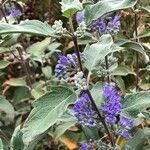
Caryopteris x clandonensis
Blue mist spirea · Blue beard · Blue mist · Blue-mist shrub · Blue spirea
Description
Source: leafsnapCaryopteris x clandonensis, often known as blue beard or blue mist, is one of the rare plants that produces truly blue flowers. It was bred to generate several famous cultivars after an accidental cross of C. incana and C. mongholica1. Blue beard plants are a fantastic choice for any size garden because of their compact size and soft gray foliage. These plants are planted as deciduous shrubs or woody perennials that die back to the ground each winter, depending on the climate. The tiny silvery-gray leaves, which grow in compact little mounds, resemble willow leaves.
Care Guide
💧 Water 1-2 times a week
Drought-tolerant blue beard plants, but water them often when they're young. They don't require any additional watering once planted. Water the plant only during long dry periods when the soil is nearly dry.
☀️ Light
🌡️ Temperature
In USDA zones 6b to 9a, the blue beard is reliably hardy; but, in the northern portion of the range (zone 6), it may die back to ground level in the winter. This isn't a problem because this is a fast-growing shrub that blooms on current-year growth.
💨 Humidity
🪴 Soil
🌱 Fertilizer
Because these plants aren't heavy eaters, a few organic materials placed into the planting hole should suffice. Chemical fertilizers are favored over side dressings with compost for Blue mist plants. An overabundance of fertilizer results in a green plant with fewer blooms.
🪴 Pot & Repot
✂️ Pruning
Blue mist plants should be cut down by at least half in the early spring to maintain them shaped and blossoming. You can safely cut them back to 12 to 18 inches. You'll notice some dead wood in the core of the plant as it becomes older. As needed, prune this out.
🌿 Propagating
🐛 Diseases & pets
☠️ Toxicity
Characteristics
- Plant Type
- Deciduous shrub or woody perennial
- Genus
- Caryopteris
- Family
- Lamiaceae
- Hardiness Zone
- 5-9
- Bloom Time
- Mid-to-late summer
- Native Area
- Parent species are native to East Asia