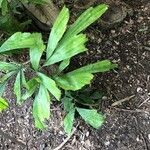
Caryota mitis
Fishtail palm · Tufted fishtail palm · Burmese fishtail palm · Clustered fishtail palm · Clustering fishtail palm
Description
Source: leafsnapCaryota mitis, commonly known as the fishtail palm or clustering fishtail palm, is a tropical plant native to Southeast Asia and the Pacific Islands. As a member of the Arecaceae family, it can grow up to 20 feet tall with a spread of 10-15 feet. The plant is named for its distinct leaves, which resemble fish tails. These pinnate leaves feature numerous leaflets that grow in clusters along the stem. The fishtail palm is an excellent choice for both indoor and outdoor settings in tropical and subtropical regions, as it thrives in warm temperatures and high humidity levels. It prefers well-draining soil rich in organic matter and requires regular watering. In addition to its ornamental value, Caryota mitis produces small yellow flowers on long inflorescences, followed by small black fruits. While these fruits are edible, they are not commonly consumed by humans. Beyond its decorative appeal, Caryota mitis has traditional medicinal applications in Southeast Asia. It is used to treat various ailments such as fevers, coughs, headaches, and skin diseases. Overall, Caryota mitis is an attractive ornamental plant with unique foliage, making it suitable for cultivation in warm climates both indoors and outdoors.
🌳 Burmese fishtail palm has distinctive traits that make it a popular choice for ornamental landscaping in tropical and subtropical regions. Beyond its aesthetic appeal, the Burmese fishtail palm is noted for its hardy wood, which is used to make small furniture and crafts. However, the Burmese fishtail palm is not commonly used for extracting essential oils, spices, pigments, or sweeteners because its sap and fruit can be potentially irritating.
Care Guide
💧 Water Every 7 days
The Burmese fishtail palm thrives in consistently moist soil, reflecting its tropical rainforest origins. Ideally, it should be watered every two weeks, taking care to prevent waterlogging. To maintain the necessary humidity, especially during its active growing season, regularly misting the plant is beneficial. This helps support the palm's optimal health as an ornamental indoor plant.
What is the most effective way to give water to my Burmese fishtail palm?
When it comes to watering your Burmese fishtail palm, you have several options. You can use watering cans, hoses, or even cups – any common watering tool will do. Regardless of what you use, make sure to apply the water directly to the soil. It's important to moisten all areas of the soil evenly to provide water to all parts of the root system. Using filtered water is a good idea because tap water may contain harmful particles. Also, it's best to use water that is at or slightly above room temperature, avoiding water that is too cold or too hot, as this may shock the plant. However, the Burmese fishtail palm is generally tolerant of different types of water.
What do I need to do if I give my Burmese fishtail palm too much or too little water?
When it comes to outdoor plants, especially newly planted ones or seedlings, they are prone to not getting enough water. It's important to remember to continue watering them regularly for a few months while the tree is still small or newly planted. Once the roots are established, the Burmese fishtail palm can typically rely on rain for hydration. However, if you have planted the palm in a pot, overwatering becomes a greater risk. If you accidentally overwater your Burmese fishtail palm, it's crucial to take immediate action to address the issue. First, stop watering your plant right away to minimize the negative effects of overwatering. Then, remove the palm from its pot to inspect its roots. If you find that none of the roots have developed root rot, you can safely return the plant to its container. On the other hand, if you notice signs of root rot, you should trim away any affected roots and use a fungicide to prevent further damage. Finally, make sure to repot your Burmese fishtail palm in well-draining soil. If you have underwatered your Burmese fishtail palm, it's a relatively easy problem to fix. When a palm is underwatered, its leaves will droop, dry out, and eventually fall off. However, once you provide sufficient watering, the leaves will quickly regain their fullness. Therefore, it's important to adjust your watering frequency promptly if you notice signs of underwatering.
How often do I need to water my Burmese fishtail palm?
To give your outdoor plants the proper care, consider their water needs based on the season. Most outdoor plants can thrive with natural rainfall. However, if your area lacks rainfall, make sure to provide adequate watering every 2 weeks in the spring and fall, and more frequently in the summer. In the winter, when growth slows down and water needs decrease, water sparingly or not at all. For young or newly planted Burmese fishtail palms, more frequent watering is recommended to help them establish and become more adaptable to drought. When it comes to potted plants, there are two main ways to determine watering frequency for your Burmese fishtail palm. One approach is to follow a set watering schedule, such as once a week or once every other week. However, this method may not take into account the specific conditions of your plant's environment. Another option is to gauge watering based on soil moisture. Generally, it is best to wait until the top two to four inches of soil have completely dried out before watering again. Keep in mind that during summer, when water needs are higher, a fixed watering schedule may not be sufficient.
How much water does my Burmese fishtail palm tree need?
When watering your Burmese fishtail palm, it's important to note that it doesn't always require a large amount of water. If only a few inches of soil have dried since the last watering, giving the plant about five to ten ounces of water will support its healthy growth. You can also gauge the water volume by checking the soil moisture. Pay attention to how many inches of soil have dried out between waterings. To ensure the palm gets the right amount of moisture, water enough to moisten all the dry soil layers. If over half of the soil has dried out, consider giving more water than usual until you see it draining from the pot's holes. If your palm is situated in an area that receives ample outdoor rain, it may not need additional watering. However, when the palm is young or establishing itself, it should receive 1-2 inches of rain per week. As it grows and establishes further, it can rely solely on rainwater. Only when there is no rainfall for 2-3 weeks during hot weather, should you consider providing a full watering to prevent stress on the palm.
How do I know if I'm giving enough water to my Burmese fishtail palm?
The Burmese fishtail palm is more likely to be overwatered, and there are clear signs to watch out for. If it's overwatered, the leaves will turn yellow and may fall off. Additionally, the plant may become shriveled and develop root rot. On the other hand, if it's underwatered, the palm will start to wilt and the leaves may turn brown and brittle. Regardless of whether you see signs of overwatering or underwatering, you should take action to revive your Burmese fishtail palm.
☀️ Light Full sun
The Burmese fishtail palm performs best with abundant sunlight and comes from habitats where sunlight is plentiful. It can tolerate moderate shade but may show stress if light is insufficient or overly intense. For optimal health, its light requirements can shift slightly during different growth stages.
What are the sun requirements for Burmese Fishtail Palm?
The Burmese Fishtail Palm thrives in locations that receive full sun, defined as above 6 hours of sunlight daily, but it can also tolerate partial sun, which amounts to about 3-6 hours of sunlight. It's important to observe how sunlight moves through your garden, selecting areas that provide an ideal balance of light and shade to ensure the well-being of your plants.
What are the essentials for the growth of Burmese Fishtail Palm?
Thriving best in areas with abundant solar exposure, the Burmese Fishtail Palm originates from environments with profuse sunlight. It's adaptable to moderate light but shows signs of stress when lighting conditions are either too low or too intense. To maintain optimal health, the plant's sunlight needs may slightly change during its different growth phases. Indoor plants, especially, require adequate lighting for optimal growth, with artificial lights being crucial in less sunny spaces or during winter, ensuring faster, healthier plant development.
What symptoms indicate insufficient light for Burmese Fishtail Palm?
Symptoms of insufficient light in Burmese Fishtail Palm include smaller new leaves, leggy or sparse growth, faster leaf drop, delayed or halted growth, lighter-colored new leaves, chlorosis (leaves turning yellow due to loss of chlorophyll), sunscald, leaf curling, wilting, and leaf scorching. These signs show the plant's struggle with inadequate sunlight, which can significantly affect its health and appearance.
How can I manage sunlight issues for Burmese Fishtail Palm?
To manage sunlight issues for the Burmese Fishtail Palm, gradually introduce the plant to more sunlight by moving it each week until it receives at least 6 hours of direct sunlight daily, especially if indoor. Utilize a south-facing window to ensure maximal light exposure. If the plant is too large or not easily movable, consider using artificial light to supplement its light intake. For outdoor plants, similarly, increase sunlight exposure gradually to avoid sunburn. If sunlight is obstructed, consider pruning obstructive branches or, for smaller plants, transplanting to a sunnier location with good drainage, preferably during the plant's dormant period.
🌡️ Temperature 20–37.8°C
Burmese fishtail palm is native to regions with moderate to hot temperatures. It generally grows best at temperatures between 68 and 100 °F (20 to 38 ℃). In non-native climates, seasonal adjustments may be needed to keep it within that optimal temperature range.
What is the ideal temperature range for Burmese fishtail palm?
The Burmese fishtail palm, scientifically known as Caryota mitis, thrives in environments with moderate to hot temperatures, ideally between 68 to 100°F (20 to 38°C). To ensure the palm's health, seasonal adjustments might be necessary in non-native climates to maintain this optimal temperature range. The palm is extremely heat-loving, and exposure to cold temperatures can be harmful. During autumn, it's advised to bring outdoor plants indoors, placing them near a bright window yet away from heaters to maintain temperatures above 20°C. Special care should be taken during winter to keep the temperature from approaching freezing, as temperatures near 0°C can be detrimental to the plant.
How do I care for my Burmese fishtail palm during low temperatures?
The Burmese fishtail palm is sensitive to cold and thrives best in temperatures above 20°C, requiring special care during winter to remain above 0°C. If temperatures fall below -5°C, the palm's leaves may lighten in color, eventually turning brown or black with signs of wilting and drooping after frost damage. To care for the plant in low temperatures, you should trim off the frost-damaged parts and move the plant to a warmer, indoor environment immediately for protection against the cold. Positioning the plant near a south-facing window ensures ample sunlight, while avoiding placement near heaters or air conditioning vents helps prevent excessive dryness in the air.
What should I do if my Burmese fishtail palm experiences high temperatures?
During the summer, it's essential to keep the Burmese fishtail palm below 38°C. Exposure to temperatures above 43°C can lead to lighter leaf colors and increase the risk of sunburn for the plant. If you notice signs of sunburn or dried-up parts due to high temperatures, trim these areas away. Relocate the plant to a spot that offers shade during the intense midday and afternoon sun. Watering the plant in the morning and evening is also crucial to maintain moist soil, helping the plant manage better in high-temperature conditions.
💨 Humidity
🪴 Soil 6-7
🌱 Fertilizer
The best time to feed a Burmese fishtail palm is in early spring, when it comes out of dormancy. This encourages overall growth and flower development. Fertilizing boosts the leaves, stems, and branches, and supports the production of large, bright, long-lasting flowers. It helps move nutrients from the roots to the flowers and enhances the plant’s health and resistance to disease.
Why should I add fertilizer to my Burmese fishtail palm?
Regular fertilization is necessary for Burmese fishtail palms because they have beautiful leaves that require a lot of energy to grow and maintain. However, they also need energy for the growth of their stems, branches, roots, and other important structures. Neglecting fertilization can lead to two likely outcomes. Firstly, the leaves may lose their natural color and texture, giving the palm an unhealthy appearance and reducing its ornamental appeal. Secondly, the palm's overall growth may slow down or produce weak growth that is susceptible to breakage.
When should I put fertilizer on my Burmese fishtail palm?
The Burmese fishtail palm does not require a set feeding schedule, but occasional feedings are beneficial. One simple way to fertilize this plant is to apply fertilizer while watering it at times. During the growing season, the palm needs a good amount of water and can be fed once every two to three weeks. This feeding frequency should be maintained as long as the plant is producing new growth.
When is it better not to fertilize my Burmese fishtail palm?
For most of the year, you can fertilize your Burmese fishtail palm regularly. This should be done during the active growing season in spring, summer, and early fall. However, during winter, it is important to refrain from fertilizing the plant. This is because the Burmese fishtail palm enters a dormant growth phase during this time. In this phase, the plant does not produce much or any new growth. Since the plant is not actively growing, it requires less energy, and therefore, does not need fertilization.
What kind of fertilizer does my Burmese fishtail palm require?
To ensure proper nutrition for a Burmese fishtail palm, the fertilizer needs to contain a specific blend of nutrients. This blend should have a balanced N-P-K ratio of 3-1-2, although a general-purpose fertilizer with an even blend can also work well. When using a balanced fertilizer, it is important to make sure that the volume of each nutrient is at 3 or lower. The fertilizer can be either granular or liquid-based, but if you choose to use a liquid-based one, it is recommended to dilute it by half. Granular fertilizer has no major downsides, but using liquid fertilizer, particularly when watering the palm, is often the most practical approach.
How should I fertilize my Burmese fishtail palm?
To easily fertilize a Burmese fishtail palm, you have a couple of options. One way is to feed it while watering. To do this, gather fertilizer and a water container, like a watering can. Mix the fertilizer with water to dilute it, and then pour this mixture onto the soil, allowing it to reach the roots. Another option is to use granular fertilizer. Sprinkle some of this fertilizer onto the palm's soil. Granular fertilizers are slow-release and don't require frequent application like liquid fertilizers. Whichever method you choose, remember to water the palm while fertilizing for added benefits.
🪴 Pot & Repot 1-2 years
Repot your Burmese fishtail palm every 1-2 years during the spring to support its growth. Select a pot that is just one size larger to help maintain the plant's shape. After repotting, make sure there is good drainage and place the plant in a location with bright, indirect light. This will aid in its recovery and promote the healthy development of its characteristic fishtail-like leaflets.
✂️ Pruning
To ensure your Burmese fishtail palm thrives, it's best to prune it in early spring, focusing on removing dead or damaged fronds. This practice encourages new growth and helps reduce pest problems. Be careful not to over-prune, as this can stress the plant. By targeting older, browning fronds, you can enhance the vibrancy of the foliage, supporting the palm's natural growth cycle for optimal health and appearance.
🌿 Propagating
🐛 Diseases & pets
☠️ Toxicity
Fishtail palm trees contain calcium oxalate crystals, needle-like crystals that can injure when ingested or touched. You might experience itching, a burning sensation, and dermatitis upon contact. If you eat it, you may experience that same burning sensation in your mouth and throat.
Characteristics
- Plant Type
- Tree
- Life Cycle
- Perennial
- Genus
- Caryota
- Family
- Arecaceae
- Hardiness Zone
- 9-11
- Mature Height
- 3.05 m to 6.1 m
- Mature Spread
- 3.05 m to 3.66 m
- Leaf Color
- Green
- Leaf Type
- Evergreen
- Flower Color
- Purple
- Flower Size
- 1.02 cm to 2.03 cm
- Bloom Time
- Early summer, Mid summer
- Planting Time
- Spring, Autumn
- Harvest Time
- All year round
- Native Area
- Malaysia, Indonesia, Cambodia, Vietnam, Myanmar, Philippines, Singapore, Laos, Brunei, Thailand, China