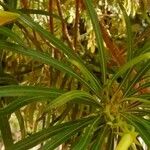
Cascabela thevetia
فندق خوشبختی · خرزهره زرد يا شيناس · Luckynut · Kaner · Yellow Oleander
Description
Source: leafsnapCascabela thevetia, commonly known as yellow oleander or lucky nut, is a small evergreen tree or shrub that belongs to the Apocynaceae family. It is native to the tropical and subtropical regions of Central and South America but has been widely cultivated in various parts of the world for its ornamental value. The plant can grow up to 6 meters tall and features a dense crown with glossy green, lance-shaped leaves. Its trumpet-shaped flowers, composed of five petals, range in color from yellow to orange. The fruit takes the form of a woody capsule that contains numerous seeds. Cascabela thevetia contains toxic cardiac glycosides, which can cause serious health problems if ingested by humans or animals. Nonetheless, these same compounds have been used in traditional medicine for centuries due to their medicinal properties. Apart from its medicinal uses, Cascabela thevetia is also prized as an ornamental plant for its attractive flowers and foliage. It thrives in full sun but can tolerate partial shade and prefers well-drained soil. Overall, Cascabela thevetia is a fascinating plant with both toxic properties and potential health benefits when used properly under medical supervision.
🌳 Yellow oleander is a popular tree valued for its slender leaves and vibrant yellow flowers. It is often used as an ornamental garden plant in temperate climates or as a natural privacy hedge when planted closely together. You can combine it with other species in the same genus to create contrasting heights and colors, or pair it with plants like crotons, firebush, and plumbago for an attractive display.
🎭 Mind made supramental
Care Guide
💧 Water Every 7 days
Yellow oleander, which originates from tropical regions, thrives in well-draining soil and moderate humidity. Water the plant every 1-2 weeks, allowing the soil to dry slightly between waterings. In warmer climates, it can be grown outdoors. Applying mulch helps retain moisture during hot weather and protects the health of the roots.
☀️ Light Full sun
The yellow oleander grows best when it receives plenty of light for most of the day, which promotes its healthy growth and development. While it can survive in areas with less light, it performs best when exposed to ample light. Both too much and too little light can adversely affect the plant's overall health and vigor.
What are the sunlight requirements for yellow oleander?
Yellow oleander requires full sun, which means it should receive more than 6 hours of sunlight daily for optimal growth. It can also tolerate partial sun, where it gets about 3-6 hours of sunlight. It's crucial to watch how sunlight moves through your garden to find spots that offer the right balance of light and shade, ensuring the plant's well-being.
How essential is light for the growth of yellow oleander?
Light is extremely essential for the growth and development of yellow oleander. The plant thrives best under abundant light for most of the day, contributing significantly to its health. While it can survive with less light, generous light exposure is necessary for its wellbeing. Both an excess and a deficit of light can adversely affect the plant's vitality.
Can artificial lighting be used for yellow oleander, and how?
Yes, artificial lighting can be a vital solution for indoor yellow oleander plants, especially when natural sunlight is insufficient, like in winter or less sunny spaces. LED lights are recommended because they can provide specific wavelengths needed by the plants. Full sun plants require 30-50W/sq ft, partial sun plants need 20-30W/sq ft, and full shade plants require 10-20W/sq ft of artificial light. The light source should be placed 12-36 inches above the plant to mimic natural sunlight, and most plants need 8-12 hours of light per day.
What are the symptoms of light deficiency in yellow oleander?
Symptoms of light deficiency in yellow oleander include small and mature leaves growing in size, leggy or sparse growth, faster leaf drop, slower or no new growth, and chlorosis. Insufficient sunlight can lead to lighter-colored or pale new leaves, which indicates a lack of chlorophyll and essential nutrients. Other symptoms like sunscald, leaf curling, wilting, and leaf scorching can arise from excessive sunlight exposure.
What solutions can help improve light exposure for yellow oleander?
To ensure optimal growth, gradually move yellow oleander plants to a sunnier location each week, aiming for at least 6 hours of direct sunlight daily. Use south-facing windows to maximize sunlight exposure for indoor plants, keeping curtains open during daylight. Consider artificial lighting if the plant is large or not easily movable. Outdoors, avoid sudden changes in light intensity to prevent sunburn. For plants in the ground, minimize obstructions by pruning trees or shrubs blocking sunlight and relocate smaller plants during their dormant period to spots with ample sunlight and good drainage. Note that parts affected by insufficient light may not recover, but new growth will be healthy with improved light exposure.
🌡️ Temperature 20–41.1°C
The yellow oleander favors temperatures between 68 to 105 ℉ (20 to 41 ℃) for optimal growth. Native to tropical areas, it does best in warm conditions with ample sunlight. In colder seasons, it is advisable to protect the plant with mulch or bring it indoors to keep the temperature consistent.
What are the optimal growth conditions for Yellow Oleander?
Yellow Oleander, also known by its botanical name Cascabela thevetia, thrives in a temperature range of 68 to 105°F (20 to 41°C), making it well-suited for warm, tropical climates. It requires sufficient sunlight to grow optimally. During colder months, it's recommended to either protect the plant with mulch or move it indoors to ensure it remains within its preferred temperature range. As a heat-loving plant, Yellow Oleander should be brought indoors during the autumn to prevent cold damage, positioned near a bright window while avoiding direct heat sources to maintain appropriate winter temperatures.
How should Yellow Oleander be cared for in low temperatures?
Yellow Oleander is sensitive to cold and should be kept in environments above its minimum tolerable temperature during winter. If temperatures drop below its growth limit, the leaves may discolor, becoming brown or black with symptoms like wilting and drooping indicative of frost damage. In such cases, frost-damaged parts should be trimmed and the plant immediately moved to a warmer, indoor setting. Placing it near a south-facing window ensures it receives ample sunlight, while keeping it away from heaters or air vents helps avoid air dryness.
What steps should be taken if Yellow Oleander experiences high temperatures?
During the summer, it's crucial to monitor the Yellow Oleander's exposure to high temperatures to prevent overheating and sunburn. The plant should be kept under its maximum temperature tolerance. If temperatures exceed this limit, leaves may lighten in color, and the plant becomes at risk of sunburn. To mitigate this, sunburned or dried parts must be trimmed off, and the plant should be moved to a partially shaded area, especially away from the harsh midday and afternoon sun. Ensure the soil remains moist by watering the plant in the cooler morning and evening hours.
💨 Humidity
🪴 Soil 6-7
🌱 Fertilizer
Fertilization is essential for the care of Yellow oleander. Regular feeding during the growing season maintains the energy for its showy leaves and supports overall growth. Neglecting fertilization can lead to unhealthy leaves, reduced ornamental appeal, and stunted or weak growth prone to breakage.
🪴 Pot & Repot 2-3 years
When repotting Yellow oleander, pick a pot 1-2 inches (2.5–5.1 cm) larger with ample drainage. Use a well-draining potting mix. Repot in spring or fall, making sure the root ball is slightly lower than the rim of the pot. Water thoroughly after repotting and place in a warm spot with indirect sunlight.
✂️ Pruning
Yellow oleander is an evergreen shrub known for its vibrant yellow flowers. To keep the plant healthy and promote growth, it's important to prune it regularly in early spring. When pruning, focus on removing dead branches and thinning out dense sections. This will improve air circulation, enhance flowering, and prevent leggy growth, ensuring the shrub remains in optimal condition.
🌿 Propagating
🐛 Diseases & pets
☠️ Toxicity
Characteristics
- Plant Type
- Shrub, Tree
- Life Cycle
- Perennial
- Genus
- Cascabela
- Family
- Apocynaceae
- Hardiness Zone
- 10-13
- Mature Height
- 1.83 m to 2.44 m
- Mature Spread
- 1.22 m to 1.52 m
- Leaf Color
- Green
- Leaf Type
- Evergreen
- Flower Color
- Yellow
- Flower Size
- 5.08 cm to 7.62 cm
- Bloom Time
- All year round
- Planting Time
- Spring, Autumn
- Harvest Time
- All year round
- Native Area
- Belize, Honduras, Mexico, Guatemala, Peru, Panama, Colombia, Paraguay, Argentina, Bolivia, Venezuela, Guyana, El Salvador, Nicaragua, Brazil, Ecuador, Suriname, Costa Rica