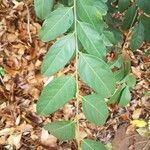
Casearia sylvestris
Wild sage · Crackopen
Description
Source: leafsnapCasearia sylvestris, commonly known as the guaçatonga plant, is a species of flowering plant in the Salicaceae family. It is native to South America and found in Brazil, Argentina, Paraguay, and Uruguay. The guaçatonga plant is a small tree or shrub that can grow up to 10 meters tall. It features smooth bark ranging from gray to brown, and its leaves are simple with serrated edges. For centuries, indigenous people have used the guaçatonga plant for its medicinal properties. Its leaves are rich in flavonoids and tannins, which have anti-inflammatory effects, making the plant useful for treating various ailments such as wounds, ulcers, fever, and respiratory problems. Beyond its medicinal uses, the guaçatonga plant plays an important role in the ecosystem by providing food for birds and other wildlife. Its wood is also used locally for construction purposes. In summary, Casearia sylvestris, or the guaçatonga plant, serves practical purposes such as medicine-making while also contributing to biodiversity conservation by offering habitat support within the ecosystems where it naturally grows.
Care Guide
💧 Water Every 7 days
☀️ Light Partial sun
Crackopen is native to habitats like forest understories and rocky areas, where it grows in natural shade. It prefers partial sun but can adjust to full sun or full shade, illustrating its versatile and hardy character.
🌡️ Temperature 20–37.8°C
Crackopen comes from tropical areas, where the climate is generally warm and humid. Consequently, it is well suited to high temperatures and moisture. It is sensitive to abrupt temperature shifts and favors a steady temperature, so avoiding indoor temperature swings is important. It typically cannot withstand cold and needs relatively high temperatures to grow. If the surrounding temperature falls too far, the plant may stop growing or even perish.
💨 Humidity
🪴 Soil 6-7
🌱 Fertilizer
Fertilization is essential for the care of Crackopen. Regular feeding during the active growing season helps maintain the energy needed for its showy leaves and supports overall growth. If fertilization is neglected, leaves can become unhealthy, the plant’s ornamental appeal can decline, and growth may be stunted or weak and prone to breakage.
🪴 Pot & Repot
✂️ Pruning
🌿 Propagating
🐛 Diseases & pets
☠️ Toxicity
Characteristics
- Plant Type
- Shrub
- Life Cycle
- Perennial
- Genus
- Casearia
- Family
- Salicaceae
- Hardiness Zone
- 10-12
- Mature Height
- 4.88 m to 14.94 m
- Mature Spread
- 3.05 m to 6.1 m
- Leaf Color
- Dark Green, Forest Green
- Leaf Type
- Evergreen
- Flower Color
- White
- Flower Size
- 0.25 cm to 0.51 cm
- Bloom Time
- Spring, Summer
- Planting Time
- Spring, Summer, Autumn
- Harvest Time
- Summer, Early fall, Mid fall
- Native Area
- Belize, Honduras, Mexico, Guatemala, Peru, Panama, Jamaica, Colombia, Cuba, Bolivia, Venezuela, Guyana, Brazil, Nicaragua, Ecuador, Costa Rica