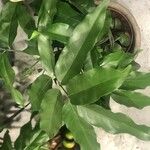
Castanospermum australe
Moreton Bay chestnut · Black bean · Black bean tree
Description
Source: leafsnapCastanospermum australe, commonly known as the Moreton Bay chestnut or black bean, is a large evergreen tree native to the east coast of Australia. It can grow up to 40 meters tall and features a dense canopy adorned with glossy, dark green leaves. In spring and summer, the tree produces large clusters of bright yellow flowers, which are followed by woody pods containing up to eight shiny black seeds. While the seeds are toxic if consumed raw, they can be roasted or boiled to remove the toxins, rendering them a nutritious food source. The wood of Castanospermum australe is highly valued for its durability and resistance to decay, making it popular for use in furniture making. The Moreton Bay chestnut plays a crucial role in its native habitat, providing food for various animals, including birds, possums, and flying foxes. Its extensive root system helps stabilize riverbanks, preventing erosion. Castanospermum australe has been introduced to other parts of the world, such as Hawaii, Florida, and South Africa, where it is grown as an ornamental tree for its attractive foliage and flowers. However, in some areas, it has become invasive, outcompeting native vegetation. Overall, Castanospermum australe is an impressive species with significant ecological importance within Australia's ecosystem and practical uses such as timber production. It is also appreciated worldwide for its ornamental value.
🌳 The Moreton Bay chestnut flourishes in sunny, tropical, and coastal gardens, as well as in wildlife areas. This ornamental tree is known for its vibrant evergreen leaves and striking flowers that bloom in the summer. It serves wonderfully as a specimen or shade tree. Potted varieties are excellent for decorating indoor spaces and outdoor patios. Birds are especially attracted to the trees growing outdoors.
Care Guide
💧 Water Every 7 days
The Moreton Bay chestnut flourishes in humid coastal rainforest environments where it can enjoy consistent moisture. To keep its lush evergreen foliage healthy, water it weekly. Although it's typically grown outdoors, using mulch around the plant helps retain soil moisture, mimicking the natural layering found in its native habitat.
☀️ Light Full sun
Moreton bay chestnut flourishes with abundant sunlight throughout the day, though it can endure periods of shade. This promotes healthy growth. In its native habitat it commonly experiences days filled with plentiful light. Uneven light exposure can cause adverse effects, from stunted growth to leaf burn.
What are the sunlight requirements for Moreton bay chestnut?
Moreton bay chestnut requires a significant amount of sunlight throughout the day for healthy growth, thriving in conditions of full sun, which is above 6 hours of sunlight, and can also endure partial sun, approximately 3-6 hours of sunlight. Its native environment is accustomed to abundant light, but it's crucial to monitor the light exposure to prevent any potential issues like stunted growth or leaf burn. Observing how sunlight moves through your garden can help in identifying the ideal spots that offer the necessary balance of light and shade.
How does artificial lighting benefit indoor Moreton bay chestnuts?
In scenarios where natural sunlight is limited, especially during winter or in less sunny locations, artificial lighting becomes essential for Moreton bay chestnut's growth indoors. Suitable artificial lights like LED can mimic natural sunlight by offering tailored wavelengths needed by plants. For full sun plants, 30-50W/sq ft of artificial light is recommended, whereas partial sun plants require 20-30W/sq ft, and full shade plants need 10-20W/sq ft. The light source should be placed 12-36 inches above the plant to imitate the sun's natural position, ensuring the plant receives 8-12 hours of light per day to promote healthier and faster growth.
What are the symptoms of inadequate lighting in Moreton bay chestnuts?
When Moreton bay chestnuts are placed in low-light conditions, they may exhibit several symptoms indicating light deficiency. These include smaller new leaves, leggy or sparse growth, premature leaf drop, and halt in new growth indicating the plant is conserving resources. Additionally, new leaves might appear lighter in color or develop chlorosis, turning yellow due to a lack of chlorophyll. Excessive sunlight can lead to sunscald, leaf curling as a defense mechanism, wilting from increased water loss, and leaf scorching characterized by brown, dry edges or patches on leaves.
What are the recommended solutions for inadequate lighting for indoor, outdoor, and ground Moreton bay chestnuts?
To address inadequate lighting, gradually acclimate Moreton bay chestnuts to more sunlight. Indoors, move plants weekly towards a south-facing window for at least 6 hours of direct sunlight, and consider artificial lighting for additional support. Outdoors, transition plants carefully to sunnier spots to avoid shock and potential sunburn. Reducing obstructions like pruning trees can increase sunlight exposure. When transplanting smaller plants, choose a period when they're dormant, usually late winter to early spring, and move them to a sunlit location with suitable drainage. Remember, parts of the plant that suffered due to low light may not fully recover, but new growth should be healthy with improved lighting.
🌡️ Temperature 15–37.8°C
Moreton bay chestnut is indigenous to regions where temperatures fall between 59 and 100.4°F (15 to 38 ℃). Its best growth happens within this temperature span. Making accommodations for gradual temperature changes across the seasons is recommended to preserve its healthy growth.
What is the ideal temperature range for Moreton bay chestnut?
The Moreton bay chestnut thrives in climates where temperatures range between 59 to 100.4°F (15 to 38°C). It is important for the plant's healthy growth to make gradual adjustments to temperature fluctuations throughout the seasons. Since Moreton bay chestnut is extremely heat-loving, exposure to cold temperatures can cause harm. Therefore, in the autumn, it is advisable to bring any outdoor-grown Moreton bay chestnut plants indoors, placing them near a bright window but at a safe distance from heaters to avoid dryness. Keeping the temperatures above 59°F (15°C) during winter supports its growth, while temperatures nearing 59°F (15°C) or lower can be detrimental.
How should Moreton bay chestnut be cared for in low temperatures?
In low temperatures, Moreton bay chestnut plants are at risk since they prefer warm conditions and struggle in the cold, with optimal growth above 59°F (15°C). During winter, it's crucial to keep the plant in conditions warmer than 59°F (15°C). Exposure to lower temperatures can cause the leaves to lighten in color and, following frost damage, they may turn brown or black and show signs of wilting and drooping. To address this, trim off the frost-damaged parts and move the plant to a warm indoor space. Placing it near a south-facing window ensures it gets enough sunlight, but it should also be kept away from heaters or air conditioners to avoid air dryness.
What are the symptoms and solutions if Moreton bay chestnut is exposed to high temperatures?
Moreton bay chestnut should ideally be kept below 100.4°F (38°C) during summer months. Exposure to temperatures above this can cause the leaves to lighten and make the plant more susceptible to sunburn. If this occurs, it's recommended to trim away the sunburned and dried-up parts of the plant. To protect the plant from excessive heat, move it to a shaded area, particularly away from the harsh midday and afternoon sun. Ensuring the plant is watered in the morning and evening helps to keep the soil adequately moist, supporting its health in higher temperatures.
💨 Humidity normal (40-60%)
This plant will thrive in moderate humidity, which is probably the level in your home. However, misting it a few times a week can be very beneficial. Make sure the room has good ventilation.
🪴 Soil 5-6
🌱 Fertilizer
The best time to fertilize a Moreton Bay chestnut is in early spring, as it breaks dormancy. This encourages overall growth and supports flower development. Fertilizing improves the foliage, stems, and branches, and promotes large, vibrant, long-lasting flowers. It helps move nutrients from the roots to the flowers and enhances the plant’s health and resistance to disease.
🪴 Pot & Repot 2-3 years
The Moreton Bay chestnut is a hardy plant known for producing robust seeds. It requires repotting every 2 to 3 years to maintain healthy growth. For best results, repot the plant in early spring using a larger pot with good drainage. After repotting, water the plant sparingly and place it in a spot with indirect sunlight to aid its recovery.
✂️ Pruning
The Moreton Bay chestnut is an evergreen tree known for its glossy leaves and bright flowers. Pruning between early and late winter can encourage growth, enhance flowering, prevent disease, and maintain the tree's structure. Effective pruning techniques include removing dead branches and thinning crowded areas to improve air circulation.
🌿 Propagating
🐛 Diseases & pets
☠️ Toxicity
Characteristics
- Plant Type
- Tree
- Life Cycle
- Perennial
- Genus
- Castanospermum
- Family
- Fabaceae
- Hardiness Zone
- 8-12
- Mature Height
- 24.99 m
- Mature Spread
- 14.94 m
- Leaf Color
- Green
- Leaf Type
- Evergreen
- Flower Color
- Orange, Red
- Flower Size
- 2.54 cm to 5.08 cm
- Bloom Time
- Spring, Early summer, Winter
- Planting Time
- Spring, Summer, Autumn
- Harvest Time
- Mid summer, Late summer, Fall
- Native Area
- Vanuatu