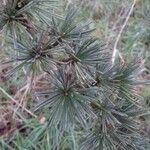
Cedrus atlantica
Atlas Cedar · Atlantic cedar
Description
Source: leafsnapCedrus atlantica, commonly known as the Atlas cedar, is a large evergreen coniferous tree native to the Atlas Mountains of Morocco and Algeria. It can grow up to 40-60 feet tall, featuring a conical shape with a broad base. The tree's blue-green needles are arranged in clusters of 30-40. Its cones are large, reaching up to 4 inches in length, with woody scales. The Atlas cedar is widely cultivated as an ornamental tree in parks and gardens due to its attractive foliage, unique shape, and drought tolerance. In Morocco, it holds cultural significance and is utilized for timber production. The wood of the Atlas cedar is highly valued for its durability, resistance to decay, and pleasant aroma. These qualities make it ideal for use in furniture making and construction projects such as roofing or flooring. Overall, Cedrus atlantica serves both aesthetic and economic purposes. It is culturally significant and economically valuable due to its timber production capabilities, making it an important plant species.
🌳 The award-winning Atlas cedar may initially appear somewhat scrawny, but it matures into a large, lush, blue-tinged evergreen that can enhance any landscape year-round. This solitary tree requires ample space to thrive, making it an ideal towering centerpiece for an informal or cottage garden, especially when placed near ornamental buildings.
🎭 Authority and prestige
Care Guide
💧 Water Every 7 days
Originating from the Atlas Mountains, the Atlas cedar flourishes in a climate that balances dry and moist conditions. It needs consistent moisture, which is best achieved with weekly watering, and it thrives in well-draining soil. As an evergreen tree, the Atlas cedar benefits from natural rainfall, which is essential for maintaining its health and year-round foliage.
How should I water my Atlas cedar tree?
Watering your Atlas cedar is a simple task. For mature trees, using a garden hose to slowly soak the soil is the best option. Large trees may require a significant amount of water, so a garden hose is ideal. However, smaller trees can be watered using a watering can or another smaller tool. It's important to avoid overhead watering, as excess moisture on the leaves can cause disease, especially in young trees.
What should I do if I give too much water or too little water to my Atlas cedar?
Overwatering can be a problem with poor soil. If the soil doesn't drain well, your Atlas cedar will start to decline. To fix this, either improve the soil's drainage or move the cedar to a better spot. If you have the cedar in a pot, you may need to use looser soil and a container with better drainage. Overwatering can also lead to diseases, so treat them right away. If your Atlas cedar is underwatered, water it more often and it will bounce back. To tell if you've overwatered, check the foliage, especially the new growth. Overwatered cedars will have discolored and fragile new growth. Look for standing water or slow drainage to confirm the soil is too moist. Underwatered cedars will have sparse, brown leaves. Consider recent rainfall or high temperatures when assessing symptoms.
How frequently should I water my Atlas cedar?
Atlas cedar is a drought-tolerant tree that typically relies on rainfall for survival. During the hottest months, you may need to water it once a week, but in other seasons, watering is usually unnecessary. Newly planted trees require regular watering to support root growth. However, it's important to avoid overwatering, as Atlas cedars cannot tolerate standing water. When unsure, it's safer to water less rather than risk overwatering.
How much water should I give my Atlas cedar?
During the height of summer, watering your Atlas cedar becomes necessary. Normally, it requires about one inch of water per week. However, this amount can be adjusted based on rainfall. If it has rained one inch or more that week, you can skip watering your Atlas cedar. Keep in mind that newly planted Atlas cedars require more water during their establishment period. This means you should aim to water them once every one to two weeks for the first few growing seasons.
How do I water my Atlas cedar in different seasons?
The Atlas cedar tree's water needs vary depending on the season. It requires the most water during the summer when it's hottest. In the absence of rainfall, it should be watered about once per week. During the rest of the year, it can often survive without any water. However, in spring and fall, it may need some water if the weather is exceptionally hot, although this is rare. Unlike many other plants, the Atlas cedar doesn't go into full dormancy in winter and continues to grow. Still, its water needs during winter are low due to the cool temperatures not drying out the soil quickly.
☀️ Light Full sun
Atlas cedar grows best with strong, widespread light. In its natural setting it occupies open areas that receive plenty of sunshine. Too little light can result in slowed growth and poor health. While it can tolerate moderately lower light levels, it performs best when light is evenly distributed.
What are the sunlight requirements for Atlas cedar?
Atlas cedar requires full sun, defined as above 6 hours of direct sunlight daily, to thrive optimally. It can also tolerate partial sun, which means about 3-6 hours of sunlight. Observing how sunlight moves through your garden will help in choosing spots that provide the perfect balance of light and shade, ensuring the plants' happiness. Atlas cedar's natural habitat is in open environments with abundant sunlight, and it thrives best with strong and extensive light exposure. Inadequate light can lead to stunted growth and poor health, though it can moderately withstand less light-saturated conditions.
How does artificial lighting support indoor Atlas cedar plants?
Indoor Atlas cedar plants require sufficient lighting to grow optimally, especially in conditions where natural sunlight is insufficient, such as in winter or less sunny spaces. Artificial lighting offers a practical solution, promoting healthier, faster growth. LED lights are favored for their ability to be customized to provide specific wavelengths needed by plants. Full sun plants need 30-50W/sq ft of artificial light, while partial sun plants require 20-30W/sq ft, and full shade plants need 10-20W/sq ft. The light source should be placed 12-36 inches above the plant to mimic natural sunlight, and most plants will need 8-12 hours of light per day.
What are the symptoms of insufficient light for Atlas cedar?
Symptoms of inadequate lighting for Atlas cedar include smaller-than-usual new leaves, leggy or sparse growth due to long spaces between leaves or stems, premature leaf drop to conserve resources, and halted or no new growth as the plant enters survival mode. New leaves may also appear lighter in color or develop chlorosis, losing their green color and turning yellow, which indicates a lack of chlorophyll and nutrients. Sunscald from intense sunlight exposure, leaf curling as a defense mechanism against excessive sunlight, wilting due to overexposure increasing water loss, and leaf scorching characterized by brown or crispy leaf edges are also symptoms of inappropriate light conditions.
What are the recommended solutions for Atlas cedar facing insufficient sunlight?
For optimal growth under insufficient sunlight conditions, gradually move the Atlas cedar to receive at least 6 hours of direct sunlight daily. Use a south-facing window and keep curtains open for maximum exposure. If moving the plant isn't feasible, consider using artificial light, like a desk or ceiling lamp for at least 8 hours daily, or professional plant grow lights. Outdoors, gradually adapt plants to sunnier spots to prevent sunburn. Reduce sunlight obstructions by pruning or transplanting smaller plants to locations with ample sunlight and good drainage during their dormant period, typically late winter or early spring. Note that parts of the plant affected by low light may not recover, but new growth should be healthy after increasing light exposure.
🌡️ Temperature 20–37.8°C
Atlas cedar is native to temperate climate regions and requires temperatures between 68 and 100 °F (20 and 38 ℃). To promote healthy growth, it is recommended to adjust these temperatures according to seasonal shifts.
What is the native climate of Atlas cedar?
Atlas cedar is native to temperate climatic regions and requires temperatures ranging from 68 to 100 °F (20 to 38 °C) for healthy growth. It thrives in heat and can be harmed by cold temperatures. Therefore, it's vital to adjust the planting environment to these temperature preferences, especially with the change of seasons.
How should Atlas cedar be cared for in cold temperatures?
During cold temperatures, especially in autumn and winter, Atlas cedar should be brought indoors if it is grown outside. It's recommended to place it near a bright window, away from direct heat sources such as heaters to avoid damage. Keeping the temperature above 20°C (68°F) during winter is beneficial for its growth, as temperatures approaching 0°C (32°F) can be detrimental.
What are the symptoms of cold damage in Atlas cedar?
Atlas cedar shows intolerance to low temperatures, thriving best above 20°C (68°F). Symptoms of cold damage include lightening of the leaves when the temperature falls below -5°C (23°F), followed by browning or blackening after frost damage. Additionally, wilting and drooping may occur, indicating significant distress due to cold temperatures.
What should be done if an Atlas cedar is damaged by cold?
If an Atlas cedar is damaged by frost, it's important to trim off the frost-damaged parts to prevent further damage. The plant should be immediately moved to a warm environment indoors for protection from the cold. Placing it near a south-facing window will ensure it receives ample sunlight, but it should not be placed near heaters or air conditioning vents to avoid dry air, which could worsen its condition.
What are the symptoms of heat damage in Atlas cedar?
In the summer, Atlas cedar should be kept below 38°C (100°F) to prevent heat damage. Symptoms of heat damage include a lighter color of the leaves and increased susceptibility to sunburn when temperatures exceed 43°C (109°F). These conditions indicate that the plant is under significant stress due to excessive heat.
💨 Humidity
🪴 Soil 6-7
🌱 Fertilizer
The Atlas cedar has specific nutrient needs and does not require heavy fertilization. Fertilizing in spring is best for encouraging optimal growth. Supplying nutrients improves its health, increases resistance to pests and diseases, and helps maintain its long lifespan.
Why should I use fertilizer on my Atlas cedar?
Encouraging healthy growth in Atlas cedar can be done by fertilizing it in the spring. Keep in mind that this plant has a long lifespan and requires support. Adding nutrients to the soil not only improves the plant's health, but also enables it to better resist common pests and diseases that can stunt growth or shorten its lifespan.
When should I fertilize my Atlas cedar tree?
The growing medium often lacks enough nutrients for healthy growth, but Atlas cedar is an exception. Unlike garden annuals and perennials, Atlas cedar doesn't need a lot of extra nutrients. The optimal time to fertilize it is in the spring, before new growth emerges.
When is it not a good idea to fertilize my Atlas cedar?
While certain plants benefit from regular fertilization, the Atlas cedar is an exception. It does not need a significant amount of additional nutrients, as excessive fertilizer can lead to decline. It is advised to only apply fertilizer in the spring and avoid doing so in the other seasons of summer, fall, and winter. Additionally, refrain from adding any fertilizer or organic matter to the soil during these non-spring months.
What kind of fertilizer does my Atlas cedar tree need?
The age of your plant affects the fertilizer it needs. Keep in mind that Atlas cedars don't need a lot of nutrients. Choose a balanced plant food that promotes healthy root development and growth, but avoid fertilizers with high nitrogen levels.
How should I give nutrients to my Atlas cedar tree?
When fertilizing Atlas cedar trees, it is crucial to consider both the method and timing. The recommended approach is to apply the fertilizer once in the spring, specifically around the base of the plant. It is important to avoid getting any fertilizer on the trunk. If granulated fertilizer is being used, it is advised to cover the pellets with a thin layer of soil. This technique assists in ensuring effective absorption of the fertilizer into the soil.
🪴 Pot & Repot 2-3 years
When repotting an Atlas cedar, select a pot 1-2 inches (2.5–5.1 cm) larger with ample drainage. Use a well-draining potting mix. Repot in spring or fall, making sure the root ball is slightly lower than the rim of the flower pot. Water thoroughly after repotting and place it in a warm spot with indirect sunlight.
✂️ Pruning
The Atlas cedar thrives with strategic pruning, which involves removing dead branches and thinning the canopy to improve air circulation. It's best to prune the tree from early to late winter, as this encourages healthy growth while minimizing sap loss. Always use clean, sharp tools to make precise cuts, as this helps reduce the risk of disease.
🌿 Propagating
🐛 Diseases & pets
☠️ Toxicity
The toxicity of Weeping Blue Atlas Cedar has been reported by the University of Arizona as benign or non-toxic. It is also said to be non-allergenic, making it perfect for those who suffer from allergies and asthma.
Characteristics
- Plant Type
- Tree
- Life Cycle
- Perennial
- Genus
- Cedrus
- Family
- Pinaceae
- Hardiness Zone
- 9-11
- Mature Height
- 29.87 m to 39.93 m
- Mature Spread
- 0.91 m to 3.66 m
- Leaf Color
- Green, Blue, Silver
- Leaf Type
- Evergreen
- Flower Color
- Green, Yellow
- Bloom Time
- Mid summer, Late summer
- Planting Time
- Spring, Autumn
- Harvest Time
- Late summer, Fall
- Native Area
- Morocco, Algeria