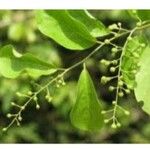
Celastrus paniculatus
Oriental bittersweet · Celastrus · Staff vine · Intellect plant · Black Oil Plant
Description
Source: leafsnapCelastrus paniculatus is a woody liana commonly known as black oil plant, climbing staff tree, and intellect tree (Sanskrit: jyotishmati ज्योतीष्मती, Hindi: mal-kangani माल-कांगनी, Chinese: deng you teng 灯油藤). This climbing shrub grows throughout India at elevations up to 1,800 m (5,900 ft).C. paniculatus is a deciduous vine with stems up to 10 cm (3.9 in) in diameter and 6 m (20 ft) long with rough, pale brown exfoliating bark covered densely with small, elongated lenticles. The leaves are simple, broad, and oval, obovate or elliptic in shape, with toothed margins.
Care Guide
💧 Water
The black oil plant flourishes in tropical forests where high humidity and consistent moisture are prevalent. To care for it indoors, water it twice a week, being careful not to overwater and cause waterlogging. When grown outdoors, applying mulch can help retain moisture and mimic its natural habitat.
☀️ Light Full sun
Black oil plant comes from open habitats, such as sunny meadows and forest edges, which provide abundant light. It does best in Full Sun but can also tolerate Partial Sun, adapting well to a range of light conditions.
What are the sun requirements for the Black oil plant (Celastrus paniculatus)?
The Black oil plant, or Celastrus paniculatus, thrives in varying degrees of sunlight, depending on your goals and the specific environment. For full sun exposure, the plant requires above 6 hours of sunlight a day, which is ideal for optimal growth and health. For those areas in your garden that receive partial sun, about 3-6 hours of sunlight will suffice. It's important to observe how sunlight moves through your garden throughout the day, selecting locations that offer a harmonious balance of light and shade. This careful placement ensures that your Black oil plants are happy and healthy, yielding the best possible results.
🌡️ Temperature 20–37.8°C
Black oil plant comes from tropical areas, which have warm, humid climates. Consequently, it is adapted to high heat and humidity. It does not tolerate abrupt temperature shifts and favors a steady temperature, so preventing indoor temperature swings is important. It generally cannot withstand cold and needs relatively high temperatures to grow. If the ambient temperature falls too much, growth can stop or the plant may die.
💨 Humidity
🪴 Soil 6-7
🌱 Fertilizer
The best time to fertilize a Black oil plant is in early spring, as it breaks dormancy. This supports overall growth and the development of flowers. Fertilizing improves the foliage, stems, and branches, and encourages flowers that are large, vibrant, and long-lasting. It helps transport nutrients from the roots to the flowers and enhances the plant’s health and resistance to disease.
🪴 Pot & Repot
✂️ Pruning
Pruning a black oil plant in early spring helps it thrive by encouraging dense growth. You can remove up to one-third of the plant to achieve better shape, improved air circulation, and enhanced vitality. This process also helps reduce pests and supports fruit production, resulting in a robust and visually appealing plant.
🌿 Propagating
🐛 Diseases & pets
☠️ Toxicity
Characteristics
- Plant Type
- Vine
- Life Cycle
- Perennial
- Genus
- Celastrus
- Family
- Celastraceae
- Hardiness Zone
- 9-11
- Mature Height
- 10.06 m
- Mature Spread
- 4.88 m to 7.92 m
- Leaf Color
- Green
- Leaf Type
- Deciduous
- Flower Color
- White
- Flower Size
- 5.08 cm to 10.16 cm
- Bloom Time
- Late spring, Early summer
- Planting Time
- Spring, Summer, Autumn
- Harvest Time
- Fall