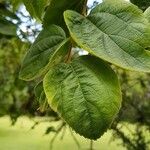
Celtis africana
White Stinkwood · Camdeboo · Witstinkhout
Description
Source: leafsnapCeltis africana, commonly known as the white stinkwood, is a deciduous tree native to Africa. It can grow up to 20 meters tall and boasts a spreading crown with a diameter of up to 15 meters. The bark is smooth and greyish-white, adorned with small bumps or lenticels. The leaves of Celtis africana are simple and alternate, with an oval or elliptical shape that tapers at both ends. They are dark green and have serrated edges. In the spring, the tree produces small greenish-yellow flowers, which are followed by small round fruits that transition from green to yellow when ripe. Celtis africana serves multiple purposes. It is often used as an ornamental plant due to its attractive foliage and expansive crown. The tree's large size also makes it ideal for providing shade in outdoor spaces such as parks and gardens. Additionally, the wood is utilized for making furniture, tool handles, and musical instruments like drums and xylophones. In traditional African medicine, Celtis africana has been employed to treat various ailments. Its bark extract, known for its anti-inflammatory properties, can be boiled into a tea to help reduce fever. Overall, Celtis africana is a versatile plant with both aesthetic appeal and practical uses, making it an important species in African ecosystems today.
Care Guide
💧 Water Every 7 days
White stinkwood flourishes in sunny areas with moderate watering and exhibits drought tolerance, requiring water every 2-3 weeks. Although it thrives with consistent moisture, it can endure dry spells. As a deciduous plant, its water requirements decrease during dormancy when it sheds its leaves.
☀️ Light Full sun
White stinkwood is native to open habitats, such as sunny meadows and forest edges, where light is abundant. It prefers full sun but will also tolerate partial sun, adapting well to a range of light conditions.
🌡️ Temperature 15–37.8°C
White stinkwood is native to areas where temperatures typically range from 59 to 100.4 °F (15 to 38 ℃). It grows best within that range. Seasonal adjustments should account for periods of intense heat or cool conditions.
What temperature range is ideal for White stinkwood?
White stinkwood is native to regions where temperatures typically range between 59 to 100.4°F (15 to 38°C), thriving best within this range. It has some level of cold tolerance and usually doesn't require special care when temperatures are above -5°C. However, if temperatures are expected to drop below -5°C, it's crucial to implement temporary cold protection measures like wrapping the plant in plastic film, fabric, or other materials. These protective measures should be removed once temperatures rise again.
How does White stinkwood react to low temperatures?
White stinkwood has a moderate tolerance to low temperatures, performing optimally when the temperature remains above 15°C. During winter, it's important to keep it above -5°C to avoid damage. If temperatures fall below -10°C, the leaves might droop; they can recover in mild cases, but severe conditions will cause wilting and eventual leaf drop. To protect the plant from low temperatures, trim off frost-damaged parts and, to anticipate future cold spells, wrap the plant with non-woven fabric or cloth and construct a wind barrier for additional protection.
What should be done if White stinkwood experiences high temperatures?
In the summer months, it's advisable to keep White stinkwood below 38°C. Should the temperature rise above 43°C, you may observe a lightening of leaf color, drying and withering of leaf tips, curling of the leaves, and increased susceptibility to sunburn. To mitigate these effects, trim away the sunburned and dried-up sections of the plant. Relocate the plant to an area offering shade during the midday and afternoon sun, or use a shade cloth. Additionally, ensure the soil remains moist by watering the plant in the morning and evening.
💨 Humidity
🪴 Soil 6-7
🌱 Fertilizer
Fertilize your White stinkwood in early spring to encourage healthy growth. Regular feeding boosts overall health, producing vigorous growth, increased tolerance of challenging conditions, and better resistance to diseases and pests. Keep to a specific fertilization schedule for your White stinkwood to maintain foliage that is vibrant, deeply colored, and lush.
🪴 Pot & Repot
✂️ Pruning
The white stinkwood tree features a wide canopy and gracefully arching branches. To maintain its health, prune it in early spring to remove any dead or overcrowded branches, which will enhance air circulation. Be careful not to remove more than one-third of the canopy to prevent stress on the tree. This approach promotes healthier growth and improves the tree's appearance.
🌿 Propagating
🐛 Diseases & pets
☠️ Toxicity
Characteristics
- Plant Type
- Tree
- Life Cycle
- Perennial
- Genus
- Celtis
- Family
- Cannabaceae
- Hardiness Zone
- 8-11
- Mature Height
- 11.89 m to 24.99 m
- Mature Spread
- 3.05 m to 11.89 m
- Leaf Color
- Light Green, Forest Green
- Leaf Type
- Deciduous
- Flower Color
- Yellow, Green
- Flower Size
- 0.25 cm
- Bloom Time
- Early spring, Mid spring
- Planting Time
- Spring, Summer, Autumn
- Harvest Time
- Summer
- Native Area
- Saudi Arabia, Malawi, Somalia, Lesotho, Angola, South Africa, Zambia, Sudan, Eritrea, Guinea, Yemen, Kenya, Uganda, Tanzania, Zimbabwe, Cameroon, Mozambique, Ghana, Eswatini, Ethiopia, Congo (DRC), Botswana, Central African Republic