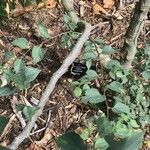
Celtis iguanaea
Iguana hackberry · Snaky
Description
Source: leafsnapCeltis iguanaea, commonly known as the iguana hackberry, is a species of tree in the Cannabaceae family. It is native to Central and South America, found in countries such as Mexico, Guatemala, Honduras, Nicaragua, and Costa Rica. The tree can grow up to 20 meters tall with a trunk diameter reaching up to 60 centimeters. Its bark is grayish-brown, characterized by deep furrows and ridges. The leaves of Celtis iguanaea are arranged alternately and have an elliptical shape that tapers at both ends. They are dark green on the top and lighter underneath, with serrated edges. The flowers are small greenish-yellow clusters that bloom in the spring, followed by small edible fruits that transition from green to orange when ripe. Celtis iguanaea serves multiple purposes. Its wood is hardy yet flexible, making it ideal for furniture making and construction uses such as fence posts or tool handles. The fruits are edible, either raw or cooked, and the leaves possess medicinal properties used for treating various ailments, including fever reduction. The plant prefers well-drained soils but can tolerate a range of soil types, from sandy loam to clay. This adaptability allows it to thrive in various environments, including disturbed areas like roadsides or urban spaces, where it is often planted for ornamental purposes due to its attractive foliage and fruit production. Overall, Celtis iguanaea is an important species not only because of its ecological significance but also due to its economic value. It is beneficial locally in its natural habitat and globally in regions where it has been introduced, often due to human activities like trade routes.
Care Guide
💧 Water Every 7 days
The Iguana Hackberry, native to arid regions, is highly drought-tolerant and typically requires watering only every 2 to 3 weeks. This plant thrives in warm climates that mimic its natural sporadic rainfall pattern. As a deciduous plant, its water requirements decrease during dormancy, allowing it to conserve resources for the growing season.
How should I water my Iguana hackberry plant in the best way possible?
To promote excellent root development, it's recommended to place a garden hose at the base of the plant. When watering, avoid directly spraying the leaves. If the plant is outdoors and in direct sunlight, the leaves will need more water. Using bubblers or soaker hoses can help moisten the roots of each plant. When adding or removing plants, consider using soaker hoses that cover the entire garden or bed to ensure deep root penetration. After watering, make sure to drain any excess water and allow the soil to dry before watering again. To prevent diseases, water at ground level. On a sunny day, it may be beneficial to spray the entire bush with water. Whether the plant is in a pot or in the ground, remember that Iguana hackberry prefers deep watering rather than light sprinkling.
What should I do if I give an Iguana hackberry tree too much or too little water?
An overwatered Iguana hackberry may exhibit yellowing, dropping, and wilting leaves, along with a dull and unhealthy appearance. Mushy stems may also be present. Adjusting your watering schedule when these signs appear is recommended. Wilting can also indicate under watering, with leaves becoming crispy and dry. On the other hand, overwatered plants will have soft, wilted leaves. If the soil is dry and watering alone is not sufficient, give it a thorough watering. This will help the Iguana hackberry recover, but yellowing and dry leaves may persist due to root damage for a few days. Once the plant returns to normal, the yellowing of leaves will cease. Indoors, always check the moisture levels of the pot and avoid overwatering. Look for any signs of black spots, and if present, allow the soil to dry out by abstaining from watering for a few days. Overwatering can lead to root rot. If you observe discolored and slimy roots, consider repotting the plant. To prevent root rot, avoid overly soggy soil. When planting the Iguana hackberry outdoors, dig a bit deeper. If the soil feels too dry, it may indicate under watering. Adequate watering is necessary for the plant's recovery.
How often do I need to give my Iguana hackberry water?
The Iguana hackberry prefers deep and infrequent watering, especially when planted in pots. Pots have limited water storage, so soaking them in a gallon of water each time is recommended. In cold regions, watering is needed every 3 to 5 days. Watering early in the morning is best, when the soil is dry. You can check if watering is needed by examining the top 2-3 inches of soil; if it is dry, the plant needs watering. During hot days, check the moisture daily as the heat can quickly dry out the soil in the pot. In garden beds, irrigation is required, and in hot climates, watering once a week is advisable. Only water if about 2 to 3 inches of soil is too dry. It is important to consider rainfall and prevent overwatering to avoid root rot. Adding mulch about 3 to 4 inches deep can help conserve water when plants are outdoors. Sandy soil needs more frequent watering, while clay soil needs less frequent watering to prevent root rot. To monitor watering frequency, mark the date on a calendar and look for drooping leaves as a sign that watering may be needed.
How much water does my Iguana hackberry need?
The Iguana hackberry generally needs about a gallon of water on a regular basis. For potted plants, water them deeply until water drips out of the bottom of the pot. Wait for the soil to dry before watering again. Use a water calculator or moisture meter to determine how much water you give the plant over a week. Provide plenty of water during the flowering period, but let the moisture dry out to prevent root rot. If the Iguana hackberry is planted outside with enough rainfall, it may not need extra watering. When the plant is young or newly planted, make sure it receives 1-2 inches of rain per week. As the hackberry grows, it can rely on rainfall alone. Only water it fully during hot weather or if there has been no rain for 2-3 weeks. Water during cooler times of the day to prevent heat damage. Additional watering is needed during long dry periods.
Do I need to change how often I water my Iguana hackberry based on the time of year or different weather conditions?
To successfully care for an Iguana hackberry, it is important to provide appropriate watering based on the season. During the spring and fall, the soil should be kept moist but not overly saturated. It is beneficial for the soil to alternate between dry and moist conditions. In the summer, hot weather can cause water to evaporate quickly, so additional watering may be necessary if there is a lack of rainfall. During the winter, the Iguana hackberry requires less water since it loses its leaves and goes into a dormant state. Using a well-draining soil mixture can help with water evaporating more efficiently. Once the plant begins to leaf out and go dormant, watering can be skipped, as fall and winter rains are typically sufficient for survival. When the plant is in a pot, it has limited root growth, so it is important to keep it well-watered, especially in the summer, while ensuring proper drainage to avoid cold and wet roots. It is recommended to water the entire root system deeply once or twice a week, depending on the weather, rather than using shallow sprinkles. It is important to avoid allowing the Iguana hackberry to dry out completely during the fall and winter, even in dormancy. Overwatering should be avoided, as the plant does not tolerate sitting in water for extended periods, and inadequate soil drainage can be harmful, particularly in winter. Applying mulch can help reduce stress, conserve water, and promote healthy blooms.
☀️ Light Full sun
Iguana hackberry is native to open habitats, such as sunlit meadows and forest edges, which receive abundant light. It thrives in Full Sun but can also tolerate Partial Sun, adapting well to a range of sunlight conditions.
🌡️ Temperature 20–37.8°C
Iguana hackberry comes from tropical areas, where the climate is generally warm and humid. Because of this, it is adapted to high temperatures and moisture. It is sensitive to sudden temperature changes and prefers a consistent temperature, so avoiding indoor temperature swings is important. It usually cannot tolerate cold and needs higher temperatures to grow. If the ambient temperature falls too low, the plant may stop growing or even die.
💨 Humidity
🪴 Soil 6-7
🌱 Fertilizer
Fertilizing is essential for the care of the Iguana hackberry. Regular feeding during the growing season maintains energy for its showy leaves and supports overall growth. Failing to fertilize can cause unhealthy leaves, reduced ornamental value, and stunted or weak growth that is prone to breaking.
🪴 Pot & Repot Every 12 months
✂️ Pruning
The Iguana hackberry features dense foliage and thorny stems. To maintain its health and appearance, prune it in early spring. Begin by removing any dead branches and thinning out crowded areas to improve airflow. Shape the plant by trimming any unruly branches. Proper pruning not only enhances growth and fruit production but also ensures the plant remains a manageable size. Remember to clean your tools to prevent the spread of disease and avoid overgrowth.
🌿 Propagating
🐛 Diseases & pets
☠️ Toxicity
Characteristics
- Plant Type
- Tree, Vine, Shrub
- Life Cycle
- Perennial
- Genus
- Celtis
- Family
- Cannabaceae
- Hardiness Zone
- 9-11
- Mature Height
- 4.88 m to 10.06 m
- Mature Spread
- 3.05 m to 6.1 m
- Leaf Color
- Green, Dark Green
- Leaf Type
- Deciduous
- Flower Color
- Yellow, Green
- Flower Size
- 0.25 cm to 0.51 cm
- Bloom Time
- Mid spring, Late spring
- Planting Time
- Summer
- Harvest Time
- Mid summer, Late summer, Early fall
- Native Area
- Belize, Honduras, Mexico, Guatemala, Peru, Panama, Jamaica, Colombia, Bahamas, Cuba, Bolivia, Venezuela, Brazil, Guyana, El Salvador, Nicaragua, Ecuador, Costa Rica