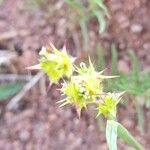
Cenchrus spinifex
Field sandbur · Mat sandbur · Spiny bur grass · Coast sandbur · Coast sandbur grass
Description
Source: leafsnapCenchrus spinifex, known commonly as the common sandbur, coastal sandbur, or stickerweed, is a perennial grass that grows from 5 to 30 inches (13 to 76 cm) high in sandy or gravelly terrain. It is native to the southern United States southward into Mexico and the Caribbean. It has been introduced elsewhere in the United States and in the Philippines and South Africa. It is a noxious weed in Europe.The grass produces a bur, a type of grain fruit, consisting of eight to forty sharp, barbed spines that lodge in clothes, exposed feet, and fur.
Care Guide
💧 Water
Coast sandbur is well-suited for arid environments due to its exceptional drought tolerance. It thrives in sandy soils, making it an excellent choice for xeriscaping. This resilient plant can withstand dry spells thanks to its robust root system, which efficiently absorbs moisture. Although it is highly drought-tolerant, it benefits from weekly watering to maintain its health.
☀️ Light Full sun
Coast sandbur thrives with ample sunlight, which is essential for its healthy development. Because of the environment it originated from, it can tolerate not having full sun all day. Still, very limited light or excessive sunlight can impede its growth.
What are the sun requirements for Coast Sandbur?
Coast Sandbur thrives in areas that receive generous sunlight. For optimal growth, it requires full sun, which equates to more than 6 hours of sunlight daily, or partial sun, about 3-6 hours of sunlight. It's important to observe the movement of sunlight through your garden to ensure your plants receive the ideal balance of light and shade, which is crucial for their well-being. The plant’s ability to prosper in its natural environment suggests it can tolerate varying levels of sunlight, though both extremely limited and excessive sunlight exposure can be detrimental.
How can artificial lighting benefit indoor Coast Sandbur plants?
For Coast Sandbur plants grown indoors, artificial lighting can be a viable solution when natural sunlight is insufficient, especially during winter or in less sunny spaces. Adequate lighting is essential for optimal growth, with LED lights being a popular choice due to their ability to provide specific wavelengths required by plants. Full sun plants need about 30-50W/sq ft, partial sun plants require 20-30W/sq ft, and full shade plants about 10-20W/sq ft of artificial light. The light source should be positioned 12-36 inches above the plant, mimicking natural sunlight as closely as possible, and typically for 8-12 hours per day to promote faster, healthier plant growth.
What are the common symptoms of inadequate light in Coast Sandbur?
When Coast Sandbur is grown indoors or under inadequate light conditions, it may exhibit symptoms indicating light deficiency. These include new leaves growing smaller than mature ones, leggy or sparse growth, with increased spacing between leaves and stems leading to a stretched appearance, faster dropping of older leaves as the plant conserves resources, a halt in new leaf production as it enters survival mode, lighter-colored new leaves indicating insufficient chlorophyll, and conditions like chlorosis (turning leaves yellow), sunscald (damage from intense sunlight), leaf curling (a defense mechanism against water loss), wilting (loss of turgor pressure), and leaf scorching (from excessive sunlight).
What solutions can address Coast Sandbur's light-related issues?
To mitigate light-related issues in Coast Sandbur, consider the following solutions based on the setting: Indoor - Gradually move the plants to a location receiving at least 6 hours of direct sunlight daily, possibly near a south-facing window. Use artificial lighting if necessary, keeping a light on for at least 8 hours daily. Outdoor - Adapt your plants to increasing sunlight gradually to prevent sunburn, choosing the optimal location for sunlight exposure. For plants on the ground, minimize obstructions like trees by pruning and consider transplanting smaller plants during their dormant period to a location with better sunlight and drainage. Note that while parts of the plant damaged by insufficient sunlight may not recover, new growth should improve with better light exposure.
🌡️ Temperature 10–35°C
Coast sandbur is a plant adapted to temperate environments and prefers temperatures of 68 to 95 °F (20 to 35 ℃). In cooler climes, consider sheltering it during periods of extreme cold to prevent damage.
What is Coast sandbur and where does it thrive best?
Coast sandbur, scientifically known as Cenchrus spinifex, is a plant that thrives in temperate environments, particularly favoring temperatures ranging from 68 to 95°F (20 to 35°C). It has a strong cold resistance and generally does not require special frost protection measures, even though it prefers to be sheltered during extreme cold weather to prevent damage. The plant is well-suited to conditions where winters do not consistently drop below -25°C.
How should I care for Coast sandbur during winter?
During winter, Coast sandbur should be protected if temperatures are expected to fall below -25°C by covering it with materials like soil or straw. Before the first freeze of autumn, it's recommended to water the plant abundantly so the soil remains moist and freezes in that state. This helps in preventing drought and water scarcity for the plant during the winter and early spring period.
What should I do if Coast sandbur experiences temperatures below its tolerance level?
For temperatures falling below Coast sandbur's cold tolerance level of -25°C, although the plant may not show noticeable changes during winter, there could be a decrease or even lack of sprouting in spring. In such cases, any parts of the plant that have failed to sprout should be removed come springtime.
How does high temperature affect Coast sandbur and what measures should be taken?
Coast sandbur should ideally be kept below 35°C during summer. Temperatures exceeding 41°C can cause the leaves to become lighter in color, curl, become prone to sunburn, and in severe cases, the plant might wilt and dry out. To mitigate these effects, trim away the sunburned and dried parts of the plant, move it to a shaded location or use a shade cloth to protect it from the midday and afternoon sun. Additionally, watering the plant in the morning and evening can help keep the soil moist and provide relief from high temperatures.
💨 Humidity
🪴 Soil 7-8
🌱 Fertilizer
Coast sandbur responds well to regular, light applications of fertilizer to encourage healthy leaf growth. You should apply fertilizer to Coast sandbur roughly once a month during the summer. Nitrogen is essential for foliage, and adding nitrogen-rich sources helps Coast sandbur thrive.
🪴 Pot & Repot
✂️ Pruning
Coast sandbur thrives in sandy soils and coastal areas. To encourage healthy growth, manage its spread, and remove dead stems, it is important to prune this plant from early to late spring. Using clean tools during pruning is essential to prevent the spread of disease. This process not only results in denser foliage but also boosts the plant's resilience, leading to a more attractive appearance.
🌿 Propagating
🐛 Diseases & pets
☠️ Toxicity
Characteristics
- Plant Type
- Herb
- Life Cycle
- Annual, Perennial
- Genus
- Cenchrus
- Family
- Poaceae
- Hardiness Zone
- 6-10
- Mature Height
- 13 cm to 76 cm
- Mature Spread
- 30 cm to 49 cm
- Leaf Color
- Green, Blue
- Leaf Type
- Semi-evergreen
- Flower Color
- Yellow, Green, Brown
- Flower Size
- 1.02 cm to 2.03 cm
- Bloom Time
- Summer, Early fall, Mid fall
- Planting Time
- Spring, Summer, Autumn
- Harvest Time
- Late summer, Fall, Early winter
- Native Area
- Russia, Colombia, Bahamas, Belize, Cuba, Honduras, Mexico, Bolivia, Venezuela, Peru, Brazil, El Salvador, Nicaragua, Ecuador, Costa Rica, Panama, Jamaica