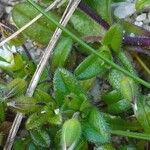
Cerastium diffusum
Fourstamen chickweed · Sea Mouse-ear · Dark-Green Mouse-Ear · Sea mouse-ear chickweed
Description
Source: leafsnapCerastium diffusum, the fourstamen chickweed or sea mouse-ear, is a species of flowering plant in the pink and carnation family Caryophyllaceae. It is an annual herb, to 30 cm.high, occurring in western Europe and northern Africa. Found mainly in coastal areas of Algeria, the Baleares, Belgium, Corsica, Denmark, France, the Faroe Islands, Germany, Great Britain, Ireland, Italy, Libya, Morocco, Netherlands, Norway, Portugal, Sardinia, Sicily, Spain and Sweden. The flowers have 4, (or seldom 5) petals, 4 or 5 stamens appearing between March and May. The petals are much shorter than the sepals. The leaves are opposite, (sessile) without petioles and the sepals and bracts are all green, without pale margins. The fruit petioles are erect and diffuse at maturity.: 490 : 52 There are 2 known Infraspecifics; Cerastium diffusum subsp. diffusum Cerastium diffusum subsp. gussonei (Tod. ex Lojac.) P.D.Sell & WhiteheadIt was first published in Synopsis plantarum 1 on page 520 in 1805.
Care Guide
💧 Water
Sea mouse-ear is native to coastal areas and flourishes in environments with moderate moisture levels. It grows best in soil that remains consistently moist without becoming waterlogged and typically requires weekly watering. Its strong root system efficiently utilizes water, showcasing its ability to adapt to both wet and slightly drier conditions.
☀️ Light Full sun
Sea mouse-ear is a sun-loving, perennial herbaceous plant native to open habitats and commonly found in meadows and grasslands. It prefers full sun but can tolerate partial sun conditions.
🌡️ Temperature 5–35°C
Sea mouse-ear can tolerate a broad range of temperatures, but its distribution can still be restricted by specific combinations of moisture and heat. It performs best in warm summer conditions with sufficient rainfall or watering. Extended stretches of cloudy, rainy weather, as well as prolonged high temperatures, raise the likelihood of Sea mouse-ear dying. In winter, proper protection from cold can improve the plant's chances of survival.
💨 Humidity
🪴 Soil 6-8
🌱 Fertilizer
Typically, a single fertilizer application in spring is adequate for Sea mouse-ear, though additional feedings can boost growth to its fullest. Fertilize every month to every month and a half. Fertilization improves the leaves' appearance and function, maintaining uniform color and a healthy texture. It also encourages root development and enhances nutrient uptake for lasting plant health.
🪴 Pot & Repot
✂️ Pruning
The sea mouse-ear plant benefits from selective pruning, ideally done from early to late spring to remove any dead stems. Light pruning encourages growth and reduces the risk of disease. Trimming spent flowers regularly helps promote continuous blooming. Be sure to always use clean, sharp tools to maintain the plant's health and vigor.
🌿 Propagating
🐛 Diseases & pets
☠️ Toxicity
Characteristics
- Plant Type
- Herb
- Life Cycle
- Perennial
- Genus
- Cerastium
- Family
- Caryophyllaceae
- Hardiness Zone
- 5-9
- Mature Height
- 5 cm to 15 cm
- Mature Spread
- 10 cm to 30 cm
- Leaf Color
- Light Green, Gray
- Leaf Type
- Semi-evergreen
- Flower Color
- White
- Flower Size
- 0.51 cm to 0.76 cm
- Bloom Time
- Spring
- Planting Time
- Spring, Summer, Autumn
- Harvest Time
- Late spring, Early summer, Mid summer