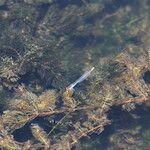
Ceratophyllum submersum
Soft hornwort · Spineless Hornwort · Tropical hornwort
Description
Source: leafsnapCeratophyllum submersum, commonly known as the soft hornwort or tropical hornwort, is a species of Ceratophyllum. It is a submerged, free-floating aquatic plant. It has been reported from Europe, Central Asia, northern Africa, scattered places in tropical Africa, Turkey, Oman, Florida, and the Dominican Republic. It is similar to the submerged macrophyte Ceratophyllum demersum, a congeneric plant that is found in most regions of the world.
Care Guide
💧 Water
Soft hornwort flourishes in submerged aquatic environments, needing a steady supply of moisture and weekly watering. It performs exceptionally well outdoors, where it forms dense mats on the water’s surface. This not only oxygenates the water but also provides a habitat for aquatic life.
☀️ Light Full shade
Soft hornwort is native to habitats such as forest understories or rocky areas that offer natural shade. It prefers Full Shade but can tolerate Partial Sun.
What are the sunlight requirements for Soft hornwort (Ceratophyllum submersum)?
Soft hornwort, or Ceratophyllum submersum, has specific sunlight requirements to thrive. It requires full shade, which means it should receive less than 3 hours of sunlight per day. It can also tolerate partial sun, implying about 3-6 hours of sunlight. It's crucial to observe how sunlight moves through your garden to identify spots that offer the ideal balance of light and shade, ensuring your Soft hornwort's wellbeing by adapting to its sunlight needs.
🌡️ Temperature 10–37.8°C
Soft hornwort can tolerate a wide range of temperatures, but its distribution may still be restricted by various combinations of moisture and heat. It does best in warm summer conditions with sufficient rainfall or watering. Long stretches of cloudy, rainy weather, as well as prolonged high temperatures, can raise the chance of Soft hornwort dying. In winter, proper protection from the cold can improve the plant’s survival.
💨 Humidity
🪴 Soil
🌱 Fertilizer
🪴 Pot & Repot
✂️ Pruning
Soft hornwort, with its feathery submerged leaves, is an excellent addition to water gardens. To maintain a balanced aquatic environment and promote healthy growth, it's important to prune the plant from early to late spring. This helps to thin out dense growth, remove dead stems, and control its spread.
🌿 Propagating
🐛 Diseases & pets
☠️ Toxicity
Characteristics
- Plant Type
- Herb
- Life Cycle
- Perennial
- Genus
- Ceratophyllum
- Family
- Ceratophyllaceae
- Hardiness Zone
- 6-11
- Mature Height
- 30 cm to 91 cm
- Mature Spread
- 20 cm to 49 cm
- Leaf Color
- Dark Green
- Leaf Type
- Semi-evergreen
- Flower Size
- 0.10 cm to 0.20 cm
- Bloom Time
- Summer, Early fall, Mid fall
- Planting Time
- Spring, Summer, Autumn
- Harvest Time
- Late summer, Fall, Early winter
- Native Area
- Libya, Egypt, Turkey, Austria, Sweden, Slovakia, Montenegro, Croatia, Slovenia, Morocco, Belarus, Uzbekistan, Russia, Germany, Indonesia, Cameroon, Estonia, Oman, Romania, Latvia, Belgium, Botswana, Netherlands, France, Saudi Arabia, Tunisia, Czech Republic, Bulgaria, Bangladesh, Poland, Armenia, Greece, Ukraine, Serbia, Lithuania, Kyrgyzstan, Kazakhstan, Italy, Spain, Switzerland, Vietnam, Myanmar, Denmark, Albania, Azerbaijan, United Kingdom, Hungary, Algeria, Turkmenistan