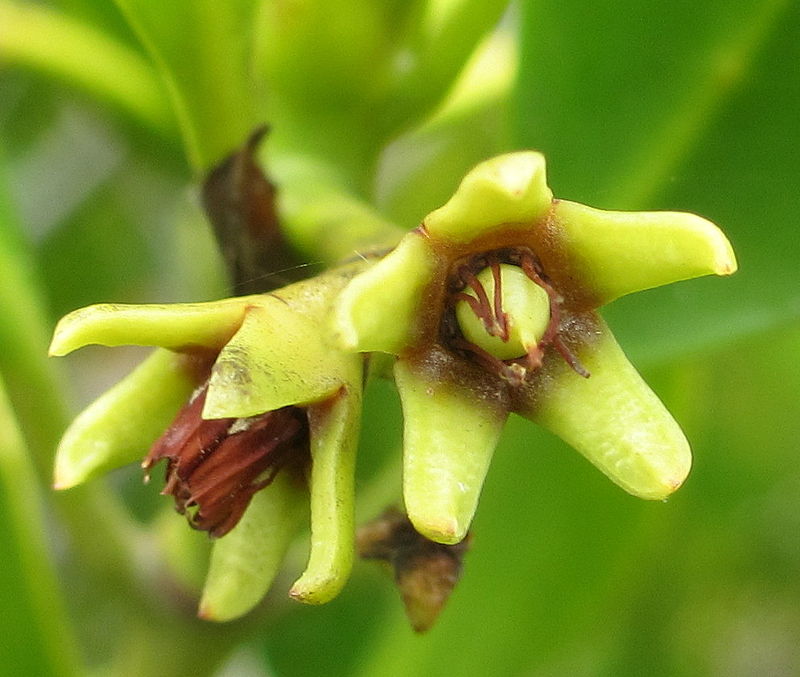
Ceriops tagal
Spurred mangrove · Black mangrove · Indian mangrove
Description
Source: leafsnapCeriops tagal, commonly known as the Indian mangrove or yellow mangrove, is a tree species within the family Rhizophoraceae. This small to medium-sized tree can grow up to 20 meters tall and has a trunk diameter reaching up to 30 centimeters. Its bark is grayish-brown and marked with vertical fissures. This species thrives in coastal areas throughout Southeast Asia, including India, Indonesia, Malaysia, the Philippines, and Thailand. It typically grows in brackish water or tidal mudflats along riverbanks and estuaries. Ceriops tagal has adapted well to its environment by developing specialized roots called pneumatophores, which help it survive in waterlogged soils with low oxygen levels. Its leaves are thick and leathery with pointed tips, which help reduce water loss through transpiration. The tree produces green capsules that turn brown upon maturing. Each capsule contains four seeds, which are dispersed by tidal currents. The wood of Ceriops tagal is used for fuel and making charcoal, while its bark contains tannins used for dyeing textiles and leather goods. Ceriops tagal plays a vital role in coastal ecosystems. It provides habitat for various marine organisms such as crabs, mollusks, and fish, and helps protect shorelines from erosion caused by waves during storms or high tides.
Care Guide
💧 Water Every 7 days
The spurred mangrove thrives in coastal saline environments and demonstrates drought tolerance due to irregular rainfall. When cultivating this plant, it is recommended to water it every 2-3 weeks, allowing the soil to dry out between waterings. As an evergreen, the spurred mangrove retains its foliage year-round, which reflects its efficient use of water in changing moisture conditions.
☀️ Light Full sun
The spurred mangrove originates from open habitats, such as sunny meadows and forest edges, which supply abundant light. It flourishes in Full Sun but can also tolerate Partial Sun, demonstrating adaptability to different sunlight conditions.
What are the sunlight requirements for Spurred Mangrove?
Spurred Mangrove, scientifically known as Ceriops tagal, thrives in Full Sun, requiring above 6 hours of sunlight daily. It can also tolerate Partial Sun, adapting well to about 3-6 hours of sunlight. It's essential to watch how sunlight moves through your garden to choose spots that provide a balance of light and shade, ensuring your plants' happiness.
What are the essential growth conditions for Spurred Mangrove?
The Spurred Mangrove originates from open environments, such as sunny meadows and forest edges, which provide ample light. It thrives best in Full Sun but can tolerate Partial Sun. When natural sunlight is insufficient, especially during winter or in less sunny spaces, artificial lighting offers a solution for optimal growth. Indoor plants require LED lights or other sources of artificial light, ranging from 10-50W per square foot depending on the light requirements (Full Sun, Partial Sun, Full Shade), placed 12-36 inches above the plant for 8-12 hours per day.
What are the signs of light deficiency in Spurred Mangrove?
When Spurred Mangrove receives inadequate light, it exhibits symptoms such as smaller new leaves, leggy or sparse growth, faster leaf drop, slower or no new growth, lighter-colored new leaves, chlorosis, sunscald, leaf curling, wilting, and leaf scorching. These signs indicate that the plant is struggling with the current light conditions and adjustments are needed.
How can you address light deficiency issues for Spurred Mangrove?
To address light deficiency in Spurred Mangrove, indoor plants should be moved gradually towards a sunnier location each week to receive at least 6 hours of sunlight daily or supplemented with artificial light for at least 8 hours. For outdoor plants, relocate them to a sunnier spot gradually to prevent sunburn. Reduce obstructions like overhanging branches, and consider transplanting smaller plants during their dormant period to areas with ample sunlight and good drainage. Note, parts of the plant affected by insufficient sunlight may not recover, but new growth will be healthy after adjusting light exposure.
🌡️ Temperature 20–37.8°C
Spurred mangrove comes from tropical areas where the climate is generally warm and humid. Consequently, it is well adapted to high temperatures and moisture. It does not tolerate sudden temperature changes and prefers a stable thermal environment, so avoiding temperature fluctuations indoors is important. It typically cannot withstand cold and needs warmer conditions to grow. If the ambient temperature becomes too low, the plant may stop growing or even die.
💨 Humidity
🪴 Soil 6-7
🌱 Fertilizer
Fertilization is essential for the care of Spurred mangrove. Regular feeding during the growing season preserves the energy needed for its showy leaves and supports overall growth. Ignoring fertilization can cause unhealthy leaves, reduced ornamental appeal, and stunted or weak growth that is prone to breaking.
🪴 Pot & Repot
✂️ Pruning
Spurred mangroves, known for their dense foliage and prop roots, thrive when carefully pruned. Effective pruning techniques involve removing dead branches and thinning out overcrowded areas to enhance airflow. The best time to prune is in the winter when the trees are dormant, as this promotes new growth. Making precise cuts close to the trunk helps minimize damage and encourages healthy regrowth.
🌿 Propagating
🐛 Diseases & pets
☠️ Toxicity
Characteristics
- Plant Type
- Tree
- Life Cycle
- Perennial
- Genus
- Ceriops
- Family
- Rhizophoraceae
- Hardiness Zone
- 10-12
- Mature Height
- 24.99 m
- Mature Spread
- 3.05 m to 4.88 m
- Leaf Color
- Dark Green
- Leaf Type
- Evergreen
- Flower Color
- White
- Flower Size
- 0.51 cm to 0.76 cm
- Bloom Time
- Late spring, Summer, Early fall, Mid fall
- Planting Time
- Summer, Autumn
- Harvest Time
- Late summer, Fall, Early winter, Mid winter
- Native Area
- Sri Lanka, Somalia, India, Malaysia, South Africa, Philippines, Madagascar, Bangladesh, Pakistan, Kenya, Brunei, Tanzania, China, Indonesia, Cambodia, Vietnam, Mozambique, Myanmar, Singapore, Ethiopia, Thailand