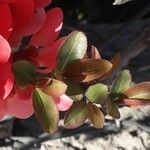
Chaenomeles japonica
به ژاپنی · Japanese-quince · Flowering-quince · Japanese Flowering Quince · Maule's Quince
Description
Source: leafsnapChaenomeles japonica, commonly known as Japanese quince, is a deciduous shrub belonging to the Rosaceae family. Native to Japan and China, it has been cultivated for its ornamental value for centuries. This plant typically grows up to 2 meters in height and spreads out with thorny branches. The leaves of Chaenomeles japonica are glossy and dark green with serrated edges. In early spring, before the leaves emerge, the plant produces beautiful flowers that are usually red or pink, featuring five petals arranged in a cup-like shape. While the fruit of Chaenomeles japonica is edible, it is not commonly consumed due to its sour taste. Resembling small apples or quinces, the fruit can be used to make jams or jellies. Chaenomeles japonica prefers well-drained soil and full sun exposure but can also tolerate partial shade. It is relatively easy to grow and requires minimal maintenance once established. Besides its ornamental value, Chaenomeles japonica has been used medicinally for centuries due to its anti-inflammatory properties. Traditionally, its bark, fruit, and seeds have been used as herbal remedies for various ailments, including coughs, sore throats, and fever reduction. Overall, Chaenomeles japonica is an excellent addition to any garden, serving as both an ornamental shrub and a medicinal plant. It is a perfect choice for gardeners who prefer plants with multiple benefits.
🌳 The Japanese quince is highly versatile, serving both as an ornamental display and a culinary resource. Admired for its eye-catching blossoms, it offers more than just visual enjoyment. Its fruit can be used to make delightful teas or tangy marmalade, and it also provides natural pectin for jams and preserves. Additionally, the plant’s ability to produce essential oils allows its use in soothing aromatherapy and cosmetic products.
🎭 Fortune, Wealth, Blessings, Affection
Care Guide
💧 Water Every 7 days
The Japanese flowering quince thrives in cool temperate regions and is well-suited to environments with low water availability and moderate humidity. It should be watered every 1 to 2 weeks to maintain the right balance. As a deciduous plant, its water needs are closely tied to the seasonal shedding of its leaves. This process encourages robust growth in the spring following the plant's dormant period.
When Should I Water My Japanese Flowering Quince?
The best time to water your Japanese Flowering Quince (Chaenomeles japonica) is when the soil moisture level decreases. Check the soil's moisture by inserting your finger about an inch deep; if the soil feels dry, it’s time to water. Pay attention to wilting leaves, as they signify the need for water, but be cautious of overwatering, which can lead to root diseases. During hot summer days, a slight afternoon wilting may occur but should recover by evening. Slow or stunted growth also indicates inadequate water supply. Balancing the water supply according to the plant's needs ensures healthy growth and blossoms.
How Should I Water My Japanese Flowering Quince?
Water your Japanese Flowering Quince deeply, allowing water to reach the roots, preferably using a watering can with a narrow spout to avoid wetting the foliage excessively. Tools like a moisture meter can assist in maintaining optimal soil moisture levels. Focus on watering the soil around the plant base and avoid excessive moisture on the leaves to prevent fungal diseases. The watering frequency should be adjusted based on climate, soil type, and seasonality, ensuring that the plant is watered when the top inch of soil feels dry.
How Much Water Does Japanese Flowering Quince Really Need?
The Japanese Flowering Quince requires a balanced amount of water, depending on its growth stage and environmental conditions. For a young plant in a 1-gallon pot, start with about 1 pint (\u200b\u200b500ml) of water. Mature plants in the ground should be watered deeply, down to 8-10 inches, which could amount to 1.5-2 gallons of water spread over the root zone. Proper watering is identified by the plant maintaining vibrant green leaves, with under or over-watering leading to wilting, curling, or yellowing leaves.
What Kind of Water is Best for Japanese Flowering Quince?
Japanese Flowering Quince thrives best on rainwater or filtered water with a neutral pH, avoiding hard or highly chlorinated water, which can slow growth and harm the plant's health. Let tap water sit out to evaporate chlorine if necessary. Rainwater is the most recommended for its quality, and fluoride or excess minerals should be avoided to prevent leaf burn or stunted growth. Always strive for a moisture level that supports a well-hydrated soil while ensuring good drainage.
How Do Japanese Flowering Quince's Watering Needs Change with the Seasons?
Seasonal changes affect the water needs of the Japanese Flowering Quince. In spring, increase watering as the plant enters an active growth phase, aiming for moist soil, yet be mindful not to over-saturate. During summer, keep the soil consistently moist to support growth and flowering, adjusting based on rainfall. Reduce watering frequency in autumn as growth slows and further decrease in winter during dormancy, ensuring only to water when the topsoil is dry, to minimize the risk of root diseases and adapt to the plant's reduced water requirement.
☀️ Light Full sun
Japanese quince performs best with a substantial amount of sunlight, which supplies energy for its vivid flowers. Although it comes from areas with plentiful sun, Japanese quince can continue to grow even in somewhat shaded spots. Still, insufficient light may cause reduced flowering, while too much exposure can put the plant under stress.
What are the sunlight requirements for Japanese flowering quince?
Japanese flowering quince requires a considerable amount of sunlight to thrive and produce its vibrant blossoms. Ideally, it should receive full sun, which is above 6 hours of sunlight a day, or partial sun, about 3-6 hours of sunlight daily. Although it is native to habitats with abundant sunlight and can grow under somewhat shaded conditions, inadequate light may lead to suboptimal blossoming, and excessive exposure could stress the plant. It's essential to watch how sunlight moves through your garden and choose spots that provide a perfect balance of light and shade for your plants, ensuring their happiness.
How does artificial lighting affect the growth of indoor Japanese flowering quince plants?
Indoor Japanese flowering quince plants require adequate lighting for optimal growth, especially when natural sunlight is insufficient, such as in winter or less sunny spaces. Artificial lights, like LED lights, offer a vital solution by promoting faster, healthier growth. These lights can be customized to provide specific wavelengths needed by the plants. Full sun plants should have 30-50W/sq ft, partial sun plants 20-30W/sq ft, and full shade plants 10-20W/sq ft of artificial light. The light source should be placed 12-36 inches above the plant to mimic natural sunlight, with 8-12 hours of light per day to mimic the natural daylight hours for your plant species.
What are some indicators of poor lighting conditions for Japanese flowering quince?
Japanese flowering quince may show several symptoms under poor lighting conditions, including smaller new leaves, leggy or sparse growth, faster leaf drop, slower or no new growth, lighter-colored new leaves, chlorosis, sunscald, leaf curling, wilting, and leaf scorching. These symptoms range from new leaves growing smaller, spaces between leaves or stems becoming longer, to leaves losing their green color or turning yellow due to chlorophyll breakdown. These issues indicate inadequate sunlight, which can affect the plant's ability to photosynthesize and maintain optimal health.
What are the recommended solutions for addressing insufficient sunlight in Japanese flowering quince?
To address insufficient sunlight for Japanese flowering quince, gradual adjustments and proper positioning are key. For indoor plants, gradually move them to sunnier locations each week until they receive at least 6 hours of direct sunlight daily, using south-facing windows for maximum exposure. Consider using artificial light for large or immovable plants, keeping a lamp on for at least 8 hours daily or investing in professional plant grow lights. Outdoors, progressively relocate your plants to sunnier spots weekly to avoid sunburn. Minimize obstructions by pruning or transplanting to locations with ample sunlight and good drainage. Note that parts of the plant affected by low light may not recover, but new growth should be healthy with increased light exposure.
🌡️ Temperature 5–35°C
In its native habitat, japanese quince grows in regions with cool winters and moderate summers, indicating a preference for cooler temperatures. Generally, it prefers temperatures between 41 to 95 ℉ (5 to 35 ℃) but can tolerate temperatures as low as 23 ℉ (-5 ℃) in winter. In summer, it may benefit from afternoon shade or misting to avoid heat stress.
What are the ideal growing conditions for Japanese flowering quince?
The Japanese flowering quince thrives in environments with cool winters and moderate summers, favoring cooler temperatures generally between 41 to 95°F (5 to 35°C). It has strong cold resistance and can tolerate winter temperatures as low as 23°F (-5°C). Special frost protection measures are not usually necessary, but in extremely cold winters, wrapping the trunk and branches with non-woven fabric or cloth can offer protection. To prepare for winter, it is recommended to water the plant abundantly before the first freeze in autumn to ensure the soil remains moist and enters a frozen state, helping prevent drought and water scarcity during winter and early spring.
How should I care for Japanese flowering quince in low temperature conditions?
Japanese flowering quince is cold-tolerant and best thrives at temperatures above its critical minimum. During winter, keeping it above the tolerable minimum temperature is crucial. If the temperature falls below the critical limit, the plant may not show immediate damage in winter, but come spring, branches might become brittle, dry, and fail to produce new shoots. To mitigate this, prune away any dead branches that have failed to produce new leaves in spring.
What steps should I take if my Japanese flowering quince is exposed to high temperatures?
During summer, it's important to keep the Japanese flowering quince below its maximum temperature tolerance. Exceeding this range can cause the leaves to lighten in color, tips to become dry and withered, and increase susceptibility to sunburn. To protect the plant, trim away sunburned and dried-up parts. Moving the plant to a shaded location, especially from the midday and afternoon sun, or using a shade cloth can be beneficial. Ensure the plant is watered in the morning and evening to keep the soil moist and prevent heat stress.
💨 Humidity normal (40-60%)
This plant will thrive in moderate humidity, which is probably the level in your home. However, misting it a few times a week can be very beneficial. Make sure the room has good ventilation.
🪴 Soil 6-7
🌱 Fertilizer
Fertilize your Japanese quince in early spring to encourage healthy growth. Regular feeding boosts the plant’s overall health, producing vigorous growth, greater tolerance of harsh conditions, and improved resistance to diseases and pests. Keep to a consistent fertilization schedule for your Japanese quince to achieve vibrant, deeply colored foliage and a lush appearance.
Why should I put fertilizer on my Japanese flowering quince?
If you own a Japanese flowering quince, regular fertilization is important for its overall health. Supplying the proper nutrients will help it grow better, handle tough conditions, and resist diseases and pests. Keeping the foliage intact is crucial as it is a visually appealing feature. To achieve this, follow a regular fertilization schedule that specifically suits your Japanese flowering quince. This will result in vibrant leaves and an attractive appearance.
When should I fertilize my Japanese flowering quince for the best results?
To ensure the healthy growth of your Japanese flowering quince, it is recommended to fertilize it for the first time in late winter or early spring. This provides the necessary nutrients for the plant to thrive as the weather becomes warmer. Additionally, if you live in a warm climate region, it can be beneficial to fertilize the plant again in early fall. This replenishes the soil with nutrients that will be used in the following growing season and helps the plant withstand the winter cold without damage to its foliage. Early fertilization will also give the new branches enough time to grow and withstand the cold winter.
When is the best time to not use fertilizer on my Japanese flowering quince?
There are certain times of the year when you should avoid fertilizing your Japanese flowering quince. The first is in the early and mid-winter months when the plant is dormant and does not require any nutrients. It is also not recommended to fertilize during late spring and summer when the weather is hotter and drier. Fertilizing during this time can have a negative impact on the plant. To prevent any issues, it is best to stick to a fertilization schedule that includes feeding only in early spring and early fall.
What kind of plant food does my Japanese flowering quince require?
For Japanese flowering quince, nitrogen is usually the most important nutrient. However, this does not mean that phosphorus and potassium are unimportant. Actually, your Japanese flowering quince typically requires a decent amount of all three main nutrients. This is why a balanced fertilizer like a 10-10-10 can be effective. Yet, a more specific nutrient ratio tends to promote optimal growth. For Japanese flowering quince, fertilizers with a slightly higher nitrogen content often yield better results. For instance, a ratio of 10-6-4 is often successful. When fertilizing, you can choose between granular or liquid-based fertilizers.
How do I add nutrient to my Japanese flowering quince?
To fertilize your Japanese flowering quince, you have two options
🪴 Pot & Repot 2-3 years
When repotting a Japanese quince, select a pot 1-2 inches (2.5–5.1 cm) larger that provides good drainage. Use a well-draining potting mix. Repot in spring or fall, making sure the root ball is positioned slightly below the rim of the flower pot. Water thoroughly after repotting and set it in a warm location with indirect sunlight.
✂️ Pruning
The Japanese flowering quince is a deciduous shrub that produces stunning blooms in early spring. To maintain its health and shape, it is important to prune the plant after it has finished flowering. During this time, remove any dead wood and thin out the interior branches, which will improve air circulation and encourage bushier growth. Annual pruning is recommended to enhance flowering and reduce the risk of pests.
🌿 Propagating
🐛 Diseases & pets
☠️ Toxicity
Nitriles, which are abundant in rose seeds, are present in the seeds. Some nitriles are hydrolyzed in the stomach by enzymes, stomach acid, or both, resulting in hydrogen cyanide, a flammable gas. Only if consumed in big numbers are the seeds poisonous.
Characteristics
- Plant Type
- Shrub
- Life Cycle
- Perennial
- Genus
- Chaenomeles
- Family
- Rosaceae
- Hardiness Zone
- 5-9
- Mature Height
- 61 cm to 91 cm
- Mature Spread
- 0.91 m to 2.13 m
- Leaf Color
- Green
- Leaf Type
- Deciduous
- Flower Color
- Red, Pink, White
- Flower Size
- 2.54 cm to 4.06 cm
- Bloom Time
- Spring
- Planting Time
- Spring, Autumn
- Harvest Time
- Mid summer, Late summer
- Native Area
- Japan, South Korea