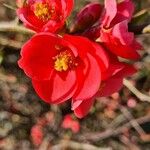
Chaenomeles lagenaria
Japanese Quince · Flowering quince · Common flowering quince · Japanese flowering quince · Chinese quince
Description
Source: leafsnapChaenomeles speciosa, the flowering quince, Chinese quince, or Japanese quince (in the context of traditional Chinese medicine known as zhou pi mugua), is a thorny deciduous or semi-evergreen shrub native to eastern Asia. It is taller than another commonly cultivated species, C. japonica, usually growing to about 2 m (6 ft 7 in). The flowers are usually red, but may be white or pink. The fruit is a fragrant but hard pome that resembles a quince.
🌳 Flowering quince provides more than decorative appeal; it is unexpectedly versatile. The plant's flowers can be processed to produce a natural fabric dye that yields a range of shades. Its blossoms also supply fragrant essential oils with potential applications in the perfumery industry.
🎭 Safety, Affection, Joy
Care Guide
💧 Water
☀️ Light Full sun
Flowering quince requires a substantial amount of sunlight for best growth, though it can tolerate more moderate light levels. Native to bright environments, inadequate sun can cause stunted growth or fewer blooms. Conversely, too much sun may scorch the leaves.
🌡️ Temperature 20–37.8°C
Flowering quince originates from temperate regions. It does best in a temperature range of 68 to 100°F (20 to 38℃). During colder months, keeping it in a warmer indoor location is preferable for maintaining suitable temperatures.
💨 Humidity
🪴 Soil 6-6
🌱 Fertilizer
The best time to fertilize a Flowering quince is in early spring when it emerges from dormancy. Fertilizing then stimulates overall growth and flower development. It improves the foliage, stems, and branches, while encouraging flowers that are larger, more vibrant, and longer-lasting. It also helps move nutrients from the roots to the flowers and enhances the plant’s health and resistance to disease.
🪴 Pot & Repot
✂️ Pruning
🌿 Propagating
🐛 Diseases & pets
☠️ Toxicity
Characteristics
- Plant Type
- Shrub
- Life Cycle
- Perennial
- Genus
- Chaenomeles
- Family
- Rosaceae
- Hardiness Zone
- 10-11
- Mature Height
- 2.13 m
- Mature Spread
- 2.13 m to 3.05 m
- Leaf Color
- Green
- Leaf Type
- Deciduous
- Flower Color
- Red, Pink, White
- Flower Size
- 4.06 cm to 5.08 cm
- Bloom Time
- Spring
- Planting Time
- Spring, Autumn
- Harvest Time
- Mid summer, Late summer
- Native Area
- Myanmar, China