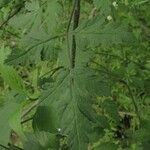
Chaerophyllum temulum
Rough chervil · Chervil
Description
Source: leafsnapChaerophyllum temulum, commonly known as Rough Chervil or Cow Parsley, is a biennial or perennial herbaceous plant belonging to the Apiaceae family. Native to Europe and Western Asia, it has also been introduced to North America. The plant can reach a height of 1 to 2 meters and features a hollow stem with finely divided, fern-like leaves. The small white flowers of Chaerophyllum temulum are arranged in umbels at the end of the stem and bloom from May to July. The plant produces small, oval-shaped seeds. Chaerophyllum temulum thrives in moist soils such as those found in meadows, hedgerows, and woodland edges, but it can also grow in drier soils. It serves as an important food source for many insects, including butterflies and bees. The plant contains several bioactive compounds, including flavonoids with antioxidant properties. However, Chaerophyllum temulum also harbors toxic compounds that can cause skin irritation or even poisoning if ingested. For centuries, traditional medicine in Europe has used it for its diuretic properties. Given its toxicity risks, however, its use should be avoided without proper medical supervision. In summary, Chaerophyllum temulum is an intriguing herbaceous species with both beneficial properties and potential health risks. It must be handled carefully by both humans and animals to avoid adverse effects.
🌳 Although commonly seen as a weed, rough chervil possesses underused potential in a range of applications. One lesser-known role is in bioremediation, notably phytoextraction, where it can help reveal the presence of heavy metals in soil. This trait comes from the plant's relative tolerance to such pollutants, offering a natural, low-cost alternative to conventional soil testing methods.
Care Guide
💧 Water Every 3 days
Rough chervil, originally from temperate regions, grows best in conditions with moderate moisture and consistently hydrated soil. To maintain its health, water the plant weekly to ensure the soil stays evenly moist. This is especially important during its active growing season, as proper hydration is essential for its development.
How should I water my Rough chervil?
To properly water the Rough chervil, it is best to use filtered water that is at room temperature. Tap water should be avoided, as it may contain harmful particles. Since the Rough chervil is native to warm environments, it is important to use room temperature or slightly warmer water to avoid shocking the plant. It is recommended to not water the plant from above, as this can lead to issues with the foliage. Instead, carefully pour the filtered room temperature water onto the soil until it is completely soaked. This helps to moisten the roots and promote their spreading throughout the soil, ensuring the plant receives the necessary nutrients.
What do I do if I give my Rough chervil too much or too little water?
Both overwatering and underwatering can harm your Rough chervil, but overwatering is more common. When the plant gets too much water, its stems and leaves may wilt and turn yellow. Overwatering for a long time can also lead to diseases like root rot, mold, and mildew, which can kill the plant. Underwatering is less common because the Rough chervil can handle drought. However, it is still possible, and in that case, the leaves will become brittle and brown. It's important to recognize the signs of overwatering early when caring for your Rough chervil. Some diseases like root rot can't be fixed if you wait too long. If you notice early signs of overwatering, reduce watering immediately. Check the soil quality where your Rough chervil is planted. If it doesn't drain well, replace it with a loose, well-draining potting mix. If you see signs of underwatering, simply water more regularly until the signs go away.
How much should I water my Rough chervil plant?
If your Rough chervil is in a pot, the most precise way to determine if it needs water is to check the soil by plunging your finger into it. If you find that the top two to three inches of soil are dry, it's time to water it. For Rough chervil grown outdoors in the ground, you can use a similar method to check the soil. When you notice that the top few inches have dried out, it's time to add water. Typically, during the spring and early fall, this plant should be watered about once a week using this method. However, when there is extremely hot weather, you may need to increase watering to about twice or more per week. It's worth noting that mature, well-established Rough chervil plants tend to have a noteworthy ability to withstand drought.
How much water does my Rough chervil plant need?
When watering your Rough chervil, make sure not to hold back on the amount of water you give. The soil should be about two to three inches dry before watering, and when you do water, make sure to thoroughly soak the soil. The water should be enough to flow out from the drainage holes at the bottom of the pot. If you don't see any excess water draining, it means you haven't provided enough water. However, be careful not to let the water accumulate in the soil, as this can harm the plant. On the other hand, if no water is draining through the pot, it could mean the soil doesn't drain well, which is not good for the plant's health. If the plant is outside, about one inch of rain per week should suffice.
How do I water my Rough chervil at different stages of growth?
The water needs of the Rough chervil can vary depending on its growth stages. In the early years and after transplanting, it requires more water because it's focused on developing new roots for future growth. These roots perform better with increased moisture. As it matures, the Rough chervil will require less water. Additionally, during the bloom period, when flowers are developing, it may need extra water due to the higher moisture demand.
☀️ Light Full sun
The rough chervil does best when receiving unbroken sunlight during the day, though it can tolerate periods of reduced light. Its growth pattern originates from environments dominated by clear skies. However, insufficient sunlight may impede its development, while excessive sunlight can cause harm.
What are the sunlight requirements for Rough Chervil?
Rough Chervil thrives best when it gets continuous exposure to sunlight throughout the day, adapting well even to periods of less intense light. Originating from environments with abundant sunshine, it requires full sun, described as receiving above 6 hours of sunlight, or partial sun, which means about 3-6 hours of sunlight. However, exposure to inadequate sunlight can inhibit its growth, and excessive sunlight may cause damage. It's suggested to observe your garden to find spots with the ideal balance of light and shade to ensure your plants' well-being.
How can artificial lighting support Rough Chervil's growth indoors?
For indoor Rough Chervil plants that don't receive sufficient natural sunlight, especially during winter or in less sunny areas, artificial lighting proves to be a critical solution for optimal growth. Artificial lights, such as LED lights, are recommended because they can be tailored to provide the specific wavelengths needed by plants. The intensity should range from 10-50W/sq ft depending on whether the plants prefer full sun, partial sun, or shade, while the light source should be placed 12-36 inches above the plant to mimic natural sunlight effectively. Ensuring the plants receive 8-12 hours of light daily can promote healthier and faster growth.
What are common symptoms of inadequate or excessive sunlight in Rough Chervil?
Rough Chervil shows several symptoms when suffering from improper lighting conditions. Inadequate light can lead to smaller new leaves, leggy or sparse growth, faster leaf drop, slower or halted new growth, and lighter-colored or pale new leaves. Conversely, excessive sunlight might cause chlorosis (leaves turning yellow), sunscald (damaged by intense sunlight), leaf curling (defense mechanism against extreme sunlight), wilting (loss of turgor pressure due to water loss), and leaf scorching (brown, dry patches on leaves). These symptoms highlight the plant's struggle with sunlight absorption and its effects on photosynthesis and overall health.
How do you address Rough Chervil's light-related issues?
To address light-related issues in Rough Chervil, gradually acclimatize your plants to receive at least 6 hours of direct sunlight daily, moving them closer to a south-facing window or brighter location each week. For plants that are large or not easily moved, consider using artificial light sources, such as desk or ceiling lamps, for at least 8 hours daily or invest in professional plant grow lights. Outdoors, gradually transition your plants to sunnier spots to prevent shock. Pruning obstructive branches or transplanting to locations with better sunlight and drainage are effective strategies for outdoor and ground plants, respectively. Note that parts of the plant previously affected by light issues might not recover, but new growth should be healthier with proper light exposure.
🌡️ Temperature 10–35°C
Rough chervil can tolerate a wide range of temperatures, but its distribution may still be restricted by particular combinations of water and heat. It performs best in warm summer climates with sufficient rainfall or watering. Extended spells of cloudy, rainy weather or prolonged high temperatures can raise the chance of Rough chervil dying. In winter, adequate protection from cold can increase the plant's survival rate.
What is the botanic name of Rough chervil?
Rough chervil, known in the botanical community as Chaerophyllum temulum, is a plant distinguished by its unique characteristics and classification. The information provided does not include specifics about its essentials or symptoms related to this plant, possibly indicating either an overview approach or a focused discussion on its classification and naming.
💨 Humidity
🪴 Soil 6-7
🌱 Fertilizer
Rough chervil are seen as heavy feeders in terms of nutrients. They require frequent, small doses of nitrogen and potassium fertilizers and periodic applications of phosphorus, micronutrients, sulfur, and magnesium to maintain strong growth and bright coloration. Continuous fertilization throughout the growing season is necessary to prevent deficiency symptoms and preserve optimal growth.
🪴 Pot & Repot
✂️ Pruning
🌿 Propagating
🐛 Diseases & pets
☠️ Toxicity
Characteristics
- Plant Type
- Herb
- Life Cycle
- Biennial
- Genus
- Chaerophyllum
- Family
- Apiaceae
- Hardiness Zone
- 6-9
- Mature Height
- 91 cm
- Mature Spread
- 30 cm to 61 cm
- Leaf Color
- Green, Dark Green
- Leaf Type
- Deciduous
- Flower Color
- White
- Flower Size
- 0.51 cm
- Bloom Time
- Late spring, Early summer
- Planting Time
- Autumn
- Harvest Time
- Mid summer
- Native Area
- Turkey, Sweden, Austria, Slovakia, Montenegro, Slovenia, Morocco, Croatia, Belarus, Russia, Germany, Estonia, Romania, Belgium, Moldova, Portugal, Netherlands, France, Tunisia, Czech Republic, Bulgaria, Poland, Greece, Ukraine, Serbia, Lithuania, Italy, Spain, Switzerland, Denmark, Albania, Ireland, United Kingdom, Hungary, Algeria