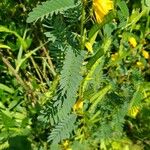
Chamaecrista fasciculata
Partridge pea · Golden cassia · Sensitive-pea · Showy partridge-pea · Prairie-senna
Description
Source: leafsnapChamaecrista fasciculata, the partridge pea, is a species of legume native to most of the eastern United States. It is an annual which grows to approximately 0.5 meters tall. It has bright yellow flowers from early summer until first frost, with flowers through the entire flowering season if rainfall is sufficient.The flowers are hermaphroditic, although a fraction of plants, less than 5%, do not produce sufficient pollen to reproduce as males. This phenomenon has been studied in a variety of plants as a possible evolutionary step towards dioecy, in which male and female flowers occur on separate plants. C. fasciculata is pollinated only by bees.The flowers have yellow anthers that produce reproductive pollen, and purple anthers that produce food pollen, but no nectar. Long-tongued bees such as bumblebees, honey bees, long-horned bees, and leafcutting bees pollinate the flowers. There are extrafloral nectaries on the leaf stems, which attract a different set of insects: sweat bees, flies, wasps, and ants.It thrives in areas that have been burned recently before declining in number in the following years. It is considered an excellent choice for planting in disturbed areas, as it will quickly cover an area, preventing erosion, while still allowing other plants to become established. It is also grown as an ornamental or for honey production.
🌳 Partridge pea contributes to soil fertility because it can fix nitrogen. This leguminous species forms root nodules that contain nitrogen-fixing bacteria, which enrich the soil by converting atmospheric nitrogen into forms usable by other plants, indicating its potential use in sustainable agriculture as a green manure.
🎭 Wealth, Love
Care Guide
💧 Water Twice per week
Partridge pea is well-suited to open fields and prairies, where it demonstrates drought tolerance and a preference for balanced moisture levels. Watering the plant twice a week can replicate its natural rainfall conditions. Native to temperate regions, partridge pea effectively absorbs water during its growing season, promoting robust growth and resilience.
How should I water my Partridge pea plant?
To water Partridge pea, you have several options: a garden hose with a spray nozzle, a watering can, or any other common watering tool. Partridge pea is not too picky about the water source—it can thrive on rainwater, tap water, or filtered water. However, watering from above should be avoided as it can harm the leaves, flowers, and potentially cause disease. A more effective watering method for Partridge pea is setting up a drip irrigation system, as it provides even and direct water supply to the soil. For container-grown Partridge pea, you can follow a similar approach, but use a cup, watering can, or tap to water the soil directly.
What should I do if I give my Partridge pea too much water or too little water?
To remedy underwatering for Partridge pea, simply increase the frequency of watering when you notice it lacks moisture. However, overwatering can be a serious issue that can lead to diseases and the plant's decline. To prevent this, ensure the plant is in a suitable location with ample sunlight to dry the soil and proper drainage to prevent waterlogging. If you overwater a potted Partridge pea, consider transferring it to a new pot with better drainage. Use loose soils and a pot that drains efficiently during the repotting process.
How much water does my Partridge pea need?
Partridge pea requires regular watering throughout the growing season. In the spring, water once a week. As the season progresses and it gets warmer, increase watering to two to three times a week, but be careful not to exceed this rate as it can harm the plant. Regardless of watering frequency, ensure that the soil remains moist but not soaked. For Partridge pea in pots, water more frequently as the soil can dry out faster. Generally, water container-grown plants a few times a week compared to once a week for plants in the ground.
How much water does my Partridge pea plant need?
To determine how much water to give your Partridge pea, there are a few options. Some gardeners choose to go by feel, watering until the first six inches of soil feel moist. Another option is to use a set measurement, such as giving two gallons of water per week, adjusting based on temperature and soil dryness. However, be careful not to overwater if your plant needs less than two gallons. When growing in a container, you'll need a different approach. Water enough to moisten all dry soil layers, checking by sticking your finger in the soil or until you see excess water draining from the pot.
How do I know if I'm giving enough water to my Partridge pea plant?
Avoiding overwatering your Partridge pea can be a bit challenging. On one hand, these plants need to be watered weekly because they have deep roots. However, overwatering can lead to root rot and browning. Underwatering is less of a concern as Partridge pea can survive without supplemental watering for some time. However, if you neglect to water it for too long, it will wilt and its leaves will become dry.
☀️ Light Full sun
Partridge pea prefers an environment with abundant sunlight for optimal growth, although it can tolerate lower light levels. Originally rooted in deciduous forest habitats, it flourishes under open sky. Adverse effects occur when light is either too intense, causing leaf damage, or too scarce, resulting in stunted growth.
What are the sunlight requirements for Partridge pea?
Partridge pea requires a generous amount of sunlight for optimal growth, thriving best in environments that mimic its original deciduous forest setting under the open sky. It needs full sun, which is above 6 hours of sunlight daily, but can also tolerate partial sun, about 3-6 hours of sunlight. It's important to observe how sunlight moves through your garden to find spots that offer a perfect balance of light and shade, ensuring the plants' happiness. However, the plant can experience negative effects if exposed to either too much light, leading to leaf damage, or too little, resulting in limited growth.
How does artificial lighting benefit indoor Partridge pea plants and what are the recommendations?
For indoor Partridge pea plants, when natural sunlight is insufficient, particularly in less sunny spaces or during winter, artificial lighting serves as a vital growth promoter. Using the right type of artificial light, such as LED lights that can be tailored to provide specific wavelengths needed by the plants, is crucial. Recommendations for artificial lighting include: ensuring full sun plants receive 30-50W/sq ft, partial sun plants 20-30W/sq ft, and full shade plants 10-20W/sq ft. Place the light source 12-36 inches above the plant, and mimic natural daylight hours, requiring 8-12 hours of light per day, to promote faster, healthier growth.
What are the symptoms of inadequate light for indoor Partridge pea plants?
Indoor Partridge pea plants with insufficient light may exhibit several symptoms, including smaller new leaves compared to older ones, leggy or sparse growth due to longer spaces between leaves or stems, faster leaf drop as the plant tries to conserve resources, slower or halted growth as the plant enters survival mode, lighter-colored new leaves indicating a lack of chlorophyll, and symptoms of excessive sunlight exposure like chlorosis, sunscald, leaf curling, wilting, and leaf scorching. These signs indicate that the plant's light requirements are not being met, affecting its overall health and growth.
What are effective solutions for addressing light-related issues in Partridge pea plants?
To address light-related issues in Partridge pea plants, both indoor and outdoor strategies can be employed. For indoor plants, gradually moving them to a sunnier location each week until they receive at least 6 hours of direct sunlight daily is recommended, using a south-facing window and keeping curtains open during the day for maximum sunlight exposure. If the plant is large or not easily movable, consider using artificial light, keeping a desk or ceiling lamp on for at least 8 hours daily or investing in professional plant grow lights. For outdoor plants, it's crucial to gradually move them to better sunlight spots, avoiding sudden changes in light intensity to prevent sunburn. Solutions also include reducing obstructions like pruning trees that block sunlight, and for ground-planted ones, consider transplanting during their dormant period to a location with ample sunlight and good drainage. Note that parts of the plant affected by insufficient sunlight may not recover, but new growth will be healthy after increasing light exposure.
🌡️ Temperature 5–32.2°C
Partridge pea is native to areas where temperatures typically range from 68 to 95 °F (20 to 35 ℃). It prefers warm conditions and may have difficulty when temperatures fall outside that range. Consider providing shade in summer and warmth in winter if necessary.
What is the ideal temperature range for growing Partridge Pea?
Partridge Pea (Chamaecrista fasciculata) thrives in warm climates, with an ideal temperature range between 68 to 95 °F (20 to 35 °C). It has strong cold resistance but may struggle in temperatures outside this preferred range. To support its growth through varying seasons, consider providing shade during hot summers and warmth during colder winters. If winter temperatures are expected to drop significantly, protecting the plant with soil or straw coverings can help, along with ensuring the soil remains moist before the first freeze in autumn.
How does low temperature affect Partridge Pea, and what should be done?
Partridge Pea is capable of tolerating low temperatures up to a certain extent. However, if temperatures fall below its tolerance level, the plant may not show immediate damage but can experience a decrease in sprouting or fail to sprout at all come spring. To manage this, it is recommended to remove any parts of the plant that have failed to sprout in the spring, encouraging healthier growth in the warmer seasons.
What are the effects of high temperatures on Partridge Pea, and how can they be mitigated?
High temperatures, especially above the plant's preferred maximum, can cause the leaves of Partridge Pea to lighten in color, curl, become prone to sunburn, and, in severe cases, lead to the wilting and drying out of the entire plant. To mitigate these effects, sunburned and dried parts should be trimmed away. The plant may also benefit from being moved to a shaded location or covered with a shade cloth during the hottest parts of the day. Keeping the soil moist with morning and evening watering can also help counteract the stress of high temperatures.
💨 Humidity
🪴 Soil 6-7
🌱 Fertilizer
Partridge pea responds well to regular, light applications of fertilizer to encourage healthy leaf development. You should fertilize Partridge pea about once a month during the summer months. Nitrogen is essential for foliage, and adding nitrogen-rich sources helps Partridge pea thrive.
🪴 Pot & Repot Every 12 months
When repotting Partridge pea, choose a pot that's 1-2 inches (2.5–5.1 cm) larger in diameter and make sure it has good drainage. Use a well-draining potting mix and consider adding perlite for extra drainage. Repot in spring or early summer, water thoroughly afterward, and place it in a shady spot at first.
✂️ Pruning
Pruning partridge pea in the spring, either early or late, helps improve airflow and encourages new growth. To do this effectively, focus on removing dead stems and trimming branches that have grown too long. Using clean, sharp tools is essential for making precise cuts just above the leaf nodes, which promotes healthier growth and results in a bushier plant.
🌿 Propagating
🐛 Diseases & pets
☠️ Toxicity
Characteristics
- Plant Type
- Herb
- Life Cycle
- Annual
- Genus
- Chamaecrista
- Family
- Fabaceae
- Hardiness Zone
- 4-8
- Mature Height
- 49 cm
- Mature Spread
- 30 cm to 91 cm
- Leaf Color
- Green, Blue
- Leaf Type
- Deciduous
- Flower Color
- Yellow
- Flower Size
- 2.54 cm
- Bloom Time
- Early summer, Mid summer
- Planting Time
- Spring
- Harvest Time
- Mid summer, Late summer
- Native Area
- Eastern United States