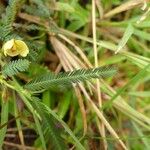
Chamaecrista nictitans
Sensitive partridge pea · Sensitive-pea · Sensitive cassia · Wild sensitive-plant · Sensitive Plant
Description
Source: leafsnapChamaecrista nictitans, commonly known as the sensitive partridge pea or wild sensitive plant, is a herbaceous annual belonging to the Fabaceae family. Native to North America, it thrives in diverse habitats such as fields, meadows, and roadsides. The plant reaches up to 2 feet in height, featuring a slender stem with small leaflets that fold up when touched or exposed to heat. It produces bright yellow flowers with five petals, which bloom from July through September. The fruit is a small pod containing several seeds. In traditional medicine, Chamaecrista nictitans has been valued for its anti-inflammatory properties and used to treat skin conditions like eczema. It is also an important food source for various wildlife, including birds, bees, butterflies, and other insects. Overall, Chamaecrista nictitans is an attractive wildflower that enhances natural landscapes with its beauty while providing significant ecological benefits by supporting wildlife populations.
🌳 Sensitive Partridge Pea is more than an attractive wildflower; it also fosters biodiversity by creating a welcoming habitat for a range of insects. It feeds the caterpillars of several butterfly species, serving as both an important food source and a nursery. Because it has extrafloral nectaries, Sensitive Partridge Pea also draws predatory and parasitic insects that act as natural pest control agents in ecosystems, showing a commonly overlooked natural interdependence.
🎭 Wealth, Love
Care Guide
💧 Water Every 7 days
Sensitive Partridge Pea flourishes in areas with regular rainfall and prefers moderate moisture levels. It needs to be watered weekly, ensuring a balance between too much and too little water. As an outdoor plant in temperate regions, the Sensitive Partridge Pea adjusts its growth to make the most of seasonal rainfall during the growing season.
How should I water my Sensitive Partridge Pea plant?
To water Sensitive Partridge Pea, you have several options for watering tools such as a garden hose with a spray nozzle or a watering can. This plant is not too particular about the type of water it receives and can thrive with rainwater, tap water, or filtered water. However, it's best to avoid watering from overhead as it can harm the leaves, flowers, and potentially cause diseases. A drip irrigation system is often the most effective method, as it evenly and directly provides water to the soil. If you have a container-grown Sensitive Partridge Pea, you can use a cup, watering can, or tap to water it directly into the soil.
What should I do if I give my Sensitive Partridge Pea too much or too little water?
If you notice that your Sensitive Partridge Pea plant is lacking moisture, the remedy is simple - start watering it more regularly. However, overwatering can be a serious issue that may lead to diseases and the eventual decline and death of the plant. To prevent this, make sure to choose a suitable growing location with ample sunlight and good drainage to prevent water from pooling and causing waterlogged soil. If your Sensitive Partridge Pea is in a pot and you've been overwatering it, you might need to consider transferring it to a new pot with better drainage. When repotting, remember to use loose soil and a pot that allows efficient drainage.
How frequently should I water my Sensitive Partridge Pea?
Sensitive Partridge Pea requires regular watering throughout the growing season. In spring, water the plant once per week. As the season progresses and temperatures rise, you may need to increase watering to two to three times per week. However, be careful not to exceed this rate, as it can harm the plant. Regardless of watering frequency, it is important to keep the soil relatively moist but not wet for the Sensitive Partridge Pea to thrive. When watering a potted Sensitive Partridge Pea, you should water more frequently compared to one planted in the ground. Generally, water the potted plant a few times per week, while an in-ground plant only needs watering once per week. This is because the soil in a pot can heat up and dry out faster.
How much water does my Sensitive Partridge Pea require?
To determine the amount of water to give your Sensitive Partridge Pea, there are a few options. One approach is to assess the soil moisture by feeling it. In this method, you would water until the top six inches of soil feel moist. Another option is to use a specific measurement. Typically, Sensitive Partridge Peas need around two gallons of water per week, but this amount may vary based on temperature and soil dryness. However, following strict guidelines may result in overwatering if your plant requires less. If you're growing your Sensitive Partridge Pea in a container, you'll need a different approach. In this case, you should water enough to moisten all the dry soil layers. To check the moisture level, you can simply stick your finger in the soil. Another indicator is the presence of slight excess water draining from the pot's holes.
How do I know if I'm giving enough water to my Sensitive Partridge Pea?
Taking care of your Sensitive Partridge Pea can be a bit challenging when it comes to watering. On one hand, the plants have deep roots that need regular moisture, so watering the soil each week is necessary. However, overwatering can lead to root rot and cause the plant's foliage to turn brown. Underwatering is less of a concern for this plant as it can survive without extra watering for some time. However, if you neglect to provide water for too long, the plant will likely start to wilt, and the leaves may become dry.
☀️ Light Full sun
Sensitive Partridge Pea does best in full sun. Throughout its various developmental stages the plant requires constant, intense light to grow healthily. Sunlight plays an indispensable role in its original adaptive environment. However, both excessive light and insufficient light can cause impediments to its growth and development.
What are the sunlight requirements for Sensitive Partridge Pea?
Sensitive Partridge Pea requires full sun, which means it needs above 6 hours of sunlight each day to thrive optimally. Sunlight is crucial throughout its different development stages for healthy growth, originating from its adaptive environment. It's important to monitor how sunlight moves through your garden to ensure your plants get the perfect balance of light and shade, promoting their well-being.
How can artificial lighting be used for Sensitive Partridge Pea?
Indoor plants, like the Sensitive Partridge Pea, require adequate lighting for optimal growth, especially when natural sunlight is insufficient. Artificial lights, such as LED lights, can provide essential wavelengths for faster, healthier growth. Full sun plants need 30-50W/sq ft, partial sun plants need 20-30W/sq ft, and full shade plants need 10-20W/sq ft of artificial light. The light source should be placed 12-36 inches above the plant, mimicking natural sunlight for 8-12 hours per day.
What are the symptoms of light deficiency or overexposure in Sensitive Partridge Pea?
Symptoms of light deficiency in Sensitive Partridge Pea include small new leaves, leggy or sparse growth, faster leaf drop, slower or no new growth, lighter-colored new leaves, and symptoms of overexposure include chlorosis, sunscald, leaf curling, wilting, and leaf scorching. These symptoms indicate either a lack of sufficient sunlight or damage from excessive sunlight exposure, both of which affect the plant's ability to photosynthesize and overall health.
What solutions can be employed for light-related issues in Sensitive Partridge Pea?
For indoor plants, gradually moving them to a sunnier location or using artificial light can address light deficiency. Outdoor plants benefit from a gradual adjustment to sunnier spots to prevent sunburn. Removing obstructions or transplanting to sunnier locations can improve sunlight exposure. For severe cases, employing professional plant grow lights or ensuring a minimum of 8 hours of direct sunlight with techniques like using a south-facing window can also be effective solutions.
🌡️ Temperature 5–35°C
Sensitive Partridge Pea is adapted to grow in temperatures between 68 and 95 °F (20 to 35 ℃). As a native of temperate regions, extreme cold or heat can negatively affect its growth. To ensure optimal development, maintain this temperature range, especially during extreme seasons.
What is the ideal temperature range for growing Sensitive Partridge Pea?
The ideal temperature range for growing Sensitive Partridge Pea (Chamaecrista nictitans) is between 68 to 95 °F (20 to 35 °C). Being native to temperate lands, the plant's growth may be adversely affected by temperatures beyond this range. To ensure the plant thrives, it's important to maintain suitable temperatures, especially during extreme weather conditions.
Does Sensitive Partridge Pea require frost protection in winter?
Sensitive Partridge Pea showcases strong resistance to cold and typically does not require special frost protection measures during winter. However, in instances where winter temperatures are anticipated to fall below -25°C, providing cold protection is advised. This can include covering the plant with soil or straw. Additionally, watering the plant abundantly before the first freeze in autumn to keep the soil moist can help prevent drought and water scarcity during the colder months.
How does low temperature affect Sensitive Partridge Pea, and what are the solutions?
Sensitive Partridge Pea can tolerate cold well, preferring temperature to stay above 20°C and ideally not to fall below 0°C. In conditions where the temperature plunges below -25°C, the plant may not exhibit immediate damage during winter, but come spring, there could be a noticeable decrease in sprouting, or the plant may not sprout at all. To alleviate this issue, in spring, any parts that have failed to sprout should be removed to encourage new growth.
What are the effects of high temperature on Sensitive Partridge Pea and the recommended solutions?
In summer, it's crucial to keep Sensitive Partridge Pea below 35°C. Exposure to temperatures above 41°C may lead to lighter leaf coloration, curling leaves, susceptibility to sunburn, and in severe cases, wilting and drying up of the entire plant. To combat these issues, trim away sunburned and dried parts. Relocating the plant to a shaded area during the midday and afternoon sun, or employing a shade cloth for protection, can be beneficial. Ensuring the plant is watered in the morning and evening will help keep the soil adequately moist.
💨 Humidity
🪴 Soil 6-7
🌱 Fertilizer
When Sensitive Partridge Pea has opened most of its flowers to full size, it's time to resume fertilizing. At the height of bloom production, begin applying fertilizer again every three to four weeks, weather permitting. Then, once Sensitive Partridge Pea starts producing fewer new flowers, stop fertilizing; there's no need to feed it when the plant can no longer produce more blooms.
🪴 Pot & Repot
✂️ Pruning
🌿 Propagating
🐛 Diseases & pets
☠️ Toxicity
Characteristics
- Plant Type
- Herb
- Life Cycle
- Annual, Perennial
- Genus
- Chamaecrista
- Family
- Fabaceae
- Hardiness Zone
- 5-10
- Mature Height
- 61 cm
- Mature Spread
- 20 cm to 40 cm
- Leaf Color
- Green, Dark Green
- Leaf Type
- Deciduous
- Flower Color
- Yellow
- Flower Size
- 2.54 cm
- Bloom Time
- Early summer, Mid summer
- Planting Time
- Spring, Summer, Autumn
- Harvest Time
- Mid summer, Late summer
- Native Area
- Belize, Honduras, Mexico, Guatemala, Peru, Trinidad and Tobago, Panama, Jamaica, Colombia, Bahamas, Cuba, Paraguay, Argentina, Bolivia, Venezuela, Brazil, Guyana, El Salvador, Nicaragua, Ecuador, Suriname, Costa Rica