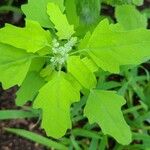
Chenopodium ficifolium
سلمه تره · Fig-leaf goosefoot · Fig-Leaved Lamb'S-Quarters · Fig-leaved Goosefoot · Figleaf Goosefoot
Description
Source: leafsnapChenopodium ficifolium, commonly known as fig-leaved goosefoot, is a species of flowering plant in the Amaranthaceae family. Native to Europe and western Asia, it has also been introduced to North America. This plant can grow up to 1 meter tall and features a branching stem with green leaves that resemble fig leaves. Its small, greenish-white flowers are arranged in clusters at the ends of its branches. Fig-leaved goosefoot prefers moist soils, such as those found along riverbanks or in wet meadows, but it can also thrive in dry soils. It is an annual or biennial plant that reproduces by seeds. Historically, various cultures have used this plant for its anti-inflammatory properties in medicinal applications. Native Americans even utilized it as a food source, grinding its seeds into flour. While fig-leaved goosefoot can be grown as an ornamental plant due to its attractive foliage, it has the potential to become invasive if not properly managed, because of its easy self-seeding ability. In summary, Chenopodium ficifolium is a fascinating species with both medicinal and cultural significance. It adds beauty when grown ornamentally but should be carefully monitored if planted outside controlled environments to avoid potential invasiveness.
🌳 Long neglected, fig‑leaved goosefoot is more than a mere weed; it presents a wide array of uses. Native peoples once prized it as a food, likening it to spinach. In the present day, its high biomass production has prompted interest as a potential biofuel, placing fig‑leaved goosefoot into discussions about renewable energy. It is also valuable as animal fodder, demonstrating its versatility and emphasizing the potential of embracing and using formerly overlooked plant species.
Care Guide
💧 Water Every 7 days
Native to temperate regions, the fig-leaved goosefoot flourishes with consistent soil moisture and can endure short periods of dryness. To ensure it stays well-hydrated, especially during its active growing season, it's best to water it weekly. This practice encourages lush foliage and strong growth.
How should I water my Fig-leaved goosefoot in the best way?
To water Fig-leaved goosefoot, you have several options. You can use a garden hose with a spray nozzle, a watering can, or any common watering tool. This plant is not too particular about the type of water it receives. It can survive on rainwater, tap water, or filtered water. However, it's best not to water this plant from above as it can damage the leaves and flowers and increase the risk of disease. Instead, consider using a drip irrigation system, which evenly and directly applies water to the soil. If you have a Fig-leaved goosefoot in a container, you can use a similar approach but with different tools. Use a cup, watering can, or tap water to water the soil directly.
What should I do if I give my Fig-leaved goosefoot too much or too little water?
If you notice that your Fig-leaved goosefoot lacks moisture, a simple remedy is to water it more regularly. Overwatering, however, can lead to more serious issues that may not be easily noticeable. Overwatered plants may become susceptible to diseases that can cause them to decline and eventually die. To prevent this, it is important to choose a proper growing location with ample sunlight to help dry out the soil and good drainage to prevent water from pooling. If you have overwatered your Fig-leaved goosefoot in a pot, it may be necessary to transfer it to a new pot with better drainage. When repotting, make sure to use loose soil and a pot that drains efficiently.
How often should I water my Fig-leaved goosefoot plant?
Fig-leaved goosefoot requires regular watering throughout the growing season. In spring, water once a week and adjust to two to three times a week as it gets warmer. However, be careful not to exceed this amount as it can harm the plant. Keep the soil relatively moist but not wet. Watering a Fig-leaved goosefoot in a pot requires more frequency due to the soil drying out faster. Generally, water a potted plant a few times per week compared to once a week for a plant in the ground.
How much water does my Fig-leaved goosefoot require?
There are a few methods you can use to figure out how much water to give your Fig-leaved goosefoot. One option is to feel the soil and water until the top six inches are moist. Alternatively, you can use a set amount of water, such as two gallons per week, depending on the weather and soil dryness. However, be cautious as this approach may cause overwatering if your plant needs less. When growing in a container, you should moisten all layers of dry soil and check for moisture by sticking your finger in or letting excess water drain from the pot.
How do I know if I'm giving my Fig-leaved goosefoot the right amount of water?
Avoiding overwatering your Fig-leaved goosefoot can be challenging due to its unique needs. While these plants have deep roots and require weekly soil moistening, they are also highly prone to root rot and browning when overwatered. Fortunately, underwatering is less of a concern as these plants can survive without supplemental watering for some time. However, if you wait too long to provide water, the plant may begin to wilt and its leaves may become dry.
☀️ Light Full sun
Fig-leaved goosefoot prospers under uninterrupted sunlight, which is essential for its vigorous growth and overall health. Originating from habitats where light is not limited, it can do well without any shade. Both excessive and insufficient light may impair the plant's well-being.
What are the sunlight requirements for Fig-leaved goosefoot?
Fig-leaved goosefoot thrives best under full sun conditions, requiring more than 6 hours of sunlight daily to ensure vigorous growth and health. It originates from environments where sunlight is abundant, enabling it to flourish without the need for shade. However, too much or too little sunlight could negatively affect the plant's well-being. It's essential to observe the movement of sunlight through your garden and select locations that provide a balance of light and shade suited to the needs of your plants, ensuring their optimal growth.
How important is sunlight for the growth of Fig-leaved goosefoot, and are there any recommendations for artificial lighting?
Sunlight plays a crucial role in the growth and health of Fig-leaved goosefoot, a plant that flourishes with unobstructed solar exposure. In situations where natural light is insufficient, especially during winter or in less sunny indoor spaces, artificial lighting can serve as an effective substitute to promote healthier, faster growth. For optimal results, choose LED lights tailored to provide specific wavelengths needed by your plants. Full sun plants should receive 30-50W/sq ft of artificial light, partial sun plants 20-30W/sq ft, and full shade plants 10-20W/sq ft. Place the light source 12-36 inches above the plant, mimicking natural sunlight conditions, and ensure that most plants receive 8-12 hours of light per day.
What are the symptoms of light deficiency or overexposure in Fig-leaved goosefoot?
When grown indoors with insufficient light, Fig-leaved goosefoot may exhibit signs of light deficiency such as smaller new leaves, leggy or sparse growth, faster leaf drop, slower or no new growth, lighter-colored new leaves, symptoms of chlorosis, sunscald, leaf curling, wilting, and leaf scorching. These symptoms can range from subtle to more severe, indicating either a lack of adequate sunlight or the negative effects of too much direct exposure. It's crucial to monitor these signs and adjust the plant's exposure to light accordingly to maintain its health and vitality.
What are the solutions for managing light-related issues in Fig-leaved goosefoot?
To address light-related issues in Fig-leaved goosefoot, consider gradually moving indoor plants to sunnier locations, aiming for at least 6 hours of direct sunlight daily, and using south-facing windows for maximum light exposure. Artificial lighting, such as desk lamps or professional grow lights, can supplement natural light for large or stationary plants ensuring they receive ample light for at least 8 hours a day. Outdoors, gradually acclimate plants to sunlight by moving them weekly to avoid shock and sunburn. Pruning obstructions and transplanting during dormant periods can also improve light exposure. While some damage from inadequate sunlight may be irreversible, new growth should be healthier following these adjustments.
🌡️ Temperature 5–32.2°C
Fig-leaved goosefoot originates from habitats with mild to moderately warm climates and prefers temperatures of 68 to 95 °F (20 to 35 ℃). For best growth, it is advisable to adjust the environment seasonally to match those conditions.
What is the optimal climate for Fig-leaved goosefoot?
Fig-leaved goosefoot prefers moderate to somewhat warm climates, thriving best in temperatures ranging from 68 to 95 °F (20 to 35 °C). For optimal growth, it is advised to adjust your growing environment seasonally to mirror these conditions. Although the plant is strong in cold resistance and usually does not require special frost protection measures during winter, in areas where winter temperatures are expected to drop below -30°C, it is crucial to provide cold protection by covering the plant with soil or straw. Additionally, watering the plant abundantly before the first freeze in autumn helps ensure the soil remains moist and enters a frozen state, which prevents drought and water scarcity for the plant during the winter and early spring.
How does Fig-leaved goosefoot respond to low temperatures?
Fig-leaved goosefoot is particularly cold-tolerant and thrives best when temperatures are maintained above 20°C. During winter, it is advisable to keep the temperature above 0°C. However, exposure to temperatures below -30°C may not show noticeable changes during winter but could lead to a decrease in sprouting or even result in no sprouting during the spring. If such an event occurs, the solution is to remove any parts of the plant that have failed to sprout in the spring.
How does Fig-leaved goosefoot react to high temperatures?
During the summer, it is crucial to ensure that temperatures around Fig-leaved goosefoot do not exceed 35°C. When temperatures go beyond 38°C, the plant may exhibit signs of stress such as lighter-colored leaves that are prone to curling, susceptibility to sunburn, and in severe cases, wilting, and drying of the entire plant. To mitigate these issues, affected parts should be trimmed away, and the plant should be moved to a shadier location or protected with a shade cloth to shield it from the midday and afternoon sun. It is also important to water the plant in the morning and evening to maintain soil moisture.
💨 Humidity
🪴 Soil 6-7
🌱 Fertilizer
Fig-leaved goosefoot benefits from regular, dilute fertilizer applications to encourage healthy leaf development. You should fertilize Fig-leaved goosefoot about once a month during the summer months. Nitrogen is essential for foliage, and providing nitrogen-rich sources helps Fig-leaved goosefoot thrive.
🪴 Pot & Repot
✂️ Pruning
🌿 Propagating
🐛 Diseases & pets
☠️ Toxicity
Characteristics
- Plant Type
- Herb
- Life Cycle
- Annual
- Genus
- Chenopodium
- Family
- Amaranthaceae
- Hardiness Zone
- 4-8
- Mature Height
- 20 cm to 49 cm
- Mature Spread
- 20 cm to 49 cm
- Leaf Color
- Green, Dark Green
- Leaf Type
- Semi-evergreen
- Flower Color
- Yellow, Green
- Flower Size
- 0.10 cm to 0.20 cm
- Bloom Time
- Early summer, Mid summer
- Planting Time
- Spring
- Harvest Time
- Mid summer
- Native Area
- Nepal, Saudi Arabia, Egypt, Austria, Bulgaria, Pakistan, Poland, Laos, Greece, Thailand, Ukraine, China, Uzbekistan, Russia, Afghanistan, Hungary, Iraq, Germany, Italy, Kazakhstan, Spain, Switzerland, Vietnam, Myanmar, Israel, France, Iran, Romania, Belgium, Turkmenistan, Netherlands