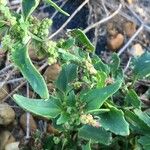
Chenopodium murale
Nettle-leaved Goosefoot · Nettleleaf Goosefoot · Sprainbush · Nettle-leaf goosefoot · Nettle-leaved fat-hen
Description
Source: leafsnapChenopodium murale, commonly known as nettle-leaved goosefoot or prickly saltwort, is an annual herbaceous plant belonging to the Amaranthaceae family. Native to the Mediterranean region, it has spread worldwide as a weed. The plant can reach up to 1 meter in height and features a branching stem with green leaves that are triangular or diamond-shaped, covered with tiny hairs that give it a prickly texture. Its flowers are small, greenish-white, and clustered at the ends of the branches. Chenopodium murale thrives in dry, sandy soils but can also grow in disturbed areas such as roadsides, fields, gardens, and waste places. It is considered an invasive species due to its ability to outcompete native plants for resources. Historically, the plant has been used for medicinal purposes by various cultures. The leaves have been used topically to treat skin conditions such as eczema and applied directly to wounds for their antiseptic properties. Additionally, the seeds of Chenopodium murale have been consumed by humans since ancient times due to their high nutritional value. They are rich in protein and contain essential minerals such as calcium and iron. Overall, Chenopodium murale is a fascinating plant with both beneficial medicinal properties and detrimental impacts on local ecosystems when it becomes invasive outside of its natural habitat.
🌳 Although it appears modest, nettle-leaved goosefoot has been acknowledged for its nutritional qualities and its potential as a pseudo-cereal, much like quinoa. In some cultures it has been eaten because of its high protein and vitamin content. Today it attracts attention for its suitability in gluten-free diets and as a healthy alternative grain. Furthermore, its occurrence as a weed across many regions shows its adaptability to varied environments, suggesting it could be used for soil reclamation and as an emergency food source during ecological disasters.
🎭 Virtue
Care Guide
💧 Water Every 7 days
☀️ Light Full sun
The nettle-leaved goosefoot grows best in locations with full sun but can also tolerate less bright conditions. It comes from habitats that receive plenty of sunlight. Excessive sun can dry it out, whereas too little light may hinder growth or cause the leaves to wilt.
🌡️ Temperature 15–35°C
Nettle-leaved goosefoot originates from temperate zones and does best in temperatures of 68 to 95 °F (20 to 35 ℃). It is adaptable and can tolerate cooler conditions, though warmer climates encourage more rapid growth. Adjust as the seasons change.
💨 Humidity normal (40-60%)
This plant will thrive in moderate humidity, which is probably the level in your home. However, misting it a few times a week can be very beneficial. Make sure the room has good ventilation.
🪴 Soil 6-7
🌱 Fertilizer
Nettle-leaved goosefoot benefits from regular, light applications of fertilizer to encourage healthy leaf development. Apply fertilizer to Nettle-leaved goosefoot about once per month during the summer. Nitrogen is important for the foliage, and providing nitrogen-rich fertilizers supports the plant's growth.
🪴 Pot & Repot
✂️ Pruning
🌿 Propagating
🐛 Diseases & pets
☠️ Toxicity
Characteristics
- Plant Type
- Herb
- Life Cycle
- Annual
- Genus
- Chenopodium
- Family
- Amaranthaceae
- Hardiness Zone
- 8-10
- Mature Height
- 61 cm
- Mature Spread
- 20 cm to 61 cm
- Leaf Color
- Green, Blue
- Leaf Type
- Deciduous
- Flower Color
- Green
- Flower Size
- 0.20 cm
- Bloom Time
- Late spring, Early summer, Mid summer
- Planting Time
- Spring, Autumn
- Harvest Time
- Mid summer
- Native Area
- Sri Lanka, Libya, Turkey, Sweden, United Arab Emirates, Slovakia, Madagascar, Montenegro, Pakistan, Slovenia, Croatia, Morocco, Belarus, Tanzania, Germany, Ethiopia, Romania, Latvia, Belgium, Netherlands, Portugal, Saudi Arabia, Tunisia, Bulgaria, Bangladesh, Cyprus, Ukraine, Chad, Lebanon, Afghanistan, Syria, Kyrgyzstan, Kazakhstan, Italy, Finland, Bosnia and Herzegovina, Eswatini, Iran, Azerbaijan, Kuwait, Djibouti, Somalia, Egypt, Lesotho, Austria, Namibia, Eritrea, Yemen, Kenya, Niger, Zimbabwe, Uzbekistan, Russia, Mali, Iraq, Estonia, Oman, Qatar, Botswana, France, Nepal, Tajikistan, South Africa, Sudan, Mauritania, Armenia, Poland, Zambia, Greece, Serbia, Lithuania, Hungary, Spain, Switzerland, Denmark, Israel, Albania, United Kingdom, Algeria, Turkmenistan