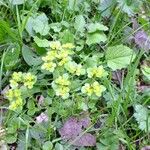
Chrysosplenium oppositifolium
Opposite-leaved Golden Saxifrage · Opposite-leaved Golden-saxifrage · Golden saxifrage
Description
Source: leafsnapChrysosplenium oppositifolium, commonly known as opposite-leaved golden saxifrage, is a perennial herbaceous plant belonging to the Saxifragaceae family. Native to Europe and Asia, it thrives in damp environments like stream banks, wet meadows, and woodland floors. This plant features opposite, rounded or kidney-shaped leaves with toothed edges that are dark green and glossy. Its thin stems can reach up to 20 cm in height. From April to June, Chrysosplenium oppositifolium produces small yellow-green flowers that bloom in clusters on short stalks above the foliage. Historically, the plant has been valued for its anti-inflammatory properties and used medicinally for centuries. Additionally, its yellow-green color has made it a natural dye for fabrics. Ecologically, Chrysosplenium oppositifolium is crucial for insects such as bees and butterflies, offering nectar-rich flowers, and it provides habitat for small animals like snails and slugs. In summary, Chrysosplenium oppositifolium is a visually appealing perennial that enhances the beauty and diversity of wetland habitats while delivering significant ecological benefits.
Care Guide
💧 Water
☀️ Light Partial sun
🌡️ Temperature 5–32.2°C
💨 Humidity
🪴 Soil 6-7
🌱 Fertilizer
🪴 Pot & Repot
✂️ Pruning
🌿 Propagating
🐛 Diseases & pets
☠️ Toxicity
Characteristics
- Plant Type
- Herb
- Life Cycle
- Perennial
- Genus
- Chrysosplenium
- Family
- Saxifragaceae
- Hardiness Zone
- 4-8
- Mature Height
- 20 cm
- Mature Spread
- 91 cm
- Leaf Color
- Light Green, Yellow Green
- Leaf Type
- Semi-evergreen
- Flower Color
- Yellow
- Flower Size
- 2.54 cm
- Bloom Time
- Early spring, Mid spring
- Planting Time
- Spring, Summer
- Harvest Time
- Late spring, Early summer
- Native Area
- Czech Republic, Poland, Croatia, Slovenia, Norway, Germany, Italy, Spain, Switzerland, Denmark, Netherlands, France, Ireland, United Kingdom, Belgium, Portugal