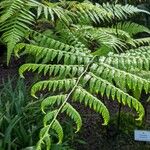
Cibotium barometz
Scythian-lamb · Golden chicken fern · Vegetable lamb
Description
Source: leafsnapCibotium barometz, the barometz, golden chicken fern or woolly fern, is a species of tree fern native to parts of China and to the western part of the Malay Peninsula. The fern's woolly rhizome was thought to be the inspiration for the mythical "Vegetable Lamb of Tartary".
Care Guide
💧 Water
The vegetable lamb thrives in humid tropical rainforests, requiring constant moisture and high humidity. To replicate these natural conditions, it is best to water it twice a week. As an evergreen plant, the vegetable lamb benefits from stable moisture levels, which support continuous foliage growth year-round.
☀️ Light Full shade
The vegetable lamb prefers a mix of light and shade and does best with gentle, dappled sunlight. Native to partly shaded habitats, it grows well in those conditions. However, too much or too little light can cause problems such as poor growth or scorched leaves.
What are the sunlight requirements for a Vegetable Lamb?
The Vegetable Lamb, or Cibotium barometz, requires about 3-6 hours of sunlight daily, enjoying a balance of light and shade. This semi-shaded preference stems from its natural habitat, where it thrives in mild, filtered sunlight exposure. It's important to observe the sun's movements through your garden to choose spots that offer this balance, ensuring the plant's happiness and avoiding problems like poor growth or leaf scorching due to improper light exposure.
How important is artificial lighting for Vegetable Lamb, and how should it be used?
Artificial lighting is crucial for the Vegetable Lamb, especially when natural sunlight is inadequate, like in winter or less sunny spaces. It promotes faster, healthier growth. LED lights are recommended because they can provide specific light wavelengths needed by plants. For full sun plants, 30-50W/sq ft is needed, partial sun plants require 20-30W/sq ft, and full shade plants need 10-20W/sq ft. Place the light source 12-36 inches above the plant, mimicking natural sunlight, and ensure it receives 8-12 hours of light daily to support optimal growth.
What are the signs of inadequate lighting for a Vegetable Lamb?
Symptoms of light deficiency in Vegetable Lamb include small leaves, leggy or sparse growth, faster leaf drop, slower or no new growth, lighter-colored new leaves, chlorosis, sunscald, leaf curling, wilting, and leaf scorching. These signs indicate the plant isn't receiving enough light, leading to a halt in growth and potential damage. Chlorosis and sunscald also signify that the plant may be getting too much direct sunlight, adversely affecting its health.
What solutions can remedy insufficient light exposure for Vegetable Lamb?
To remedy insufficient light for Vegetable Lamb, gradually move the plants to sunnier locations each week to adapt without shock, aiming for 3-6 hours of direct sunlight daily. If moving the plant isn't feasible, using artificial lighting like a desk or ceiling lamp for at least 8 hours a day or investing in professional plant grow lights can provide the necessary light exposure. For outdoor plants, ensure to avoid drastic changes in light intensity to prevent sunburn. If light obstruction is an issue, consider pruning trees or transplanting smaller plants to locations with more sunlight and better drainage during their dormant period.
🌡️ Temperature 15–37.8°C
The vegetable lamb is indigenous to regions where temperatures fluctuate between 59 and 100.4 °F (15 and 38 ℃). It favours these moderate to warm conditions, and seasonal adjustments to its environment may be required to reproduce this natural temperature range.
What is the ideal temperature range for a vegetable lamb?
The vegetable lamb thrives in environments where temperatures fluctuate between 59 to 100.4 °F (15 to 38 °C). These moderate to warm conditions are ideal for the plant, and it may require seasonal adjustments to its surroundings to replicate its natural temperature range effectively.
Does the vegetable lamb have any cold tolerance?
Yes, the vegetable lamb has some degree of cold tolerance and generally does not require additional cold protection measures if the temperature remains above -5°C. However, if temperatures are expected to drop below -5°C, temporary measures such as wrapping the plant with plastic film, fabric, or other materials are necessary. These protective measures should be removed once the temperature rises again to avoid any potential damage.
How does the vegetable lamb react to low temperatures?
The vegetable lamb has moderate tolerance to low temperatures and thrives best when the temperature is above 15°C. During winter, it should be kept above -5°C. If the temperature falls below -10°C, the leaves may start to droop. In mild cases, the leaves can recover, but in severe cases, the leaves will wilt and eventually fall off. To address frost damage, trim off the frost-damaged parts. Before encountering low temperatures again, it's advisable to wrap the plant with non-woven fabric or cloth and construct a wind barrier for additional protection.
What should be done if the vegetable lamb experiences high temperatures?
During summer, it's crucial to ensure that the vegetable lamb is kept below 38°C to avoid heat stress. When the temperature exceeds 43°C, the leaves may lighten in color, the tips can become dry and withered, leaves might curl, and the plant becomes more susceptible to sunburn. To mitigate these effects, sunburned and dried-up parts should be trimmed away. The plant should be moved to a shaded location or covered with a shade cloth to protect it from midday and afternoon sun. Additionally, watering the plant in the morning and evening helps keep the soil moist and can reduce heat stress.
💨 Humidity
🪴 Soil 5-6
🌱 Fertilizer
🪴 Pot & Repot
✂️ Pruning
To maintain its vibrant and lush appearance throughout the growing season, prune the vegetable lamb plant in early spring. Its unique fern-like foliage benefits from the removal of damaged and older fronds, which promotes healthy growth, improves air circulation, and helps prevent disease.
🌿 Propagating
🐛 Diseases & pets
☠️ Toxicity
Characteristics
- Plant Type
- Fern
- Life Cycle
- Perennial
- Genus
- Cibotium
- Family
- Cyatheaceae
- Hardiness Zone
- 8-11
- Mature Height
- 91 cm
- Mature Spread
- 3.05 m
- Leaf Color
- Green
- Leaf Type
- Semi-evergreen
- Planting Time
- Spring, Summer, Autumn
- Native Area
- India, Malaysia, Indonesia, Cambodia, Vietnam, Myanmar, Japan, Philippines, Laos, Thailand, China