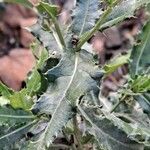
Cirsium arvense
خارلته · خارلته (FA) · خرفيش · Field thistle · Creeping Thistle
Description
Source: leafsnapCirsium arvense is a perennial species of flowering plant in the family Asteraceae, native throughout Europe and western Asia, northern Africa and widely introduced elsewhere. The standard English name in its native area is creeping thistle. It is also commonly known as Canada thistle and field thistle.The plant is beneficial for pollinators that rely on nectar. It also was a top producer of nectar sugar in a 2016 study in Britain, with a second-place ranking due to a production per floral unit of (2609±239 μg).
💡 A study conducted in Britain in 2016 revealed that creeping thistle is among the top nectar-producing flowers, making it a favored food source for pollinators. Additionally, its seeds provide nourishment for goldfinches. Despite these benefits to birds and insects, creeping thistle is highly invasive and challenging to manage.
🌳 Creeping thistle’s vigorous growth and broad distribution suggest untapped potential in the green energy sector, especially as a candidate bioenergy crop. The plant, noted for its strong root system and substantial biomass production, is being evaluated for suitability in producing cellulosic biofuel. This points to its growing role as a renewable energy source. Additionally, creeping thistle interests researchers because it yields distinctive essential oils that may have antibacterial effects, offering possible health benefits.
🎭 Power, defense, triumphing over adversity, pride
Care Guide
💧 Water
Creeping thistle is well-suited to areas with moderate moisture, balancing its tolerance for drought with a preference for regular watering. To encourage optimal growth, it's beneficial to water it weekly. This herbaceous perennial thrives outdoors, naturally syncing its growth cycle with the seasonal rainfall patterns.
When should I water my Creeping Thistle?
Watering your Creeping Thistle (Cirsium arvense) is crucial for its health, requiring that the soil remains evenly moist. Check the soil moisture by inserting your finger into the soil up to the second knuckle; if it feels dry, it's time to water. Wilting leaves and stunted growth are signs that your plant needs water, especially during hot weather or if it has been dry for a long time. During its flowering stage, maintain consistent watering to ensure healthy flowers. However, be cautious of over-watering, as it can lead to root rot and other diseases, while under-watering can cause temporary wilting or even plant death due to dehydration. The optimal growth, flower production, and resistance against diseases are achieved by recognizing these signs and managing the watering schedule effectively.
How should I water my Creeping Thistle?
For optimal hydration of your Creeping Thistle, bottom-watering is the recommended method. By placing the plant's pot in a tray of water, you allow the roots to absorb moisture from the bottom, helping to avoid moisture on the foliage and reducing the risk of fungal diseases. Avoid letting the plant sit in water for too long to prevent root rot. If using a watering can, opt for one with a narrow spout to target the base of the Thistle, thus minimizing foliage wetness. Utilizing a moisture meter helps in determining when to water. However, avoid overwatering by checking the soil's moisture level before watering again, as Creeping Thistle tolerates drought better than excessive moisture. Keeping the foliage dry is crucial to prevent diseases. Finally, adjust the watering frequency based on the plant's exposure to temperature, humidity, and soil type.
How much water does Creeping Thistle really need?
The amount of water Creeping Thistle (Cirsium arvense) needs can vary based on several factors, including pot size, root depth, and the plant's size. Generally, providing around 1-2 inches of water per week is satisfactory. It's crucial to ensure a thorough watering that reaches the entire root zone. Signs of adequate hydration include healthy, green leaves and consistent growth. Watch out for yellowing leaves, wilting, or a drooping appearance, as these could indicate overwatering or underwatering. Although Creeping Thistle is adaptable to various soil moisture conditions, it's vital to steer clear of extreme watering conditions like prolonged drought or excessive saturation. By regularly monitoring soil moisture and adjusting your watering schedule, you can maintain the plant's health and vigor.
What kind of water is best for Creeping Thistle?
Creeping Thistle is not particularly fussy about water types and can thrive on tap water or rainwater as long as the plant is well hydrated but not waterlogged. It shows a moderate resistance to chlorine commonly present in tap water but letting the water sit for a while before using it can be beneficial by allowing chlorine and other gases to dissipate. Despite its tolerance to various minerals in tap water, it's advisable to occasionally flush the plant with clean water if hard water is used regularly, to prevent mineral buildup. Ideally, water at room temperature or slightly cooler is preferred to avoid shocking the plant's roots.
How do Creeping Thistle's watering needs change with the seasons?
Creeping Thistle's watering needs vary through the seasons. In spring, the active growth phase requires maintaining consistent soil moisture by watering regularly. During summer, especially in a drought, reduce the watering frequency, allowing the soil to dry slightly between sessions. In autumn, as the plant prepares for dormancy, gradually decrease watering while keeping the soil lightly moist. Winter marks the dormant period, necessitating minimal watering and allowing the topsoil to dry out between watering sessions. These seasonal adjustments ensure the creeping thistle remains healthy and properly hydrated throughout the year.
☀️ Light Full sun
Creeping thistle prefers areas with plenty of sunlight, which promotes its optimal growth and nourishment. It can also tolerate locations with moderate sun exposure. However, too much or too little sunlight can disturb its normal growth cycle and adversely affect its health.
What are the sunlight requirements for creeping thistle?
Creeping thistle thrives in environments abundant in sunlight, with a preference for full sun conditions of more than 6 hours of sunlight to ensure its optimal growth and nourishment. It can also adapt to partial sun, which amounts to about 3-6 hours of sunlight. However, the plant's normal growth cycle and health might be disrupted if it receives too much or too little sunlight. It's crucial to observe the movement of sunlight through your garden throughout the day and choose planting spots that offer a balanced exposure to light and shade, enhancing your plants' wellbeing.
How does artificial lighting affect creeping thistle growth?
Indoor creeping thistle plants require sufficient lighting to grow optimally, which natural sunlight might not always provide, especially in winter or less sunny locations. Artificial lighting becomes essential under these conditions, supporting faster and healthier growth. LED lights are recommended for their ability to offer specific light wavelengths needed by the plants. Full sun plants should receive 30-50 watts per square foot of artificial light, partial sun plants 20-30 watts per square foot, and full shade plants 10-20 watts per square foot. The artificial light source should be placed 12-36 inches above the plant, mimicking natural sunlight, for about 8-12 hours per day.
What are the symptoms of insufficient or excessive sunlight in creeping thistle?
Insufficient sunlight can result in smaller new leaves, leggy or sparse growth, faster leaf drop, slower or no new growth, and lighter-colored or irregularly colored leaves indicating a lack of chlorophyll and essential nutrients. Chlorosis, sunscald, leaf curling, wilting, and leaf scorching are symptoms due to excessive sunlight, leading to damaged plant tissues, reduced photosynthesis, increased water loss, and overall health deterioration. It's crucial to keep an eye on these symptoms and adjust light exposure accordingly to ensure healthy plant growth.
What solutions can be implemented for creeping thistle experiencing light issues?
For indoor creeping thistle plants struggling with light issues, gradually moving them to areas with more sunlight, ensuring at least 6 hours of direct exposure, is advised. Artificial lighting, such as desk or professional grow lights, could provide additional support for at least 8 hours daily. Outdoor plants should be relocated gradually to sunnier spots, avoiding abrupt changes that could cause sunburn. Reducing obstructions like trimming tree branches can improve sunlight access. For smaller plants, transplanting during the dormant period to a better-lit location might be necessary. Remember, while parts of the plant affected by poor lighting may not recover, new growth should be healthy with adequate light adjustments.
🌡️ Temperature 0–35°C
Creeping thistle's native habitat is the temperate region. It favors temperatures from 32 to 95 °F (0 to 35 °C). In winter the plant can tolerate lows of 23 °F (-5 °C), while in summer it can endure highs up to 95 °F (35 °C).
What is the native growth environment of creeping thistle?
Creeping thistle, botanically known as Cirsium arvense, thrives in temperate regions. The plant is well-adapted to temperatures ranging from 32 to 95℉ (0 to 35℃). It can tolerate cold conditions as low as 23℉ (-5℃) during winter and can withstand heat up to 95℉ (35℃) in summer. Its strong cold resistance means special frost protection is generally unnecessary. However, in extreme cold where temperatures are expected to drop below -40℃, protective measures such as covering the plant with soil or straw are recommended. Additionally, to aid in cold protection, it's advised to water the plant abundantly before the first freeze in autumn to keep the soil moist, which helps prevent drought and water scarcity during winter and early spring.
How does creeping thistle respond to low temperatures?
Creeping thistle exhibits a high tolerance to cold, performing best when temperatures are kept above 0℃. While it can typically withstand winter conditions, it is advised to maintain a temperature above -35℃. In instances where the temperature plummets below -40℃, you may not observe immediate changes during winter, but there could be a reduced sprouting rate or complete absence of sprouting come springtime. If such an occurrence is noted in spring, the recommended action is to remove the parts of the plant that have failed to sprout, to encourage new growth.
How does creeping thistle respond to high temperatures?
In the summer, it's crucial to ensure that the creeping thistle's surrounding temperature does not exceed 35℃ to prevent heat stress. Experiencing temperatures above 41℃ can cause the leaves to lighten in color, become prone to curling, and suffer from sunburn which, in severe cases, can lead to the wilting and drying out of the entire plant. To mitigate such damage, trim away sunburned and dried portions of the plant, relocate it to a shaded area or utilize a shade cloth to protect it from the midday and afternoon sun. Additionally, maintaining soil moisture through watering in the morning and evening is advisable.
💨 Humidity
🪴 Soil 6-7
🌱 Fertilizer
Usually one fertilizer application in spring is enough for Creeping thistle, though repeated feedings can help it achieve maximum growth. Feed every month to a month and a half. Fertilizing improves the leaves' appearance and function, maintaining uniform color and a healthy texture. It also promotes root development and nutrient uptake, supporting long-term plant health.
🪴 Pot & Repot Every 12 months
✂️ Pruning
🌿 Propagating
🐛 Diseases & pets
☠️ Toxicity
Cirsium arvense is moderately toxic, mainly because it accumulates large amounts of nitrate. It has been reported that long-term consumption of creeping thistle in animals can accumulate nitrate in the body and eventually lead to poisoning. Spiny leaves can also scratch the animal's skin and sometimes cause infections.
Characteristics
- Plant Type
- Herb
- Life Cycle
- Perennial
- Genus
- Cirsium
- Family
- Asteraceae
- Hardiness Zone
- 2-10
- Mature Height
- 1.52 m
- Mature Spread
- 91 cm
- Leaf Color
- Green
- Leaf Type
- Semi-evergreen
- Flower Color
- Purple, Lavender
- Flower Size
- 1.02 cm to 2.29 cm
- Bloom Time
- Late spring, Early summer, Mid summer
- Planting Time
- Autumn
- Harvest Time
- Mid summer
- Native Area
- Austria, Slovakia, Montenegro, Pakistan, Croatia, Slovenia, Uzbekistan, Russia, Iceland, Koppen, South Korea, Romania, Belgium, Moldova, Netherlands, Nepal, France, Portugal, Tajikistan, Tunisia, Czech Republic, Sudan, Bulgaria, Bangladesh, Poland, Armenia, Greece, Ukraine, Serbia, China, Lithuania, Norway, Afghanistan, Kyrgyzstan, Kazakhstan, Italy, Spain, Denmark, Mongolia, Finland, Iran, Albania, Ireland, Azerbaijan, Hungary, Turkmenistan