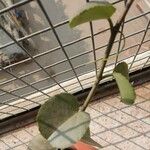
Cissus rotundifolia
Venezuelan treebine · Arabian wax cissus · Arabian wax leaf
Description
Source: leafsnapCissus rotundifolia, also known as the Arabian Wax Cissus, is a tropical plant originating from Southeast Asia and India. As a member of the grape family, it is commonly cultivated as an ornamental plant due to its appealing foliage. The leaves of Cissus rotundifolia are round, glossy, and deep green, making it a great choice for adding color to any indoor space. With proper care and maintenance, this plant can grow up to 6 feet tall. It prefers bright, indirect light but can also tolerate low light conditions. The Arabian Wax Cissus requires moderate watering, allowing the soil to dry out slightly between waterings. In traditional medicine, Cissus rotundifolia has been utilized for its anti-inflammatory properties. It has also been studied for its potential use in treating osteoporosis due to its high calcium content. Overall, this tropical vine makes an excellent addition to any indoor garden or collection because of its attractive foliage and easy care requirements.
Care Guide
💧 Water Every 7 days
The Venezuelan treebine is a drought-tolerant plant that originates from arid regions. It thrives with minimal moisture and typically needs to be watered only twice a week. To prevent root rot, it should be planted in well-draining soil. During its active growth periods, you may need to adjust the watering schedule to support its climbing habit.
☀️ Light Partial sun
The Venezuelan treebine is native to habitats like forest understories and rocky sites that provide natural shade. It prefers partial sun but can tolerate full sun or full shade, demonstrating its versatility and hardiness.
🌡️ Temperature 20–37.8°C
Venezuelan treebine comes from tropical areas, where the climate is generally warm and humid. Because of this, it is well adapted to high temperatures and humidity. It does not tolerate sudden temperature changes and prefers a stable temperature, so avoiding indoor temperature fluctuations is important. It usually cannot withstand cold and needs warmer temperatures to grow. If the ambient temperature falls too low, the plant may stop growing or even die.
💨 Humidity normal (40-60%)
This plant will thrive in moderate humidity, which is probably the level in your home. However, misting it a few times a week can be very beneficial. Make sure the room has good ventilation.
🪴 Soil 6-7
🌱 Fertilizer
The best time to fertilize a Venezuelan treebine is in early spring, as it breaks dormancy. This encourages overall growth and flower development. Fertilization improves foliage, stems, and branches, while fostering large, vibrant, and long-lasting flowers. It helps transport nutrients from the roots to the flowers and enhances the plant's health and disease resistance.
🪴 Pot & Repot 2-3 years
Repot the Venezuelan treebine in early spring, selecting a pot only slightly larger than the current container and with adequate drainage. Use a well-draining potting mix and position the root ball at the same depth it was previously. Gently loosen any roots that are pot-bound. After repotting, water thoroughly and keep the plant in a warm, shaded spot. Regular pruning will help control its size and encourage new growth.
✂️ Pruning
The Venezuelan treebine is a climbing plant with round leaves. To encourage healthy growth and maintain its shape, prune it in early spring. Start by removing any dead stems, trimming long vines, and thinning out crowded areas to improve air circulation. Be sure to use clean, sharp tools for precise cuts, which will help promote a fuller and more attractive plant.
🌿 Propagating
🐛 Diseases & pets
☠️ Toxicity
Characteristics
- Plant Type
- Vine, Shrub
- Life Cycle
- Perennial
- Genus
- Cissus
- Family
- Vitaceae
- Hardiness Zone
- 10-12
- Mature Height
- 3.05 m to 6.1 m
- Mature Spread
- 2.13 m to 3.96 m
- Leaf Color
- Dark Green
- Leaf Type
- Semi-evergreen
- Flower Size
- 0.51 cm to 1.02 cm
- Bloom Time
- Summer, Early fall
- Planting Time
- Summer, Autumn
- Harvest Time
- Late summer, Fall
- Native Area
- Malawi, Saudi Arabia, Somalia, Mozambique, Tanzania, South Africa, Sudan, Eswatini, Ethiopia, Eritrea, Kenya, Yemen, Congo (DRC), Botswana, Zimbabwe