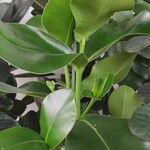
Clusia rosea
Florida clusia · Autograph Tree · Balsam-apple · Pitch apple · Scotch-attorney
Description
Source: leafsnapClusia rosea, commonly known as the Autograph Tree or Pitch Apple, is a tropical evergreen that belongs to the Clusiaceae family. Native to the Caribbean and South America, it has also been introduced to other regions as an ornamental plant. The tree can reach heights of up to 30 feet and features a dense canopy of glossy, dark green, leathery leaves. A unique characteristic of Clusia rosea is its ability to produce aerial roots from its branches, which grow downward and eventually take root in the ground. The plant blooms in the summer, producing large white or pink flowers, followed by green fruit that turns yellow when ripe. The Autograph Tree earns its name from its thick leaves, which can retain ink without smudging, making them popular for writing messages. Additionally, Clusia rosea has been used for medicinal purposes, including the treatment of skin conditions and digestive issues. Thriving in full sun or partial shade with well-draining soil, Clusia rosea is drought-tolerant once established. It is often used as a hedge plant due to its dense foliage but also makes an attractive specimen tree when given adequate space to grow. Overall, Clusia rosea is a versatile tropical plant known for its unique features, making it aesthetically pleasing and useful for various applications such as medicine and writing.
💡 The leaves of the autograph tree (Clusia rosea) are remarkably thick and sturdy, allowing people to write their names on them. In the past, these leaves were even used to make playing cards.
🌳 Could the fountain of youth be concealed in nature? Local Caribbean communities have long applied the sap of the autograph tree to treat skin ailments and lessen wrinkles. This notable tree also serves as a natural engraving surface: its leaves retain carved messages for a lifetime, which earned it the nickname "Autograph tree." Beyond folklore, research highlights the autograph tree's richness in essential oils, making it a potential asset for perfumery and cosmetics and consistent with its skin-benefiting reputation.
Care Guide
💧 Water Every 7 days
The Autograph Tree thrives in environments with high humidity and consistent moisture, typically requiring watering every 1-2 weeks. It is resilient enough to withstand short dry periods and benefits from occasional misting, which helps maintain its vibrant foliage. As an evergreen plant, it is ideal for indoor growth.
What do I do if I give my Autograph tree too much or too little water?
Outdoor plants, especially newly planted ones or plant seedlings, are prone to lack of watering. Remember to water enough for a few months when the tree is small or newly planted. Once the roots are established, Autograph trees can rely on rain most of the time. When Autograph trees are planted in pots, overwatering is more likely. If you accidentally overwater your Autograph tree, you should act immediately to fix the situation. Firstly, stop watering the plant to minimize the effect of overwatering. Then, remove the tree from its pot to inspect the roots. If the roots show no signs of root rot, you can return the tree to its container. However, if there are signs of root rot, trim the affected roots and consider using a fungicide to prevent further damage. Finally, repot the Autograph tree in well-draining soil. In the case of underwatered Autograph trees, simply water the plant more frequently. Underwatering is an easy fix, as the leaves will droop, dry out, and fall off, but quickly regain fullness after sufficient watering. Ensure to correct your watering frequency as soon as underwatering occurs.
How frequently should I water my Autograph tree?
Most plants can rely on rainfall for their water needs, but if your area doesn't get enough rain, you need to water your plants every 2 weeks in the spring and fall, more often in the summer, and less in the winter. If your Autograph tree is young or newly planted, water it more frequently to help it establish and grow. For potted plants, you can either follow a set watering schedule or water based on the moisture level of the soil. During the summer, the plant will need more frequent watering and it's best to wait until the top few inches of soil have dried out before watering again.
How much water should I give my Autograph tree?
Watering your Autograph tree may not require a large amount of water. If the soil has only dried a few inches since the last watering, it's sufficient to give it about five to ten ounces of water. You can also adjust the water volume based on the moisture of the soil. Keep track of how many inches of soil have dried out between waterings. To ensure the tree gets enough moisture, water enough to moisten all the layers of dry soil. If more than half of the soil is dry, it might be necessary to give more water. In this case, continue until excess water drains from the pot's holes. If the tree is in a rainy area, additional watering may not be needed. When the tree is young, it should get 1-2 inches of rain per week. As it grows, it can rely solely on rainwater unless there is a prolonged period of heat and no rain for 2-3 weeks, in which case a full watering is necessary to prevent stress.
How do I know if I'm watering my Autograph tree enough?
The Autograph tree is often affected by overwatering, which is a common problem. There are clear indicators to watch out for when overwatering happens. Typically, an overwatered Autograph tree will exhibit yellowing leaves and may even shed some leaves. Additionally, overwatering can cause the overall structure of the plant to shrink and can lead to root rot. In a different scenario, an Autograph tree that is not receiving enough water will start to droop. Its leaves may also turn brown or become brittle to the touch. Regardless of whether you notice signs of overwatering or underwatering, it is important to take action and restore the tree's health.
How do I water my Autograph tree as it grows?
When the Autograph tree is young, especially when it is a seedling, it needs more water compared to when it is fully grown. It is crucial to keep the soil consistently moist during the early stages of the plant's life to encourage root development. This also applies if you have moved a transplanted Autograph tree to a new growing location. Additionally, providing the correct care can result in the tree producing colorful flowers and fruits. If your Autograph tree is in a flowering or fruiting phase, it will likely require a bit more water than usual to support these plant structures.
☀️ Light Full sun
The autograph tree needs ample light to grow vigorously, so it does best in a spot that receives abundant sunlight. Originating from an area with high sun exposure, it can tolerate light shading. Too much or too little light can hinder its growth.
What are the sunlight requirements for an Autograph Tree?
The Autograph Tree (Clusia rosea) thrives best in full sunlight, requiring over 6 hours of sunlight daily to maintain its health and vigor. It can also tolerate partial sun, which means about 3-6 hours of sunlight per day. Observing how sunlight moves through your garden is crucial, as finding the ideal spot that provides a balance of light and shade can ensure the plant's well-being.
How essential is lighting for the growth of the Autograph Tree?
Lighting is fundamental for the growth of the Autograph Tree, which demands abundant illumination for robust development. Originating from regions with extensive solar exposure, it can endure mild shading. However, both excessive and insufficient light can negatively impact its growth. In conditions where natural sunlight is lacking, especially during winter or in shaded indoor areas, artificial lighting can serve as an effective alternative. It’s recommended to use LED lights for indoor plants, providing the necessary wavelengths of light. For artificial lighting, adjust the intensity based on the plant's needs: full sun plants require 30-50W/sq ft, partial sun plants need 20-30W/sq ft, while full shade plants should have 10-20W/sq ft.
What are some common symptoms of improper lighting for an Autograph Tree?
Improper lighting can lead to several identifiable symptoms in the Autograph Tree. Insufficient lighting might cause slower or no new growth, leggy or sparse growth, and smaller than normal leaves, as the plant enters a survival mode due to poor light conditions. Excessive sunlight, on the other hand, can lead to chlorosis (leaves turning yellow), sunscald (damaged leaves or stems due to intense sunlight), leaf curling or twisting as a defense mechanism, wilting from excessive water loss, and leaf scorching (brown, dry, and crispy leaf edges). These symptoms indicate the plant is struggling with its current light conditions.
What solutions can be applied to resolve lighting issues for an Autograph Tree?
To address lighting issues for the Autograph Tree, start by gradually moving the plant to a sunnier location each week until it receives at least 6 hours of sunlight daily. For indoor plants larger or not easily moved, consider using artificial lighting for at least 8 hours a day. Outdoor plants should also be moved gradually to prevent sunburn. Additionally, if physical structures are blocking sunlight, prune or remove these obstructions. For smaller plants, transplanting during the dormant season might be beneficial, choosing a spot with ample sunlight and good drainage. Remember, though, that parts of the plant already damaged by poor lighting may not recover, but new growth should be healthy following these adjustments.
🌡️ Temperature 20–37.8°C
The autograph tree is native to areas with warm, humid climates, such as Central and South America. The plant prefers temperatures from 68 to 100 °F (20 to 38 °C). In winter, keeping temperatures between 60 and 70 °F (15 to 21 °C) is important to prevent damage to the plant.
What is the native climate for the Autograph tree?
The Autograph tree, or Clusia rosea, grows natively in warm and humid climates, specifically in Central and South America. It thrives in temperatures between 68 to 100°F (20 to 38°C). To ensure the plant's health, it's crucial to maintain a suitable environment that mimics its native habitat.
How should an Autograph tree be cared for during the winter?
During the winter season, it's essential to keep the Autograph tree in temperatures ranging from 60 to 70°F (15 to 21°C) to prevent damage. Since the plant loves heat, exposure to cold can be harmful. If grown outdoors, it's recommended to bring the plant indoors near a bright window but away from direct contact with heaters. Keeping the temperature above 20°C during winter promotes healthy growth, and exposure to temperatures near 5°C can be detrimental.
What are the symptoms of an Autograph tree exposed to low temperatures?
Exposure to low temperatures affects the Autograph tree negatively. It prefers warm temperatures and is not tolerant of cold, thriving best when it's above 20°C. When exposed to temperatures below 1°C, the leaves may lighten in color. Post-frost, the affected foliage may turn brown or black, showing signs of wilting and drooping. If such symptoms appear, it's advised to trim off the frost-damaged parts and move the plant to a warmer spot indoors, preferably near a south-facing window for ample sunlight, while avoiding direct heat sources to prevent air dryness.
How does high temperature affect the Autograph tree and what are the remedies?
During summer, it's crucial to keep the Autograph tree's temperature below 38°C to prevent stress. Extreme temperatures exceeding 43°C can lighten the leaves' color and make the plant more prone to sunburn. Remedial actions include trimming away the sunburned and dried-up parts of the plant, relocating it to a shaded area during the intense midday and afternoon sun, and ensuring the soil remains moist by watering in the morning and evening.
💨 Humidity normal (40-60%)
This plant will thrive in moderate humidity, which is probably the level in your home. However, misting it a few times a week can be very beneficial. Make sure the room has good ventilation.
🪴 Soil 5-7
🌱 Fertilizer
Fertilization is essential for caring for the Autograph tree. Consistent feeding throughout the growing season preserves the energy required for its showy leaves and promotes overall growth. Failing to fertilize can lead to unhealthy foliage, reduced ornamental value, and stunted or weakened growth that is more susceptible to breaking.
Why should I put fertilizer on my Autograph tree?
The Autograph tree needs regular fertilization because its showy leaves require a lot of energy to produce and maintain. However, it also needs to allocate enough energy to support the growth of its stems, branches, roots, and other vital structures. Neglecting fertilization can lead to two likely outcomes. Firstly, the leaves may lose their natural color and texture, appearing unhealthy and diminishing the tree's ornamental appeal. Secondly, the overall growth of the tree may slow down or produce weak growth that is susceptible to breakage.
When should I fertilize my Autograph tree?
The Autograph tree does not need a set feeding schedule when planted. Instead, you can provide occasional feedings by applying fertilizer while watering the plant. It is important to ensure that the tree receives a sufficient amount of water during the growing season. You can feed the tree once every two to three weeks, consistently throughout its period of new growth.
When should I not put fertilizer on my Autograph tree?
You can follow a regular fertilization schedule for your Autograph tree throughout most of the year, especially during the active growing season of spring, summer, and early fall. However, it is important to refrain from fertilizing during the winter months. During winter, the Autograph tree goes into a dormant growth phase, during which it either does not produce new growth or only produces very little. This lack of active growth means that the tree requires less energy overall, making fertilization unnecessary at that time.
What kind of fertilizer does my Autograph tree need?
The fertilizer for an Autograph tree requires a specific blend of nutrients, each present in relatively low amounts. An ideal fertilizer should have an N-P-K ratio of 3-1-2. However, in some cases, a general-purpose fertilizer with an even blend of nutrients can still work well. When using a balanced fertilizer, the ratio number representing the volume of each nutrient should ideally be at 3 or lower. You can choose between a granular or liquid-based fertilizer. If you opt for a liquid-based fertilizer, it is often recommended to dilute its strength by half. While there aren't many downsides to using granular fertilizer, it is often more practical to use liquid fertilizer, especially if you are providing water to your Autograph tree at the same time.
How should I fertilize my Autograph tree?
One of the easiest ways to fertilize an Autograph tree is to feed it whenever you water it. To do this, gather your fertilizer and a water container, such as a watering can. Mix the fertilizer with water to dilute it and then pour it onto the soil, allowing it to soak down to the roots. Alternatively, you can use a granular fertilizer by sprinkling it on the soil where your Autograph tree is. Granular fertilizers are slow-release, meaning you won't need to fertilize as often as with a liquid fertilizer. In both cases, it's helpful to water the tree while you feed it.
🪴 Pot & Repot 2-3 years
When repotting an Autograph tree, select a pot 1–2 inches (2.5–5.1 cm) larger with ample drainage. Use a well-draining potting mix. Repot in spring or fall, ensuring the root ball is slightly lower than the rim of the flower pot. Water thoroughly after repotting and place in a warm spot with indirect sunlight.
✂️ Pruning
The autograph tree features thick, leathery leaves and can grow into a dense shrub or a small tree. To maintain its shape and ensure healthy growth, it is best to prune in early spring. This will help remove any damaged branches and improve air circulation. Be sure to use clean tools during pruning to prevent disease, which will promote the overall health and appearance of the autograph tree.
🌿 Propagating
🐛 Diseases & pets
☠️ Toxicity
The autograph tree is toxic to humans, dogs, and cats, the fruit being the most toxic part. If ingested, it will cause vomiting, diarrhea, nausea, and other gastrointestinal issues.
Characteristics
- Plant Type
- Shrub, Tree
- Life Cycle
- Perennial
- Genus
- Clusia
- Family
- Clusiaceae
- Hardiness Zone
- 10-12
- Mature Height
- 7.01 m to 20.12 m
- Mature Spread
- 14.94 m
- Leaf Color
- Green
- Leaf Type
- Evergreen
- Flower Color
- Pink, White
- Flower Size
- 3.05 cm to 4.06 cm
- Bloom Time
- Early summer, Mid summer
- Planting Time
- Spring, Summer, Autumn
- Harvest Time
- Mid summer, Late summer, Fall
- Native Area
- Belize, Honduras, Mexico, Guatemala, Dominican Republic, Trinidad and Tobago, Panama, Jamaica, Colombia, Bahamas, Cuba, Haiti, Venezuela, Brazil, Guyana, Nicaragua, Ecuador, Suriname, Costa Rica