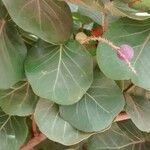
Coccoloba uvifera
Seagrape · Platterleaf · Shore sea-grape · Jamaican kino · Bay grape
Description
Source: leafsnapCoccoloba uvifera, commonly known as the sea grape, is a tropical evergreen tree that belongs to the family Polygonaceae. Native to coastal regions of the Caribbean, Florida, and Central and South America, this tree can reach heights of up to 50 feet and features a broad crown of large, glossy green leaves that are round or oval-shaped. In the spring or summer, the sea grape produces clusters of small, greenish-white flowers, followed by round, grape-like fruit. Initially green, the fruit turns purple when ripe, offering a sweet yet acidic flavor. The sea grape is frequently used as an ornamental plant in landscaping due to its attractive foliage and distinctive shape. Moreover, it has several medicinal applications, such as treating diarrhea, dysentery, fever, and skin infections. Beyond its aesthetic appeal and medicinal uses, Coccoloba uvifera plays a vital role in coastal ecosystems. Its extensive root system helps stabilize sand dunes along beaches, preventing erosion from storms and high tides. Additionally, its leaves provide food for various species, like iguanas, while its fruit serves as sustenance for birds such as pelicans. In summary, Coccoloba uvifera is not only visually appealing but also serves crucial ecological functions and offers numerous health benefits. This makes it an important plant species worth preserving.
🌳 Often appreciated for its decorative role in providing shade and enhancing coastal scenery, the sea Grape Tree offers more than meets the eye. Its often overlooked fruit, when ripe, can be made into delicious preserves such as jellies, wines, and vinegars. Delving deeper, the plant's large leaves served indigenous populations well: they were a natural choice for wrapping food for cooking, imparting aromatic qualities, and those same leaves were also resourcefully used in constructing thatch roofs in the past.
🎭 Reproductive Ability, Garden Area, Sorcery, Psychic Powers
Care Guide
💧 Water Every 7 days
Seagrape is a plant native to coastal regions, and it thrives in sandy soils while tolerating salt spray. It needs to be watered just once every one to two weeks, and it prefers environments with high humidity. Seagrape grows best in full sun and well-draining soil, which makes it an excellent choice for xeriscaping in coastal climates.
How should I water my Seagrape plant?
Your Seagrape is not demanding when it comes to watering. You can use a variety of common watering tools like cans, hoses, or cups to water this plant. It is important to water directly into the soil and make sure every area is equally moist to ensure all parts of the root system receive enough water. Using filtered water is recommended to avoid harmful particles that tap water may contain. Similarly, using water at or slightly above room temperature is beneficial as extreme hot or cold water can be harsh for the Seagrape. Nonetheless, the Seagrape usually responds well to any type of water you provide.
What do I do if I give my Seagrape plant too much water or too little water?
Newly planted outdoor plants and seedlings are vulnerable to not getting enough water. It's important to water them consistently for a few months until their roots are established. Once established, Seagrape plants can rely on rainfall most of the time. When growing Seagrape in pots, overwatering is more likely to happen. If you accidentally overwater your Seagrape, take immediate action to fix the situation. Stop watering the plant right away to minimize the impact of overwatering. Then, remove the Seagrape from the pot and inspect its roots. If there's no root rot, you can put the plant back in its container. However, if you find root rot, remove the affected roots and consider using a fungicide to prevent further damage. Repot the Seagrape in well-draining soil. On the other hand, if your Seagrape is underwatered, simply water it more frequently. Underwatering is usually an easy problem to fix. The leaves of the plant may droop, dry out, and fall off. However, they will regain their fullness quickly after receiving sufficient water. Make sure to adjust your watering schedule promptly if underwatering occurs.
How frequently do I need to water my Seagrape?
If your area gets enough rainfall, most outdoor plants can grow normally without additional watering. However, if your area has a lack of rainfall, you should water your plants every 2 weeks in the spring and fall. In the summer, you'll need to water more frequently. During the slower growth of winter, you can water less often or not at all. If your Seagrape plant is young or newly planted, it is important to water it more frequently to help it establish and grow. For potted plants, there are two main approaches to determine watering frequency for your Seagrape. One option is to set a specific schedule, watering about once a week or every other week. However, this method may not consider the specific conditions of your Seagrape's growing environment, so it may not always be effective. Another approach is to determine watering frequency based on the moisture level of the soil. It is generally best to wait until the top 2 to 4 inches of soil (about ⅓ to ½ depth of the pots) have completely dried out before watering again. This method allows you to adjust watering frequency according to the season, as the water needs of the plant will be highest during the summer.
How much water does my Seagrape plant need?
When watering your Seagrape, you may be surprised to learn that it doesn't always require a large amount of water. Instead, if only a few inches of soil have dried since the last watering, you can promote healthy growth by giving it about five to ten ounces of water each time. You can also determine the amount of water based on the soil moisture. To ensure the Seagrape receives sufficient moisture, water enough to dampen all layers of soil that have dried since the last watering. If over half of the soil is dry, it's recommended to provide more water than usual. In such cases, continue watering until you observe excess water draining from the pot's drainage holes. If your Seagrape is planted in an outdoor area that receives ample rain, it may not require additional watering. However, when the Seagrape is young or establishing itself, make sure it receives 1-2 inches of rain per week. As it grows and becomes more established, it can rely solely on rainwater, but during hot weather without rainfall for 2-3 weeks, consider giving it a thorough watering to prevent stress.
How do I know if I am giving enough water to my Seagrape plant?
The Seagrape is often overwatered, which can be identified by yellowing leaves and leaf drop. Overwatering can also lead to the plant shriveling and root rot. Conversely, an underwatered Seagrape will wilt and develop brown or brittle leaves. Regardless of whether you notice signs of overwatering or underwatering, it's important to take action to restore the plant's health.
☀️ Light Full sun
The sea grape tree thrives with abundant sunlight, reflecting the sunny conditions of its native habitat. While it can tolerate spots with moderate light, it achieves best growth when plenty of light is available. Insufficient exposure can restrict growth, whereas excessive sunlight does not harm the plant.
What are the sunlight requirements for seagrape plants?
Seagrape plants flourish under conditions that replicate their natural habitat, where ample sunlight is a constant. To ensure optimal growth, they need a significant amount of light exposure. While they can survive in moderately lit areas, their growth is best in well-lit environments. Insufficient light may impede their growth, but interestingly, seagrape plants are not adversely affected by excessive sunlight exposure.
What should I do if my seagrape plant is not getting enough sunlight?
If your seagrape plant is not receiving enough sunlight, particularly during winter or in less sunny indoor locations, artificial lighting can be a beneficial solution. Choose LED lights as they can provide specific light wavelengths needed for plant growth. For full sun plants, 30-50W/sq ft is necessary, for partial sun plants, 20-30W/sq ft, and for full shade plants, 10-20W/sq ft. Keep the light source 12-36 inches above the plant, mimicking natural sunlight, and ensure the plant receives 8-12 hours of light daily.
What are the symptoms of insufficient light on a seagrape plant?
Seagrape plants exhibit particular symptoms when they don't receive sufficient light. You may notice smaller new leaves, leggy or sparse growth, faster leaf drop, slower or no new growth, and lighter-colored or yellowing leaves (chlorosis). Excessive sunlight can lead to sunscald, leaf curling, wilting, and leaf scorching. These symptoms provide crucial insights into the plant’s need for better light conditions.
How can I address the light-related issues for my seagrape plant?
To address light-related issues in seagrape plants, gradually increase their exposure to sunlight if they are not receiving enough. For indoor plants, moving them to a sunnier spot each week or using artificial lights like desk or professional grow lamps can be effective. For plants outdoors or in the ground, minimizing obstructions and considering transplanting to better-lit locations can help. Note that while parts of the plant damaged by insufficient light may not recover, new growth should be healthier with improved light conditions.
🌡️ Temperature 20–41.1°C
In its native habitat, the sea Grape Tree prefers temperatures of 20 to 41 ℃ (68 to 105.8 ℉). To keep it thriving, maintain temperatures between 23 and 28 ℃ (73.4 to 82.4 ℉) in warmer seasons, and between 18 and 24 ℃ (64.4 to 75.2 ℉) in colder seasons.
What is the optimal growth temperature for Seagrape?
Seagrape (Coccoloba uvifera) thrives in a temperature range from 20°C to 41°C (68°F to 105.8°F) in its native environment. For optimal growth, maintaining a temperature between 23°C to 28°C (73.4°F to 82.4°F) during warmer seasons and between 18°C to 24°C (64.4°F to 75.2°F) during colder seasons is recommended. Seagrape is a heat-loving plant, and exposure to cold temperatures can be harmful. In regions where temperatures drop significantly, it is advisable to move outdoor-grown seagrape indoors, placing it near a bright window yet away from heaters during autumn, ensuring the temperature stays above 20°C to support its growth throughout winter.
How does low temperature affect Seagrape, and what are the solutions?
Seagrape prefers warm climates and struggles with low temperatures, thriving best above 20°C. During winter, temperatures should be kept above 5°C to prevent stress on the plant. Exposure to temperatures below 1°C can lead to leaves lightening in color, with frostbite causing them to gradually turn brown or black, alongside wilting and drooping symptoms. To address frost damage, affected parts should be trimmed off, and the plant should be moved indoors to a warmer location. It's also recommended to place the seagrape near a south-facing window to ensure it receives enough sunlight while avoiding proximity to heaters or air conditioning vents which could excessively dry out the air and further stress the plant.
What should I do if my Seagrape is exposed to high temperatures?
During the summer months, it is crucial to ensure that Seagrape does not remain in temperatures exceeding 41°C. Exposure to temperatures above 45°C may cause the leaves to lighten in color and increase the susceptibility of the plant to sunburn. If signs of sunburn or drying are observed, affected areas should be trimmed away. To mitigate high temperature stress, relocate the plant to an area with shade, particularly away from the midday and afternoon sun. Additionally, watering the seagrape in the morning and evening can help maintain soil moisture, providing relief during hotter periods.
💨 Humidity high (>60%)
This plant needs special care because it loves high humidity levels of 60-80% or more. The best way to achieve this is by placing a humidifier near the plant. Daily misting is also essential! Make sure the room has good ventilation.
🪴 Soil 6-7
🌱 Fertilizer
Fertilization is essential for the care of the Sea Grape Tree. Regular feeding during the growing season maintains the energy needed for its showy foliage and supports overall growth. Failing to fertilize can lead to unhealthy leaves, reduced ornamental value, and stunted or weak growth that is more likely to break.
Why should I add fertilizer to my Seagrape plant?
Seagrape requires regular fertilization primarily because its showy leaves demand a significant amount of energy for production and maintenance. This poses a challenge as the plant must allocate enough energy not only to maintain its leaves, but also to support the growth of its stems, branches, roots, and other essential structures. Neglecting fertilization can lead to two likely outcomes. First, the leaves of the Seagrape may lose their natural color and texture, resulting in an overall unhealthy appearance that greatly diminishes its ornamental appeal. Second, the plant's overall growth may slow down or produce weak growth, which makes it more susceptible to breakage.
When should I put fertilizer on my Seagrape plant?
Seagrape plants can benefit from occasional feedings, so there's no need to establish a set feeding schedule when you first plant them. An easy method to fertilize your Seagrape is to apply fertilizer when you water the plant occasionally. Additionally, during the growing season, your Seagrape will require a good amount of water. You can feed this plant once every two to three weeks, consistently while it is producing new growth.
When is it not a good idea to fertilize my Seagrape?
For most of the year, you can regularly fertilize your seagrape. This is especially important during the active growing season of spring, summer, and early fall. However, in the winter, it's important to avoid fertilizing the plant. This is because the seagrape enters a dormant phase during winter where it either doesn't grow or grows very little. During this time, the seagrape uses less energy overall, so fertilization is not necessary.
What kind of plant food does my Seagrape need?
To provide the Seagrape with the necessary nutrients, a fertilizer with specific nutrient blends is required. The ideal fertilizer will have an N-P-K ratio of 3-1-2, with each nutrient present in relatively low amounts. However, a general-purpose fertilizer with an even nutrient blend can also be effective in some cases. When using a balanced fertilizer, it is important to ensure that the ratio number representing the volume of each nutrient is at 3 or lower. There are two types of fertilizer options: granular and liquid-based. If you choose to use a liquid-based fertilizer, it is recommended to dilute its strength by half. While granular fertilizer does not have significant downsides, it is often more practical to use liquid fertilizer, especially when feeding your Seagrape along with watering it.
How can I fertilize my Seagrape tree?
One of the easiest ways to fertilize a Seagrape is by incorporating fertilizer whenever you water it. To do this, gather your fertilizer and a water container, like a watering can. Dilute the fertilizer by mixing it with water. Then, pour this diluted mixture onto the soil and allow it to soak down to reach the roots. Alternatively, you can opt for a granular fertilizer. With this method, simply sprinkle the fertilizer directly onto the soil where your Seagrape is planted. Granular fertilizers are typically slow-release, meaning you won't have to fertilize as frequently as you would with a liquid fertilizer. Regardless of the method, it is helpful to water the Seagrape while you apply the fertilizer.
🪴 Pot & Repot 2-3 years
When repotting a Sea Grape Tree, select a pot 1-2 inches (2.5–5.1 cm) larger with good drainage. Use a well-draining potting mix. Repot in spring or fall, making sure the root ball sits slightly below the rim of the pot. Water thoroughly after repotting and place the plant in a warm spot with indirect sunlight.
✂️ Pruning
The Seagrape plant is characterized by its broad, leathery leaves and clusters that resemble grapes. To maintain its health, it is best to prune the Seagrape regularly, ideally from early to late winter. Pruning helps remove damaged branches and improves air circulation, which enhances light penetration and reduces the risk of disease. Additionally, this practice helps shape the Seagrape for optimal growth in the spring.
🌿 Propagating
🐛 Diseases & pets
☠️ Toxicity
Characteristics
- Plant Type
- Shrub, Tree
- Life Cycle
- Perennial
- Genus
- Coccoloba
- Family
- Polygonaceae
- Hardiness Zone
- 10-13
- Mature Height
- 7.62 m
- Mature Spread
- 4.88 m
- Leaf Color
- Green, Red, Bronze
- Leaf Type
- Evergreen
- Flower Color
- White
- Flower Size
- 0.25 cm to 0.51 cm
- Bloom Time
- Early summer, Mid summer
- Planting Time
- Spring, Autumn
- Harvest Time
- Mid summer, Late summer, Early fall
- Native Area
- Belize, Honduras, Mexico, Guatemala, Peru, Dominican Republic, Panama, Jamaica, Colombia, Bahamas, Cuba, Haiti, Venezuela, Guyana, El Salvador, Nicaragua, Ecuador, Suriname, Costa Rica