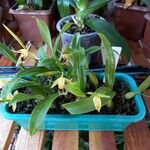
Coelogyne fimbriata
Brown Rock Orchid
Description
Source: leafsnapCoelogyne fimbriata is a species of orchid.
Care Guide
💧 Water
Fringed coelogyne, originally from misty cloud forests, requires high humidity and consistent moisture, but it's important to avoid waterlogging. To maintain optimal health, water it twice a week. While it's typically grown indoors, fringed coelogyne thrives best in terrariums or humidified rooms that mimic its native tropical environment.
☀️ Light Partial sun
Fringed coelogyne does best with abundant sunlight, which encourages strong growth. Coming from habitats rich in sunlight, such exposure supports its healthy development. Although it lacks particular light requirements at different growth stages, an imbalance—either too much or too little sun—can be harmful.
What are the sunlight requirements for Fringed coelogyne?
Fringed coelogyne, also known as Coelogyne fimbriata, thrives under conditions of full sun, needing above 6 hours of sunlight to support its robust growth. It is important to watch how sunlight moves through your garden to ensure that your plants get the perfect balance of light and shade, promoting their health and happiness. This species originates from environments abundant in sunlight, which is conducive to its healthy development. Throughout its growth stages, while it doesn't have specific light needs, an imbalance of either too much or too little sunlight can be detrimental.
How can artificial lighting be used for indoor Fringed coelogyne plants?
When natural sunlight is insufficient, especially during winter or in less sunny spaces, artificial lighting provides a vital solution for indoor Fringed coelogyne plants. For optimal growth, indoor plants may require exposure to artificial lights that promote faster, healthier growth. LED lights are a popular choice as they can be customized to provide specific wavelengths of light that plants need. The required intensity of artificial light varies: full sun plants need 30-50W/sq ft, partial sun plants 20-30W/sq ft, and full shade plants 10-20W/sq ft. The light source should be placed 12-36 inches above the plant, mimicking natural sunlight, and should be left on for 8-12 hours daily depending on the species.
What are the signs of insufficient or excessive sunlight exposure in Fringed coelogyne?
Signs of insufficient sunlight in Fringed coelogyne include smaller new leaves, leggy or sparse growth, faster leaf drop, slower or no new growth, and lighter-colored leaves, indicating a lack of nutrients. Excessive sunlight can cause chlorosis (leaves turning yellow due to the breakdown of chlorophyll), sunscald (damage from intense sunlight exposure), leaf curling (a defense mechanism against water loss), wilting (due to increased water loss from transpiration), and leaf scorching (brown, dry edges on leaves). These symptoms highlight the plant's struggle to adapt to its lighting environment, impacting its health and growth.
How can you address lighting issues for Fringed coelogyne plants?
To address lighting issues for Fringed coelogyne, gradually accustom indoor plants to brighter conditions by moving them to sunnier locations each week until they receive at least 6 hours of direct sunlight daily. Utilize a south-facing window and open curtains during the day for maximum exposure. For plants that are large or difficult to move, consider using artificial lighting, keeping lights on for at least 8 hours daily. Outdoor plants should also be moved gradually to prevent sunburn. Reduce obstructions like trees by pruning, and for smaller plants, consider transplantation during their dormant period to a sunny spot with good drainage. It's important to note that parts of the plant that have been negatively affected by poor lighting may not recover, but new growth post-adjustment will be healthy.
🌡️ Temperature 0–25°C
Fringed coelogyne naturally thrives in environments with temperatures from 32 to 77 °F (0 to 25 °C) and favors cooler conditions. The plant may need temperature adjustments according to the seasons, especially in regions that become very hot or very cold.
What are the ideal temperature conditions for fringed coelogyne?
Fringed coelogyne thrives in environments where temperatures range from 32 to 77 °F (0 to 25 °C), preferring cooler conditions. The plant is highly cold-tolerant and does not require additional frost protection measures during winter. However, it is recommended to water the plant generously before the first freeze in autumn to ensure the soil remains moist. This preparation helps prevent drought and water scarcity for the plant during winter and early spring.
What should I do if the temperature drops below -45°C for fringed coelogyne?
Fringed coelogyne is extremely cold-tolerant, but it's important to ensure the winter temperature remains above -45°C. If temperatures drop below this threshold, you may not notice immediate changes during winter, but there could be a decrease in sprouting or even no sprouting during spring. In such cases, remove any parts of the plant that have failed to sprout in spring.
How does fringed coelogyne react to high temperatures, and what are the solutions?
Fringed coelogyne is not tolerant of high temperatures. When the temperature exceeds 25°C, its growth will stop, and the plant becomes more susceptible to rot. To mitigate this, trim away any sunburned and dried-up parts of the plant. Move the plant to a location that provides shade from the midday and afternoon sun, or use a shade cloth. Additionally, ensure the soil remains moist by watering the plant in the morning and evening.
💨 Humidity
🪴 Soil 6-6
🌱 Fertilizer
The best time to fertilize a Fringed coelogyne is in early spring, as it comes out of dormancy and begins active growth. Fertilizing supplies essential nutrients needed for sound development. Although the Fringed coelogyne does not require heavy feeding, applying fertilizer once a year can improve its chances of survival and encourage healthier, longer-lasting blooms.
🪴 Pot & Repot
When repotting a Fringed coelogyne, pick a pot slightly larger with good drainage, preferably a clear orchid pot. Use a well-draining, orchid-specific mix that includes bark or moss. Gently clean the roots and cut away any that are dead or rotting. Repot after flowering, generally in spring or fall, water thoroughly, and place in bright, indirect light. Once repotted, avoid disturbing the roots.
✂️ Pruning
To ensure optimal growth for fringed coelogyne, it's important to prune carefully. In early spring, trim away any dead stems. After the plant blooms, remove the spent flower spikes. Maintain the plant's shape by trimming overgrown areas, but be careful not to damage the healthy pseudobulbs. This will enhance air circulation and encourage more blooms.
🌿 Propagating
🐛 Diseases & pets
☠️ Toxicity
Characteristics
- Plant Type
- Herb
- Life Cycle
- Perennial
- Genus
- Coelogyne
- Family
- Orchidaceae
- Hardiness Zone
- 1-5
- Mature Height
- 3 cm to 4 cm
- Mature Spread
- 49 cm
- Leaf Color
- Green
- Leaf Type
- Semi-evergreen
- Flower Color
- White, Yellow
- Flower Size
- 3.05 cm
- Bloom Time
- Mid summer, Late summer, Fall
- Planting Time
- Spring, Summer, Autumn
- Harvest Time
- Winter, Early spring, Mid spring
- Native Area
- Nepal, India, Malaysia, Cambodia, Vietnam, Myanmar, Bhutan, Laos, Thailand, China