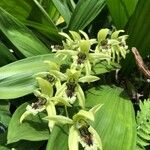
Coelogyne pandurata
Black orchid
Description
Source: leafsnapCoelogyne pandurata is a species of orchid. It is found in Malaysia, Sumatra, Borneo and the Philippines as a large sized, hot growing epiphyte found on large trees near rivers or terrestrial with well-spaced, strongly compressed, oblong or suborbicular, sulcate pseudobulb carrying 2, apical, plicate, elliptic-lanceolate, leaves with a stout petiole that blooms in late spring-summer out of the center of new leads with up to 15 flowers on a terminal, arched to pendant, 6 to 12" [15 to 30 cm] long, racemose inflorescence. The simultaneously opening flowers are highly fragrant of honey but are short lived. This orchid needs wire basket culture as it spreads out quite rapidly and sphagnum with wood chips as media works best and the best time to repot is when the new lead emerges.
Care Guide
💧 Water
☀️ Light Partial sun
The black orchid occurs naturally in habitats like forest understories and rocky areas, where it grows in natural shade. It prefers partial sun but can also adapt to full sun or full shade, showing its versatile and hardy nature.
🌡️ Temperature 20–37.8°C
Black orchid does best in warm conditions. It prefers moderately high temperatures but not extreme heat and humidity. Sunlight warms the plant and encourages it to bloom. Still, extended direct sun in summer can cause sunburn, so the amount of light it gets should be regulated during that season. The plant generally handles cold poorly, so it needs sufficient protection and warmer conditions in winter to avoid freezing.
💨 Humidity
🪴 Soil 5-6
🌱 Fertilizer
Adequate fertilization is essential for the Black orchid's health and appearance. Fertilize the Black orchid during summer, applying fertilizer once a month throughout the season. Nutrients provide the energy for growth and help maintain the plant's parts. Fertilizing improves the Black orchid's flower display, ensuring the best blooms.
🪴 Pot & Repot
When repotting a Black orchid, pick a pot slightly larger than the current one that drains well, ideally a clear orchid pot. Use an orchid-specific, well-draining medium that includes bark or moss. Carefully clean the roots and cut away any that are dead or rotting. Repot after the plant finishes flowering, typically in spring or fall, water it thoroughly, and set it in bright, indirect light. Once repotted, avoid disturbing the roots.
✂️ Pruning
🌿 Propagating
🐛 Diseases & pets
☠️ Toxicity
Characteristics
- Plant Type
- Herb
- Life Cycle
- Perennial
- Genus
- Coelogyne
- Family
- Orchidaceae
- Hardiness Zone
- 10-11
- Mature Height
- 0 cm to 3 cm
- Mature Spread
- 40 cm to 76 cm
- Leaf Color
- Green
- Leaf Type
- Evergreen
- Flower Color
- Green
- Flower Size
- 6.35 cm to 10.16 cm
- Bloom Time
- All year round
- Planting Time
- Spring, Summer
- Harvest Time
- Late spring, Summer, Fall, Winter, Early spring, Mid spring
- Native Area
- Indonesia, Philippines, Brunei, Malaysia