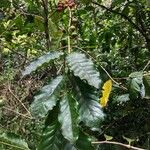
Coffea arabica
قهوه، · Coffee · Arabian coffee · Coffeetree · Arabica coffee
Description
Source: leafsnapCoffea arabica (), also known as the Arabic coffee, is a species of flowering plant in the coffee and madder family Rubiaceae. It is believed to be the first species of coffee to have been cultivated and is currently the dominant cultivar, representing about 60% of global production. Coffee produced from the (less acidic, more bitter, and more highly caffeinated) robusta bean (C. canephora) makes up most of the remaining coffee production. Arabica coffee originates from and was first cultivated in Yemen, and documented by the 12th century. Coffea arabica is called بُنّ (būnn) in Arabic, borrowed from the Amharic "Buna".
💡 According to legend, a shepherd noticed that his flock of sheep became very excited after eating a type of red fruit. Curious, he decided to try the fruit himself. He found it to be sweet and delicious, and after eating it, he too felt more energetic. Over time, Arabian coffee began to spread.
🌳 Usually connected with our favorite beverage, arabica coffee’s skin biomass, frequently discarded, is rich in antioxidants. These qualities have drawn the beauty industry’s interest, resulting in exfoliating items like scrubs and masks intended to tackle age-related skin concerns. By contrast, eco-friendly coffee grounds are valued by gardeners for boosting soil with high nitrogen content, implying a better end than the trash bin.
🎭 Dependence
Care Guide
💧 Water Every 1-2 weeks
Arabian coffee flourishes in consistently moist and humid environments, much like tropical rainforests. It thrives best when watered every 1 to 2 weeks, needing soil that remains lightly moist. Being an evergreen plant that is sensitive to cold, it benefits from misting to maintain adequate humidity levels indoors.
When Should I Water My Arabian Coffee?
Watering your Arabian Coffee is crucial for its growth and health. It's essential to water the plant when the top 2 inches of soil feel dry. Use your finger to check the soil's dryness. Keep an eye on the leaves; they should remain a vibrant green. Any sign of wilting, yellowing, or drooping indicates the plant needs water. Learning the weight difference of the pot when it's dry versus just watered can also help you determine when it's time to water again. Ensure the roots are healthy, with light-colored and sturdy roots indicating good hydration, while dark, soggy roots suggest overwatering. The goal is to avoid both overwatering and underwatering to prevent stress, growth stunt, or diseases such as root rot.
How Should I Water My Arabian Coffee?
Arabian Coffee thrives with thorough watering followed by a period to dry out, as it dislikes waterlogged soil which could lead to root rot. Bottom watering, where the plant absorbs moisture from a tray or basin, is recommended to ensure the soil gets adequately moist without wetting the leaves, which can promote disease. Use a moisture meter to gauge when the plant requires water, and water directly at the root zone, avoiding the foliage and the very base of the plant to prevent rot.
How Much Water Does Arabian Coffee Really Need?
The amount of water your Arabian Coffee needs varies with several factors like pot size and plant size. Generally, water when the top inch of soil is dry. A small plant in a 4-inch pot might need about 100-150 milliliters of water, while a larger plant in a 10-inch pot could require 500-700 milliliters per watering. Look for lush, green leaves as signs of proper hydration, and adjust watering to avoid both dry, under-watered conditions that lead to wilted, yellow leaves and over-watered conditions which can cause soggy soil and root rot.
What Kind of Water is Best for Arabian Coffee?
Rainwater is ideal for Arabian Coffee because it's natural and free of harmful chemicals. If rainwater is not available, distilled or filtered water are good alternatives. Avoid using tap water directly, as it may contain chlorine which Arabian Coffee is sensitive to, causing leaf burn. Let tap water sit for 24 hours for chlorine evaporation or use a filter. Using water at room temperature is best to avoid shocking the plant's system.
How Do Arabian Coffee's Watering Needs Change with the Seasons?
Seasonal changes affect Arabian Coffee's watering needs. In spring, incrementally increase watering to support active growth, ensuring soil remains lightly moist. Summer demands more water due to higher temperatures, but allow top soil to dry out slightly between waterings. Reduce water intake in autumn to prepare for dormancy and further decrease in winter, maintaining just lightly moist soil. These adjustments help prevent root rot while accommodating the plant's reduced growth and transpiration in cooler temperatures.
☀️ Light Partial sun
Arabica coffee performs best under moderate sunlight, though it can tolerate both increased and decreased light. This flexibility stems from the species' native environment, which featured alternating sun and shade. Insufficient or excessive light can harm its healthy development, causing reduced vigor.
What are the sunlight requirements for Arabian coffee plants?
Arabian coffee plants thrive best in environments with moderate solar exposure, being adaptable to both more and less light due to their origin in a habitat with intermittent sun and shade. These plants prefer partial sunlight of about 3-6 hours a day but can handle full sunlight or full shade conditions if exposed to more than 6 hours of sunlight. It's essential to observe how sunlight moves through your garden to choose spots that offer the right balance of light and shade, ensuring the plants' happiness.
How does artificial lighting benefit indoor Arabian coffee plants?
Artificial lighting is crucial for the optimal growth of indoor Arabian coffee plants, especially when natural sunlight is insufficient during winter or in less sunny spaces. Artificial lights, such as LED lights customized to provide specific wavelengths, can promote faster, healthier growth. For full sun plants, 30-50W/sq ft of artificial light is recommended; for partial sun plants, 20-30W/sq ft; and for full shade plants, 10-20W/sq ft. The light source should be placed 12-36 inches above the plant, mimicking natural sunlight for about 8-12 hours per day.
What symptoms indicate inadequate sunlight for Arabian coffee plants?
Inadequate sunlight exposure for Arabian coffee plants can lead to various symptoms, including slower or no new growth as the plant enters survival mode and halts leaf production. Other signs include faster leaf drop to conserve resources, lighter-colored new leaves indicating a lack of chlorophyll, and conditions such as chlorosis (leaves turning yellow), sunscald (damage from intense sunlight), leaf curling, wilting from excessive water loss, and leaf scorching, characterized by brown, dry edges on leaves due to excessive sunlight.
What are some solutions for addressing sunlight-related issues in Arabian coffee plants?
To address sunlight-related issues in Arabian coffee plants, start by gradually adapting them to changing light conditions. For indoor plants, shift them weekly to sunnier spots until they receive 3-6 hours of direct sunlight daily. If moving the plant isn't feasible, provide additional light with a desk or ceiling lamp for at least 8 hours daily or invest in professional grow lights. Outdoors, move plants gradually to sunnier locations to avoid sunburn, and consider pruning or transplanting to reduce obstructions and improve sunlight exposure. Remember that affected parts may not recover, but new growth will be healthy after increasing light exposure.
🌡️ Temperature 20–37.8°C
The arabica coffee does best in its native growing environment when temperatures are between 68 and 100 ℉ (20 to 38 ℃). However, it can tolerate temperatures as low as 50 ℉ (10 ℃) and as high as 86 ℉ (30 ℃). During cooler seasons, it's advisable to keep the plant indoors or in a greenhouse to protect it from frost or extreme heat.
What are the ideal growing conditions for Arabian coffee (Coffea arabica)?
Arabian coffee, or Coffea arabica, thrives in its native growth environment at temperatures ranging from 68 to 100°F (20 to 38°C), though it can tolerate temperatures as low as 50°F (10°C) and as high as 86°F (30°C). This plant is extremely heat-loving and struggles with cold temperatures. In cooler seasons, it's advisable to keep Arabian coffee plants indoors or in a greenhouse to shield them from frost or extreme heat. During autumn, it is recommended to bring outdoor-grown Arabian coffee indoors, placing it near a bright window but away from direct heat sources. Maintaining temperatures above the plant's lower temperature tolerance threshold in winter promotes healthy growth, while exposing it to temperatures at or below this threshold can be harmful.
How should you care for Arabian coffee plants during low temperatures?
Arabian coffee plants prefer warm temperatures and do not tolerate cold well, thriving when the temperature is maintained above their minimum temperature threshold. In winter, keep the plants above their lowest tolerable temperature. Exposure to temperatures below this threshold can cause the leaves to lighten in color, and frost damage may result in the leaves gradually turning brown or black, coupled with wilting and drooping. To mitigate frost damage, trim off the damaged parts and move the plant to a warmer indoor location. It's beneficial to place the plant near a south-facing window to ensure it receives ample sunlight, but it should be kept away from direct heat sources like heaters or air conditioning vents to avoid overly dry air.
What measures should be taken for Arabian coffee plants in high temperatures?
In summer, it's crucial to ensure that Arabian coffee plants are kept below their maximum temperature tolerance to prevent the foliage from getting lighter in color and making the plant more susceptible to sunburn. If the plant is exposed to temperatures exceeding its high-temperature tolerance, trim away the sunburned or dried parts. Then, relocate the plant to a spot where it is protected from the intense midday and afternoon sun. To maintain moisture, water the plant thoroughly in the morning and evening. This helps in avoiding the stress caused by excessive heat and ensures the plant remains healthy.
💨 Humidity normal (40-60%)
This plant will thrive in moderate humidity, which is probably the level in your home. However, misting it a few times a week can be very beneficial. Make sure the room has good ventilation.
🪴 Soil 6-6
🌱 Fertilizer
Fertilization is essential for caring for Arabica coffee. Regular feeding throughout the growing season preserves the energy required for showy leaves and supports overall growth. Neglecting fertilization can lead to unhealthy leaves, reduced ornamental appeal, and stunted or weak growth that is prone to breakage.
Why is it important to fertilize my Arabian coffee plant?
Arabian coffee requires regular fertilization because its showy leaves need a lot of energy to produce and maintain. Not only does the coffee need enough energy to keep its leaves healthy, but it also needs energy to support the growth of its stems, branches, roots, and other vital structures. Neglecting fertilization can result in two outcomes. First, the leaves may lose their natural color and texture, making the coffee look unhealthy and less attractive. Second, the coffee's overall growth may slow down or produce weak growth that is susceptible to breakage.
When should I put fertilizer on my Arabian coffee plant?
To ensure the optimal growth of your Arabian coffee plant, it is best to feed it occasionally rather than having a set feeding schedule upon planting. A simple way to fertilize it is to apply the fertilizer when watering the plant at times. Additionally, during the growing season, the plant requires a sufficient amount of water. You can feed it every two to three weeks throughout its period of new growth.
When is it not a good idea to use fertilizer on my Arabian coffee plant?
For most of the year, you can fertilize your Arabian coffee on a regular schedule. This is true during the active growing season - spring, summer, and early fall. However, in the winter, you should not fertilize the plant at all. This is because the Arabian coffee enters a dormant growth phase during that time. In this phase, the plant either does not produce any new growth or only produces very little. Since the plant is not actively growing, it requires less energy and therefore does not need fertilizer.
What kind of plant food does my Arabian coffee plant need?
The fertilizer for Arabian coffee has a specific blend of nutrients, each in relatively low amounts. An ideal fertilizer has an N-P-K ratio of 3-1-2. However, a general-purpose fertilizer with an even blend of nutrients can be effective in some cases. When using a balanced fertilizer, the volume of each nutrient should be at 3 or lower. You can choose between granular or liquid-based fertilizer. If you opt for a liquid-based fertilizer, it's best to dilute the strength by half. Granular fertilizer has few downsides, but using liquid fertilizer, especially when watering your Arabian coffee, is often more practical.
How can I make my Arabian coffee plant grow better?
To easily fertilize an Arabian coffee plant, you can do so whenever you water it. Here's how: First, gather your fertilizer and a container of water, like a watering can. Dilute the fertilizer by mixing it with water. Next, pour the water-fertilizer mixture onto the soil, ensuring it reaches the roots. An alternative method is to use granular fertilizer. Simply sprinkle some of the fertilizer onto the soil where your Arabian coffee plant is located. Granular fertilizers release nutrients slowly, so you won't need to fertilize as frequently as with liquid fertilizers. Remember to water your plant while you feed it, as this is beneficial.
🪴 Pot & Repot 2-3 years
When repotting Arabica coffee, select a pot 1–2 inches (2.5–5.1 cm) larger with good drainage. Use a well-draining potting mix. Repot in spring or fall, making sure the root ball sits slightly below the rim of the flower pot. Water thoroughly after repotting and place it in a warm spot with indirect sunlight.
✂️ Pruning
Arabian coffee plants are characterized by their glossy, dark green leaves and fragrant white flowers, which produce red berries. To maintain these plants, it's best to prune them in winter. This encourages denser foliage and better air circulation. Begin by removing any dead branches, then thin out areas that are overcrowded. Make sure to clean your tools to prevent the spread of disease. Regular pruning helps control the plant's size and boosts berry production.
🌿 Propagating
🐛 Diseases & pets
☠️ Toxicity
Except for the fruit and seeds, all parts of the coffee plant are toxic to people and pets. The saponins in the plant's bark and foliage can be poisonous if ingested in large amounts. It can lead to contact dermatitis, nausea, vomiting, diarrhea, and depression.
Characteristics
- Plant Type
- Shrub
- Life Cycle
- Perennial
- Genus
- Coffea
- Family
- Rubiaceae
- Hardiness Zone
- 10-11
- Mature Height
- 4.88 m to 7.92 m
- Mature Spread
- 2.44 m to 4.57 m
- Leaf Color
- Green
- Leaf Type
- Evergreen
- Flower Color
- White
- Flower Size
- 1.02 cm to 1.52 cm
- Bloom Time
- Late spring, Early summer, Mid summer
- Planting Time
- Spring, Autumn
- Harvest Time
- Mid summer, Late summer, Fall
- Native Area
- Sudan, Ethiopia